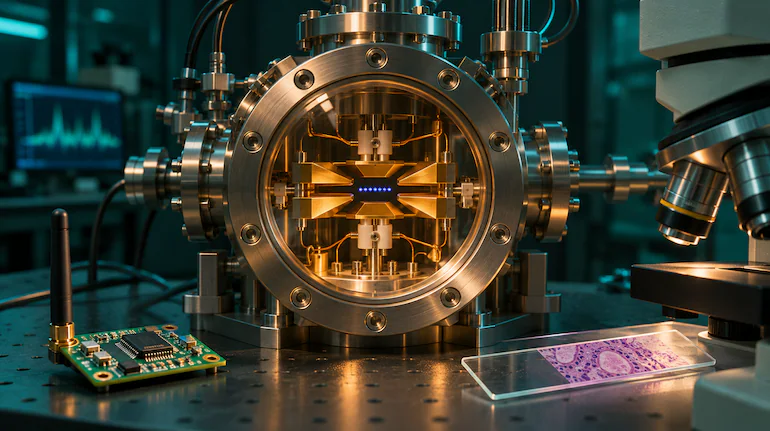
The Infosys Science Foundation has announced six winners of the Infosys Prize 2026, recognising significant contributions to research across physical sciences, engineering and computer science, life sciences, economics, mathematical sciences, and humanities and social sciences. This year’s awards highlight work spanning quantum simulation, wireless sensing, oxygen-related tissue damage, climate economics, constitutional law and probability theory.
Each winner will receive a gold medal, a citation and a prize of $100,000, or its equivalent in Indian rupees. Established in 2009, the Infosys Prize has become an important platform for recognising researchers whose work advances knowledge and addresses complex scientific and societal questions.
Since 2024, the award has focused on researchers under the age of 40, reflecting the foundation’s emphasis on recognising promising scholars early in their careers. The six winners represent different academic disciplines, but their research shares a broader goal of expanding understanding and developing ideas with potential real-world applications.
Infosys Prize 2026: Complete List of Six Winners
The 2026 awards cover six categories, with one researcher recognised in each. The winners and their respective fields are:
- Physical Sciences: Manoj Kumar Joshi, Singapore University of Technology and Design.
- Engineering and Computer Science: Swarun Kumar, Carnegie Mellon University.
- Life Sciences: Isha Jain, Gladstone Institutes and the University of California, San Francisco.
- Economics: Karthik Sastry, Princeton University.
- Humanities and Social Sciences: Gautam Bhatia, Jindal Global Law School and the University of New South Wales.
- Mathematical Sciences: Riddhipratim Basu, International Centre for Theoretical Sciences at the Tata Institute of Fundamental Research, Bengaluru.
The research recognised this year demonstrates how advances in specialised academic fields can influence wider areas, from understanding the behaviour of quantum systems and improving wireless technologies to studying inherited diseases and the economic consequences of climate change.
Quantum Simulation: Manoj Kumar Joshi Wins Physical Sciences Prize
Manoj Kumar Joshi of the Singapore University of Technology and Design received the Infosys Prize 2026 in Physical Sciences for developing programmable quantum simulators using trapped ions.
Quantum systems can behave in ways that are difficult to reproduce or understand using conventional computing methods. As the number of interacting quantum particles increases, modelling their behaviour becomes particularly challenging. Quantum simulation offers researchers a way to investigate these systems under controlled experimental conditions.
Joshi’s work uses trapped ions to build programmable systems that can simulate the behaviour of complex quantum systems. By controlling the interactions between ions, researchers can examine how quantum states evolve and how different physical processes influence one another.
Such experiments can help scientists investigate questions that are relevant to materials science and chemistry. Understanding quantum interactions could eventually contribute to the study of advanced materials and chemical processes, although practical applications depend on further research and technological development.
The recognition highlights the growing importance of experimental quantum research. Rather than relying exclusively on theoretical calculations, programmable quantum simulators allow scientists to explore physical behaviour through carefully designed experiments.
Wireless Networks Become Sensing Tools in Swarun Kumar’s Research
Swarun Kumar of Carnegie Mellon University won the Engineering and Computer Science category for research that expands the role of low-power wireless networks beyond conventional data transmission.
Wireless networks are generally associated with connecting devices and transferring information. Kumar’s work explores how the same signals can also provide information about the physical environment. Changes in wireless signals as they travel through a space can reveal information about nearby objects, movement and other environmental conditions.
This approach turns wireless infrastructure into a potential sensing system. Instead of requiring a separate sensor for every monitoring task, existing wireless signals can be used to detect changes in the surroundings.
The research also explores how wireless networks can support the control of devices. Combining communication and sensing capabilities could expand the usefulness of connected systems in homes, buildings and other environments.
Low-power wireless technology is particularly relevant as the number of connected devices continues to grow. Research that makes existing networks perform additional functions could help improve the efficiency and capabilities of future connected environments.
Isha Jain’s Life Sciences Research Examines the Effects of Excess Oxygen
Isha Jain of the Gladstone Institutes and the University of California, San Francisco, received the Life Sciences prize for research into oxygen biology and its effects on human health.
Oxygen is essential for normal cellular activity, but its effects are not always beneficial. The amount of oxygen available to tissues can influence how cells function, and excessive oxygen exposure can cause damage in certain biological conditions.
Jain’s research showed how excess oxygen can contribute to tissue damage in some mitochondrial diseases. These inherited conditions affect the functioning of mitochondria, the structures inside cells that play a central role in energy production.
The findings have helped inform the development of potential treatments for inherited metabolic disorders. By investigating the relationship between oxygen levels and tissue damage, the research offers a possible direction for understanding why certain diseases affect the body and how their effects might be reduced.
The work is significant because it examines a biological factor that is essential to life but can become harmful under particular conditions. It also illustrates how understanding the mechanisms behind inherited diseases can help researchers identify possible therapeutic approaches.
Karthik Sastry Wins Economics Prize for Research on Climate Change and Innovation
Karthik Sastry of Princeton University won the Infosys Prize 2026 in Economics for research examining the relationship between climate change, technological innovation and business cycles.
Climate change presents economic challenges that extend beyond environmental damage. Changes in climate conditions can affect production, investment decisions, economic activity and the way societies allocate resources. Responding to these challenges also requires technological development and changes in how economies operate.
Sastry’s research explores how technological innovation can influence the ability of societies to adapt to climate change. New technologies can help economies respond to environmental pressures, but their development and adoption are also shaped by broader economic conditions.
The research connects climate policy with questions about innovation and economic fluctuations. It highlights the importance of understanding how technological progress and economic activity interact when societies attempt to respond to long-term environmental challenges.
Recognising this work through the Economics category also reflects the expanding role of economic research in climate discussions. Understanding the costs of environmental change and the economic conditions that support innovation can help inform decisions about long-term development.
Gautam Bhatia Recognised for Legal Scholarship
Gautam Bhatia received the Humanities and Social Sciences prize for his contributions to legal scholarship. Bhatia is an adjunct professor at Jindal Global Law School and a Green Fellow at the University of New South Wales.
His work draws on economics, sociology and political theory to examine legal questions. This interdisciplinary approach connects constitutional and legal analysis with broader debates about society, institutions and the distribution of power.
Legal scholarship plays an important role in examining how constitutional principles operate in practice. It can help clarify the relationship between state institutions, individual rights and the rules that govern public life.
Bhatia’s recognition highlights the importance of research in the humanities and social sciences alongside scientific and technological advances. The category acknowledges scholarship that develops a deeper understanding of legal systems and their relationship with society.
Riddhipratim Basu Wins Mathematical Sciences Prize
Riddhipratim Basu of the International Centre for Theoretical Sciences at the Tata Institute of Fundamental Research in Bengaluru won the Mathematical Sciences prize for contributions to probability theory and statistical physics.
Probability theory provides mathematical tools for understanding uncertainty and random processes. Statistical physics uses mathematical and statistical methods to study how large collections of interacting particles behave. These fields have connections to several areas of modern mathematics and theoretical science.
Basu’s recognised contributions include work on the longstanding slow-bond problem. The problem concerns how a local slowdown can affect the overall movement of particles in a one-dimensional stochastic system.
Resolving the slow-bond problem was an important contribution to the mathematical study of interacting particle systems. Such models help researchers understand how local changes can influence the behaviour of an entire system.
The award recognises the value of fundamental mathematical research, which often develops concepts and techniques that support further advances in theoretical and applied sciences.
Why the Infosys Prize Focuses on Researchers Under 40
The Infosys Prize was established in 2009 by the Infosys Science Foundation to recognise outstanding research and scholarship. Since 2024, the foundation has focused on researchers under the age of 40, placing greater emphasis on early-career achievements.
Recognising researchers at an early stage can provide visibility for work that may have a lasting influence on academic disciplines. It also draws attention to the importance of supporting scientific and intellectual careers before researchers reach the later stages of their professional lives.
The six categories cover a wide range of subjects, including economics, engineering and computer science, humanities and social sciences, life sciences, mathematical sciences and physical sciences. This structure allows the foundation to recognise contributions that may not fit within a single definition of scientific progress.
Each award carries the same financial recognition: $100,000, a gold medal and a citation. The prize money can provide additional support and recognition for researchers pursuing further academic work, while the award itself brings attention to their contributions.
What the Infosys Prize 2026 Winners’ Research Means
The 2026 winners represent different approaches to understanding complex problems. Joshi’s quantum simulators address challenges in studying quantum behaviour, while Kumar’s research explores how wireless communication systems can also monitor physical surroundings.
In life sciences, Jain’s work investigates how excess oxygen can damage tissues in certain inherited diseases. Sastry’s research connects climate change with technological innovation and economic activity, while Bhatia’s legal scholarship examines constitutional questions through multiple academic perspectives. Basu’s mathematical contributions deepen understanding of probability and interacting particle systems.
Together, the awards demonstrate the breadth of contemporary research. Some contributions focus on developing new experimental tools, while others improve theoretical understanding or examine questions with direct relevance to public policy and human health.
The recognition also underlines the importance of supporting early-career researchers across disciplines. As scientific, technological, economic and social challenges become increasingly interconnected, research from different fields can contribute complementary ways of understanding and addressing them.
With six winners receiving the Infosys Prize 2026, the Infosys Science Foundation has brought attention to research that ranges from quantum systems and wireless networks to human health, climate economics, constitutional law and mathematical theory.
For breaking news and live news updates, like us on Facebook or follow us on Twitter and Instagram. Read more on Latest Technology on thefoxdaily.com.






COMMENTS 0