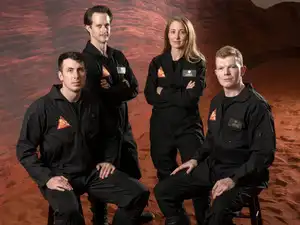
Four crew members have emerged after spending 378 days in isolation inside a NASA facility in Houston, Texas, completing a simulated Mars mission designed to prepare astronauts for the challenges of future long-duration Space Exploration.
The participants lived and worked under controlled conditions intended to replicate aspects of life on Mars, including restricted communication with the outside world, limited resources and the need to manage everyday activities as a team. Their experience will help NASA understand how humans might cope with the physical, psychological and operational demands of missions far beyond Earth.
During the 378-day mission, the crew carried out daily tasks, grew crops and experienced simulated communication delays similar to those expected when astronauts are operating on Mars. The findings will provide researchers with insights that could support preparations for future lunar and Mars exploration programmes.
Four Crew Members Complete 378-Day Mars Simulation
The four participants spent more than a year inside a controlled environment at NASA’s Johnson Space Center in Houston. The isolation programme was designed to recreate selected challenges that astronauts could encounter during an extended expedition to Mars.
Unlike astronauts travelling in space, the participants remained inside a facility on Earth. However, the environment was structured to simulate important aspects of an off-world mission, allowing researchers to observe how a small crew manages daily life while separated from normal outside activities.
The 378-day duration gave researchers an opportunity to study the effects of prolonged isolation and the demands of maintaining a stable routine over an extended period.
Long-duration space missions require astronauts to remain productive and cooperative despite limited personal space, restricted resources and communication challenges. The simulation was intended to provide information about how these factors could influence crew performance.
Why NASA Conducted the Simulated Mars Mission
Sending humans to Mars would involve challenges significantly different from those associated with shorter space missions. A journey to the Red Planet could require astronauts to spend extended periods away from Earth, with limited opportunities for direct support from mission control.
NASA therefore needs to understand how crews might respond to isolation, demanding schedules, operational difficulties and delays in communication before attempting human missions to Mars.
Earth-based simulations allow researchers to examine these challenges without sending participants into space. Scientists can observe crew interactions, evaluate daily routines and identify potential problems that could affect the success of a future expedition.
The 378-day programme was particularly valuable because it exposed participants to prolonged isolation rather than a short-duration exercise. This gave researchers a longer period in which to examine how individuals and teams adapt to an environment that remains largely unchanged over time.
Crew Grew Crops and Managed Daily Activities
Growing crops was among the activities carried out by the crew during the simulated mission. Food production is an important consideration for future Mars exploration because astronauts may not be able to depend entirely on supplies transported from Earth.
Developing ways to grow food during long-duration missions could help reduce the amount of food that must be carried from Earth. It could also provide crews with additional resources for maintaining a sustainable living environment.
The participants also completed routine tasks and operational activities throughout their isolation period. Such responsibilities are important because astronauts on Mars would need to manage their living conditions, equipment and mission schedules while working as a coordinated team.
Researchers can use observations from these activities to understand how crews divide responsibilities, maintain routines and respond to the demands of extended missions.
Simulated Communication Delays Prepared Crew for Mars Conditions
Communication delays were another important feature of the programme. Unlike astronauts aboard the International Space Station, who can communicate relatively quickly with mission control, crews operating on Mars would experience significant delays because of the distance between Earth and the Red Planet.
Depending on the positions of Earth and Mars, messages between the two planets can take several minutes to travel in either direction. This makes real-time conversations and immediate assistance difficult during a Mars expedition.
Future astronauts may therefore need to make more decisions independently rather than relying on continuous instructions from Earth-based teams.
By introducing simulated communication delays, NASA researchers could observe how participants handled tasks and made decisions when immediate contact with outside support was unavailable.
This experience could help researchers develop better procedures for communication, emergency response and crew autonomy during future missions.
What NASA Can Learn From the 378-Day Isolation Experiment
The completion of the simulation gives NASA an opportunity to examine how people adapt to prolonged confinement and demanding mission conditions. The experience can provide insights into several areas important for human space exploration.
Psychological Effects of Long-Term Isolation
Spending more than a year in a restricted environment can place considerable demands on individuals. Researchers can study how isolation affects motivation, emotional well-being, interpersonal relationships and the ability to maintain a consistent routine.
Understanding these factors is essential because astronauts travelling to Mars could spend years away from their normal surroundings and social networks.
Teamwork and Conflict Management
A successful space mission depends on cooperation between crew members. Living and working together for an extended period can create challenges involving communication, workload distribution and differences in individual behaviour.
Observations from the simulation may help NASA identify ways to improve crew selection, teamwork training and procedures for managing disagreements during long missions.
Resource Management and Food Production
Growing crops and managing daily activities also provide opportunities to study how crews could use limited resources efficiently. Future Mars missions may require astronauts to recycle materials, manage supplies and develop reliable food production systems.
Independent Decision-Making
Simulated communication delays can help researchers understand how astronauts respond when mission control cannot provide immediate guidance. This is particularly important for emergencies, equipment problems and unexpected operational challenges.
How the Mission Could Support Future Lunar and Mars Exploration
NASA plans to use insights from the isolation experiment to inform preparations for upcoming lunar and Mars missions. Although the simulation took place on Earth, the lessons could help researchers develop better systems for supporting crews during extended exploration.
The experience may contribute to research on crew health, habitat design, food production, communication procedures and mission planning.
Future lunar missions are also expected to involve more complex operations on and around the Moon. The lessons learned from long-duration simulations could help NASA prepare astronauts for environments where resources are limited and direct support from Earth is more difficult.
Mars exploration presents an even greater challenge because of the distance involved and the length of time astronauts may need to remain away from Earth.
Why Long-Duration Simulations Matter for Human Spaceflight
Human space exploration involves more than developing rockets and spacecraft. Astronauts must also be able to live, work and remain healthy in environments that differ significantly from those on Earth.
Long-duration simulations allow space agencies to examine human behaviour and operational challenges before committing crews to missions in deep space.
They also help researchers test procedures that may be difficult to evaluate during actual spaceflight. By studying how participants manage isolation, communication delays and routine responsibilities, NASA can identify areas where additional training or technological improvements may be needed.
However, an Earth-based simulation cannot reproduce every condition of a real Mars expedition. Factors such as microgravity, radiation exposure and the physical environment of another planet present separate challenges that require additional research.
What Comes After the 378-Day Mars Simulation?
With the four participants having completed their isolation period, NASA can now examine the information collected during the programme. Researchers will be able to assess the experience and identify lessons that could improve preparation for future human spaceflight.
The findings may help scientists understand how astronauts can maintain their health, productivity and cooperation during missions lasting many months or years.
The experiment also reinforces the importance of preparing humans for the realities of living beyond Earth. As NASA continues developing plans for lunar exploration and eventual human missions to Mars, research into isolation, teamwork and independent operations will remain an important part of mission preparation.
The completion of 378 days in isolation marks a significant step in studying the human challenges of deep-space exploration. While a simulated mission cannot fully recreate the experience of travelling to Mars, it offers researchers valuable information about what astronauts may need to live and work successfully far from Earth.
For breaking news and live news updates, like us on Facebook or follow us on Twitter and Instagram. Read more on Latest World on thefoxdaily.com.






COMMENTS 0