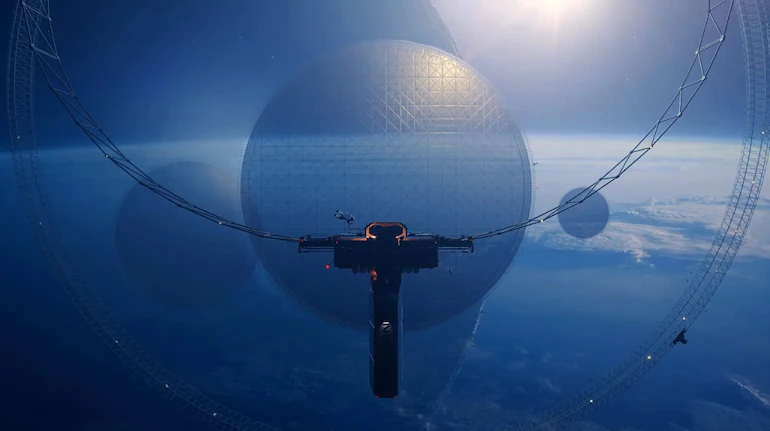
Building enormous structures in space has long presented a major engineering challenge. Conventional rockets can transport satellites, spacecraft and equipment into orbit, but launching structures hundreds of metres or even kilometres across as fully assembled units is far more difficult. Scientists are therefore exploring a different approach: sending individual components into space and using robots to assemble them after deployment.
A robotic system named ASTRA has demonstrated an important early step towards that possibility. Developed by researchers at the California Institute of Technology (Caltech), the system successfully assembled a new section of an antenna-supporting structure while operating in orbit, without astronauts physically performing the construction.
The experiment is significant because it demonstrates that robotic assembly can take place in the challenging environment of space. Although ASTRA has not built a giant telescope or kilometre-scale structure, its successful assembly operation provides an important foundation for future space manufacturing technologies.
The project is part of the US Defence Advanced Research Projects Agency’s (DARPA) NOM4D programme, which aims to develop technologies for manufacturing large structures directly in space.
ASTRA Space Robot: Key Highlights
- ASTRA stands for Autonomous In-Space Tensioned Reflector Assembly.
- The robotic system was developed by researchers at the California Institute of Technology.
- It launched on March 30, 2026, aboard SpaceX’s Transporter-16 rideshare mission.
- ASTRA successfully assembled a third section, or bay, of an antenna-supporting framework in orbit.
- The experiment could support future construction of large space telescopes, antennas and solar arrays.
What Is ASTRA and Who Developed It?
ASTRA is a robotic construction system designed to assemble lightweight structures in space. Its full name, Autonomous In-Space Tensioned Reflector Assembly, describes its intended role in building frameworks that can support reflective surfaces and other large space-based equipment.
The system was developed by researchers at Caltech with funding from DARPA. It is part of the agency’s NOM4D programme, which focuses on technologies that could make it possible to manufacture large structures in orbit rather than transporting complete structures from Earth.
ASTRA was designed to assemble a reflector antenna structure approximately 1.4 metres wide. Its framework is built from individual components that a robotic manipulator collects, positions and connects to create repeating structural sections.
These sections are known as bays. Multiple bays can be connected to form a larger supporting framework called a truss. Such structures could eventually provide the physical support needed for large antennas, reflectors and other space-based systems.
The experiment is not intended to demonstrate a complete space factory or a fully autonomous construction facility. Instead, it tests whether a robotic system can reliably manipulate and assemble structural components in orbit, where communication, movement and engineering operations are more complicated than on Earth.
When and How Was the ASTRA Robot Launched Into Space?
ASTRA was launched on March 30, 2026, as part of SpaceX’s Transporter-16 rideshare mission. The robotic experiment travelled into orbit aboard Momentus’ Vigoride 7 spacecraft.
The payload carried two pre-assembled sections of the planned structure, along with additional materials required for the robotic construction process. Once in orbit, ASTRA was tasked with assembling a third section of the framework.
This arrangement allowed researchers to test the robot’s ability to work with individual components and extend an existing structure in space. Rather than launching a complete antenna-supporting framework, the experiment involved transporting the necessary materials and allowing the onboard machine to perform the assembly.
Ground-based engineers monitored the operation through images transmitted from the spacecraft. They also sent commands during limited communication windows, meaning the team could not continuously control the robot in real time.
The physical assembly was carried out by the onboard robotic system. This distinction is important because the experiment tested the ability to perform construction in orbit rather than simply demonstrating a robot controlled through continuous ground-based instructions.
How Does the ASTRA Robot Build Structures in Space?
ASTRA uses a robotic manipulator that moves along three linear axes. This mechanism allows it to reach different positions, collect construction components and place them accurately during the assembly process.
The system works with two main types of structural components: composite-fibre tubes and aluminium joints. These materials are stored in nearby dispensers, from which the robot collects the pieces required for construction.
The assembly process involves several connected operations. The robot first retrieves the required components, moves them into position and connects them to create a structural section. It repeats the process to form a bay that becomes part of the larger truss framework.
1. Collecting Construction Components
The first stage involves retrieving composite-fibre tubes and aluminium joints from the onboard storage dispensers. These components provide the basic building blocks of the structure.
The robotic manipulator must position itself correctly to collect each part. Because the system operates in orbit, it must perform these movements while working within the physical constraints of the spacecraft and its construction equipment.
2. Positioning and Connecting the Parts
After collecting the components, ASTRA moves them into the required positions and connects the tubes and joints. The process creates repeating structural sections known as bays.
Each connection contributes to the strength and geometry of the framework. As additional sections are assembled, they can form a larger truss capable of supporting other equipment.
The process has similarities to assembling a construction kit, where individual pieces are joined in a planned arrangement. However, performing the same task in orbit introduces additional engineering challenges involving robotic movement, component handling and limited opportunities for ground intervention.
3. Attaching the Reflective Surface
The ASTRA system also incorporates a lightweight reflective film made from Kapton. The film is attached to the supporting framework to create the reflective surface required for the antenna-related experiment.
Kapton is a material used in space applications because of its suitability for demanding environmental conditions. In ASTRA’s design, the lightweight film forms part of the reflector assembly supported by the truss structure.
The combination of a supporting framework and a reflective surface demonstrates the type of construction approach that could eventually be useful for larger space-based antennas and other reflector systems.
How Did Engineers Control ASTRA From Earth?
Although ASTRA performed the physical assembly in orbit, the experiment still involved engineers working on the ground. They monitored the robot using images and sent commands during limited communication windows.
This created a challenging operating environment. Unlike a robot working inside a laboratory, ASTRA could not depend on continuous communication with its operators. The team had to plan around the periods when the spacecraft could communicate with Earth.
Unexpected problems also appeared during the experiment. Engineers needed to investigate these issues and develop solutions before sending updated commands to the spacecraft.
To test possible fixes, the researchers used an identical robot on the ground. They could reproduce problems, examine the machine’s behaviour and test adjustments before transmitting new instructions to the orbital system.
This approach helped reduce the risks associated with experimenting directly in space. A mistake during an orbital operation can be difficult to correct because physical access to the equipment is limited. Testing solutions on an identical ground-based system gave engineers an opportunity to evaluate changes before applying them to the space experiment.
The process also highlights an important distinction between autonomous operation and completely independent decision-making. ASTRA carried out the physical construction using its onboard robotic system, while ground engineers monitored the operation and provided commands when communication was available.
What Is DARPA’s NOM4D Programme?
ASTRA is part of DARPA’s NOM4D programme, which aims to develop technologies for manufacturing large structures in space. The programme addresses a fundamental limitation of conventional space transportation: rockets have restrictions on the size and shape of equipment they can carry.
Many large space systems require structures that are difficult to launch in their final dimensions. Antennas, telescopes and solar arrays may need supporting frameworks that extend far beyond the size of a typical launch vehicle’s payload capacity.
One solution is to launch the components separately and assemble them after reaching orbit. However, this requires reliable technologies for transporting, positioning and connecting structural parts in a low-gravity environment.
NOM4D focuses on developing the engineering capabilities needed to make this approach practical. Robotic construction systems such as ASTRA could become an important part of that effort.
The programme’s longer-term vision includes structures extending hundreds of metres or even kilometres. These could support advanced space-based equipment that would be extremely difficult to launch as a single assembled unit.
Why Is Building Structures Directly in Space Important?
Space infrastructure is often limited by the dimensions and weight of equipment that rockets can transport. Even when a structure can be folded or divided into smaller sections for launch, deploying and assembling it can involve complicated engineering operations.
Manufacturing structures directly in orbit could offer another way to overcome these limitations. Instead of launching a finished system, future missions could transport raw materials, prefabricated components and robotic construction equipment.
Robots could then assemble the structure according to the requirements of a particular mission. This approach could make it possible to construct systems larger than those that can be transported in a conventional launch configuration.
Giant Space Telescopes
Large telescopes require stable supporting structures to hold mirrors, reflectors and other scientific instruments in position. A telescope with a much larger collecting area could potentially observe faint or distant astronomical objects more effectively, depending on its design and scientific instruments.
However, launching a telescope with an extremely large supporting framework presents significant transportation challenges. Robotic construction could eventually allow engineers to build larger telescope structures in orbit by connecting individual components after launch.
ASTRA’s reflector-supporting framework is relevant to this broader idea because it demonstrates a robotic approach to assembling structural sections beyond Earth. It remains an early experiment rather than a demonstration of a complete space telescope.
Enormous Communication Antennas
Large antennas could also benefit from in-space manufacturing. Communication systems often depend on antenna structures that support reflective surfaces and other equipment.
Building larger antenna frameworks in orbit could expand the design possibilities for future communication and observation systems. Instead of restricting the structure to the dimensions of a rocket payload, engineers could explore designs assembled from smaller components.
Such systems would still require careful engineering to ensure that their structures remain stable and perform reliably under changing space conditions.
Large Solar Arrays and Space-Based Power Systems
Solar arrays require supporting structures that hold photovoltaic panels in the correct arrangement. Larger systems could potentially collect more sunlight, although their performance would depend on the panel technology, orbital location and overall design.
Robotic assembly could help construct larger supporting frameworks for future solar power systems. The ability to manufacture or assemble infrastructure in orbit may also reduce the need to transport every component as part of a fully integrated structure.
ASTRA does not demonstrate the construction of a large solar array, but its robotic assembly technology could contribute to the broader engineering methods needed for such projects.
What Problems Did Engineers Face During the ASTRA Experiment?
Constructing a structure in orbit is considerably more complicated than assembling the same components in a controlled laboratory. The ASTRA experiment faced challenges involving communication, unexpected technical problems and the need to test solutions before sending new instructions to the spacecraft.
One major limitation was the availability of communication windows. Ground-based engineers could not continuously observe and control the robot, so they had to work with the opportunities available to exchange information with the spacecraft.
Unexpected problems also required the team to develop and test fixes. Because the robot was already in orbit, engineers could not simply walk over to the machine and make physical adjustments.
Instead, they used an identical robot on Earth to reproduce problems and evaluate potential solutions. Only after testing could updated commands be sent to the orbital system.
These difficulties demonstrate why robotic construction in space requires more than a mechanical arm capable of connecting components. Reliable operations also depend on planning, monitoring, fault diagnosis and the ability to respond to problems without direct physical access.
Can ASTRA Robots Build a City in Space?
ASTRA’s successful experiment raises an interesting question: could robots eventually construct enormous structures, space stations or even cities beyond Earth?
The experiment is an early step towards that possibility, but it does not demonstrate the ability to build a city in space. ASTRA assembled a section of an antenna-supporting framework designed around a structure approximately 1.4 metres wide.
Building a large space habitat or an orbital city would require many additional technologies. These could include systems for transporting construction materials, assembling large modules, maintaining structural stability, providing life-support infrastructure and protecting occupants from the space environment.
Large-scale construction would also require robots capable of handling a much wider variety of components and performing more complicated assembly operations over extended periods.
ASTRA has demonstrated a much narrower but important capability: a robotic system can assemble a structural section in orbit without astronauts physically carrying out the construction.
Moving from this demonstration to kilometre-scale infrastructure will require substantial advances in Robotics, materials, autonomous operation and space transportation. The experiment should therefore be viewed as a technological foundation rather than proof that large orbital cities are now within immediate reach.
ASTRA vs Traditional Space Construction: What Is the Difference?
| Feature | Traditional approach | ASTRA-style approach |
|---|---|---|
| Construction method | Launch assembled or preconfigured equipment | Launch components and assemble them in orbit |
| Assembly location | Primarily on Earth, with deployment in space | Directly in orbit |
| Human involvement | May require astronauts for certain orbital assembly tasks | Robotic system performs the physical assembly |
| Component handling | Equipment is transported in its launch configuration | Robotic manipulator collects and connects individual components |
| Potential applications | Satellites and deployable space structures | Future large antennas, reflectors and other orbital structures |
The two approaches are not necessarily competitors. Future space missions could combine pre-assembled modules with robotic construction, depending on the size, complexity and purpose of the structure.
For smaller systems, launching equipment in a completed or folded configuration may remain the simplest option. For extremely large structures, however, assembling components in orbit could provide greater flexibility.
What Happens After ASTRA’s Successful Orbital Assembly?
The successful construction of a new framework bay is an important demonstration, but several challenges remain before robotic manufacturing can support large-scale infrastructure in space.
Future systems will need to assemble more complex structures, handle larger quantities of materials and maintain accuracy across repeated construction operations. They may also need to work for longer periods with limited communication and without continuous human supervision.
Another important requirement will be structural reliability. Large antennas and telescopes must maintain precise shapes and stable configurations to perform their intended functions. Robotic systems will therefore need to connect components consistently and verify that completed structures meet engineering requirements.
Material supply will also be essential. Large-scale manufacturing would require reliable ways to transport construction materials into orbit or potentially process resources already available in space. ASTRA’s current experiment does not establish a complete supply chain for such operations.
The development of increasingly capable robotic manipulators, autonomous control systems and in-space manufacturing technologies could gradually address these challenges.
Why ASTRA Could Be an Important Step for the Future of Space Exploration
ASTRA’s achievement demonstrates a new possibility for how future space infrastructure could be constructed. Rather than depending entirely on structures assembled on Earth and transported into orbit, engineers could eventually use robotic systems to build large equipment directly in space.
The Caltech-developed robot successfully assembled a new section of an antenna-supporting framework as part of DARPA’s NOM4D programme. The experiment also showed how ground-based engineers can support an orbital construction system through limited communication windows and testing on an identical robot.
The road to giant space telescopes, enormous antennas and kilometre-scale structures remains long. The current demonstration does not establish that such systems can already be built, but it addresses one of the basic technical questions: whether a robot can assemble structural components in orbit.
If future experiments improve the reliability, scale and autonomy of these systems, robotic construction could become an important part of building the next generation of space infrastructure. ASTRA’s successful assembly is therefore not the arrival of giant space factories, but a meaningful first step towards making construction beyond Earth more practical.
For breaking news and live news updates, like us on Facebook or follow us on Twitter and Instagram. Read more on Latest Technology on thefoxdaily.com.






COMMENTS 0