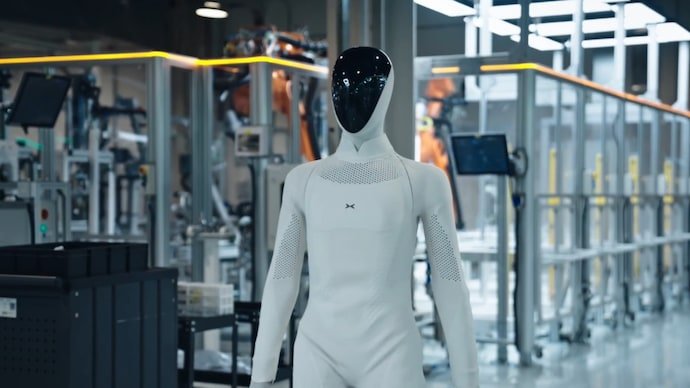
china’s push to turn Humanoid Robots from impressive demonstrations into mass-produced machines has taken another step forward. Xpeng, better known globally as an electric vehicle maker, has commissioned an automated production line designed to manufacture its IRON humanoid robots at scale.
The company marked the milestone with a striking demonstration: an IRON robot completed assembly and then walked away from the production line under its own power. The robot moved toward Xpeng chairman and CEO He Xiaopeng before stopping in front of him, turning a factory milestone into a highly symbolic demonstration of what the company wants its Robotics business to achieve.
Xpeng says more than 80% of the production line’s core processes are automated. The company describes it as the world’s first automated production line for advanced general-purpose humanoid robots, although that designation is Xpeng’s own characterization of its facility.
The development matters because building a robot that can walk is one challenge. Building thousands of reliable robots with consistent quality, cost control and repeatable manufacturing processes is a much bigger one.
IRON walks off the production line on its own
The most eye-catching part of Xpeng’s announcement was not the factory itself but what happened at the end of the assembly process.
In a video shared by He Xiaopeng on X, an IRON humanoid robot is shown completing production before standing upright and walking away from the line. It then approaches the Xpeng chief executive, who places a card around its neck before the robot remains standing in front of him.
For a conventional product, a completed item leaving a production line is routine. For a humanoid robot, however, the ability to leave the line under its own control is a visible demonstration that mechanical assembly, power systems, control software and autonomous movement have all come together successfully.
Xpeng said the particular IRON shown in the demonstration was the company’s first advanced general-purpose humanoid robot to be assembled on the production line and autonomously walk off it.
The distinction is important. The demonstration does not mean Xpeng has already achieved full-scale mass production. Instead, commissioning the line represents a transition from prototype-focused development toward a manufacturing system intended to support much larger volumes.
More than 80% of core production processes are automated
Xpeng says over 80% of the production line’s core processes are automated. The company has designed the facility around the idea that humanoid robots should eventually be manufactured more like sophisticated industrial products than hand-built research machines.
This is one of the biggest challenges facing the humanoid robotics industry. Laboratory prototypes can tolerate extensive manual work, individual calibration and engineering intervention. A commercial robot cannot depend on that model if manufacturers want to sell it in large numbers.
Mass production requires repeatability. Motors, joints, sensors, batteries, controllers, wiring, structural components and computing systems must be installed consistently. Calibration also needs to be increasingly standardized so that one robot behaves predictably relative to another.
Automating those steps could help Xpeng reduce variability while increasing output. It also gives the company a manufacturing Infrastructure that can potentially be expanded as demand grows.
Xpeng has not disclosed the specific annual capacity of the new humanoid production line. That means the commissioning should currently be viewed as a manufacturing milestone rather than evidence that the company can immediately produce humanoids at automotive-scale volumes.
Xpeng is bringing EV manufacturing expertise to humanoid robots
The strategy behind the new factory is closely tied to Xpeng’s existing automotive business. The company says the humanoid production system combines automotive-grade quality systems from its electric vehicle operations with manufacturing techniques designed for precision robotics.
That connection could give Xpeng an advantage in one of the least glamorous but most important parts of robotics: industrialization.
electric vehicles and humanoid robots are obviously different products, but there are overlapping manufacturing disciplines. Both require complex electronic control systems, power management, motors, sensors, software, high-precision components and strict quality control.
Xpeng can potentially apply lessons learned from vehicle production to robot manufacturing, particularly around supply-chain management, production testing, component consistency and factory automation.
The company is effectively betting that the skills required to build intelligent electric vehicles can be extended into what it calls the Physical AI era.
What is the Xpeng IRON humanoid robot?
IRON is Xpeng’s next-generation humanoid platform, unveiled in 2025 and developed as an advanced general-purpose humanoid robot.
The “general-purpose” description is important. Unlike robots built for one specific factory task, Xpeng intends IRON to operate across a broader range of environments and applications designed around humans.
The robot has 76 degrees of freedom across its body, while each hand has 21 degrees of freedom. In simple terms, degrees of freedom refer to the number of independent ways a mechanical system can move. More degrees of freedom can enable more complex and human-like movements when the hardware and control systems can use them effectively.
IRON also uses a proprietary fully enclosed flexible lattice structure. Xpeng says the design is intended to balance a human-like appearance with safety.
The emphasis on human-like structure is not simply cosmetic. A robot designed to work around people, use tools made for people and operate in buildings designed for people benefits from being able to reach, move and interact in a familiar physical form.
Three Turing AI chips power IRON
IRON is not relying solely on external computing hardware. Xpeng has developed an in-house AI platform around three Turing AI chips, which together provide up to 2,250 TOPS of effective computing power, according to the company.
TOPS, or trillions of operations per second, is commonly used as a measure of AI computing capability. It does not by itself determine how intelligent or useful a robot will be, because real-world performance also depends on software, model architecture, sensors, memory, power efficiency and the robot’s mechanical capabilities.
For IRON, however, the processing power is intended to allow Xpeng’s Physical AI foundation model to operate directly on the robot.
That means the company is targeting autonomous operation rather than relying continuously on a remote human operator. Xpeng says this approach can reduce inference latency and improve data security while allowing IRON to perform complex tasks independently.
The broader goal is to create a feedback cycle in which robots generate real-world data, that data improves models, improved models produce better robots and better robots can then perform a wider range of tasks.
Why robot-making robots is a bigger deal than it sounds
The idea of robots making robots can sound like a Science-fiction headline, but the underlying manufacturing concept is practical.
The global robotics industry has spent years improving robot capabilities. Manufacturers can now demonstrate machines that walk, run, dance, carry objects and perform increasingly complicated movements. The harder question is whether those machines can be produced cheaply and reliably enough to become commercially useful.
A production line capable of assembling humanoids with a high level of automation addresses that problem from the manufacturing side.
Consider the difference between building 10 robots and building 10,000. A small production run can involve engineers manually inspecting and adjusting individual machines. At larger volumes, every manual step becomes expensive and can create inconsistent results.
Automation can reduce that dependence. It can also make manufacturing data easier to collect, allowing companies to track defects, identify failure points and improve the process over time.
That is why the factory may ultimately be more important to Xpeng’s robotics ambitions than a single impressive demonstration of walking or dexterity.
Xpeng plans mass production by the end of 2026
Xpeng says IRON is expected to enter mass production by the end of 2026. The company plans to begin with deployments in its own stores and campuses before moving toward an official commercial launch and deliveries.
According to the current roadmap, China and overseas markets are expected to receive official launches and deliveries in 2027.
The staged rollout gives Xpeng an opportunity to use controlled environments before placing large numbers of humanoids into more complex public and commercial settings.
Its own stores and campuses could also provide valuable real-world operating data. Robots deployed there can encounter customers, navigate structured indoor environments, assist with routine activities and expose weaknesses that may not appear during laboratory testing.
The timing also shows that Xpeng sees manufacturing scale as an immediate priority rather than a distant research goal.
IRON is part of China’s larger humanoid robot race
Xpeng is entering a rapidly developing Chinese robotics ecosystem that includes companies such as Unitree Robotics, AgiBot and the Beijing Humanoid Robot Innovation Center.
China’s humanoid robotics push has increasingly moved beyond basic demonstrations. Companies are competing in areas ranging from industrial automation and logistics to machine intelligence, dexterity and athletic movement.
The recent World Humanoid Robot Games provided an unusually visible example of that competition. Humanoid machines were used in running, Football and other events designed to test physical capabilities.
One of the most publicized performances came from the Tiangong Ultra, which recorded a 100-metre time of 9.39 seconds during a preliminary heat at the Beijing event. That was faster than Usain Bolt’s 9.58-second human world record, although the robot competition is not directly equivalent to regulated human Athletics and should not be treated as a replacement for the official sporting record.
The comparison nevertheless illustrates how quickly Chinese developers are pushing the limits of robotic movement.
The next challenge is not walking it is useful work
Humanoid robots can attract attention by walking naturally or performing athletic demonstrations, but commercial success will depend on something less dramatic: whether they can reliably perform useful tasks.
A factory operator does not need a robot simply because it can run quickly. A retailer does not necessarily need a robot that can dance. Businesses need machines capable of completing repetitive, difficult or dangerous work accurately and safely.
That is the reasoning behind Xpeng’s emphasis on IRON as a general-purpose platform.
The company has said it wants the robot to eventually handle dangerous, repetitive or undesirable tasks. Potential applications for humanoids across the industry include logistics, factory operations, inspection, retail assistance and other environments that are already structured around human movement.
But reaching that stage requires much more than mechanical mobility. Robots have to perceive their surroundings, understand instructions, manipulate objects, recover from mistakes and remain safe around people.
Those challenges make the transition from demonstration to reliable commercial deployment the most important phase of Xpeng’s robotics project.
Can Xpeng turn IRON into a scalable business?
Xpeng has been signaling that it wants robotics to become a meaningful business rather than a side project connected to its EV operations.
That ambition received a substantial financial boost in August 2026, when Xpeng’s robotics business announced more than $900 million in financing at a post-money valuation of more than $6.3 billion. The funding is intended to support robotics research and development, Physical AI models, manufacturing infrastructure and global expansion.
The investment gives Xpeng more resources to solve one of the central problems of the humanoid sector: scaling expensive and technically complicated hardware while simultaneously improving the intelligence that controls it.
A successful business will ultimately need both sides to advance together. A highly capable robot that costs too much to manufacture will have limited commercial impact. A cheap robot that cannot perform useful tasks reliably will face the opposite problem.
What the new factory says about China’s robotics ambitions
Xpeng’s production line is part of a wider shift in China from developing humanoid prototypes toward building the industrial infrastructure needed to produce them in meaningful numbers.
The country already has extensive experience in electronics manufacturing, automotive production, batteries, electric motors and industrial automation. Humanoid robots require many of those capabilities, along with new expertise in dexterous hands, compact actuators, tactile sensing and embodied AI.
The combination could accelerate development by bringing robotics companies closer to established manufacturing ecosystems.
That does not guarantee that China will dominate every part of the global humanoid market. Practical barriers remain, including high costs, battery limitations, reliability, safety, software robustness and the difficulty of training robots for unpredictable real-world environments.
Still, the emergence of dedicated automated humanoid production lines suggests that the industry is moving into a different phase. The question is becoming less about whether humanoid robots can be built and more about how efficiently they can be built and what they can actually do once deployed.
From robot demonstrations to robot factories
Xpeng’s latest announcement captures a significant change in the humanoid robotics race. The IRON robot walking away from its own assembly line is an attention-grabbing image, but the more consequential development is the manufacturing system behind it.
With more than 80% of its core production processes automated, Xpeng is attempting to build a repeatable industrial pathway for humanoids. The company expects mass production by the end of 2026, followed by commercial launches and deliveries in 2027.
IRON’s 76 body degrees of freedom, 21 degrees of freedom in each hand and three-chip Turing AI system show how much technology Xpeng is putting into the platform. But those specifications will ultimately matter only if the robots can turn that hardware and computing power into dependable real-world performance.
The bigger story, then, is not simply that a robot made by robots can walk. It is that one of China’s major technology manufacturers is trying to create a factory in which humanoid robots can be produced at scale, tested consistently and eventually deployed as practical machines.
If Xpeng’s production roadmap holds, the next milestone may no longer be watching an IRON robot take its first steps. It may be watching hundreds or thousands of them being built quickly enough to become a real commercial product.
For breaking news and live news updates, like us on Facebook or follow us on Twitter and Instagram. Read more on Latest Technology on thefoxdaily.com.






COMMENTS 0