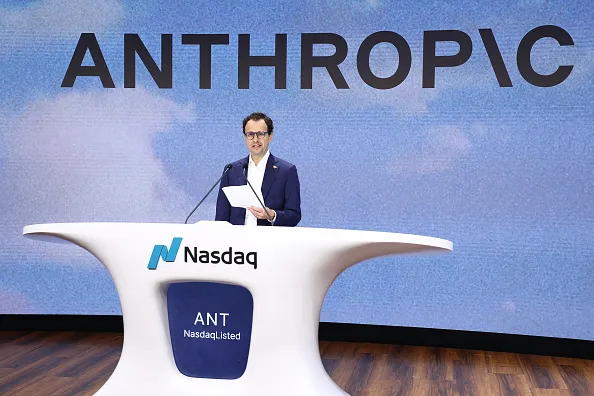
Anthropic CEO Dario Amodei used the company’s historic Nasdaq debut to reaffirm his commitment to responsible Artificial Intelligence development, promising that the company would not allow business ambitions or political pressure to dictate how quickly it builds and deploys increasingly powerful AI systems.
Speaking before the Nasdaq opening bell on Thursday, November 19, Amodei said Anthropic would take as much time as necessary to establish confidence that its AI systems are safe and remain under human control. His remarks placed AI Safety at the centre of an important milestone for the company, which completed the largest initial public offering (IPO) in history.
Anthropic raised approximately $81.3 billion through its public offering, giving the company a reported valuation of around $1.5 trillion. Rather than focusing primarily on its financial achievement, however, Amodei used his speech to explain why the company was founded, how AI could accelerate scientific progress and why the technology’s risks require serious attention.
He highlighted the potential for AI to help researchers develop medical treatments faster while warning about misuse by individuals and nation-states, economic disruption and the possibility of losing control of advanced AI systems.
His central message was clear: Anthropic wants to build increasingly capable AI, but it does not intend to sacrifice safety to move faster than it can responsibly manage.
Anthropic’s Nasdaq Debut Puts AI Safety in the Spotlight
Anthropic’s stock-market debut represents a major moment for the artificial intelligence industry. The company, best known for developing the Claude family of AI models, entered the public markets after raising a record-breaking amount from investors.
Its shares are listed on the Nasdaq under the ticker symbol ANT. The company priced its IPO at $83 per share, raising approximately $81.3 billion and securing a valuation of around $1.5 trillion.
The scale of the offering gives Anthropic a stronger financial position as competition among leading AI developers continues. However, the company’s leadership used the occasion to emphasise that financial success should not come at the expense of responsible technology development.
Amodei said the IPO would strengthen the company’s ability to pursue its mission rather than weaken its commitment to safety. He argued that demonstrating the possibility of building a commercially successful AI company while maintaining strong safety standards could encourage other organisations to follow a similar approach.
This idea is central to Anthropic’s philosophy, which the company describes as a race to the top. Instead of competing only to develop the most capable models, AI companies should also compete to establish stronger safety practices and ensure their technology benefits society.
Why Dario Amodei Started Anthropic: A Personal Story About Medical Progress
Amodei began his Nasdaq speech with a personal story about his family’s experience with disease. He explained that he and his sister, Anthropic co-founder Daniela Amodei, lost their father to an illness that became curable only a few years later.
The experience influenced his interest in biology and scientific research. Amodei said he began his career hoping to help future medical treatments arrive sooner, but his work in the laboratory exposed him to the complexity scientists face when studying diseases and developing new therapies.
He described how scientific discoveries often take years to move from an initial idea to an approved treatment. Researchers must understand complicated biological systems, conduct experiments, test potential medicines and complete clinical trials before treatments become available to patients.
Amodei argued that intelligence is one of the most important tools for overcoming these challenges. Many scientific advances begin with ideas that allow researchers to understand biological processes in new ways. However, scientists often lack the time and resources needed to investigate every promising possibility.
He believes advanced AI could help address this limitation by supporting researchers across different areas of biology and medicine.
His opening message connected Anthropic’s commercial ambitions to a broader objective: using artificial intelligence to accelerate scientific discovery and potentially reduce the time patients wait for life-changing treatments.
AI Could Accelerate Medical Research and Drug Discovery
One of the most optimistic parts of Amodei’s speech focused on the potential for AI to transform medical research. He pointed to areas such as protein folding, drug design, cancer genetics and clinical trial administration as fields where AI assistants could help scientists work more efficiently.
Anthropic’s Claude models are already being used by researchers and organisations to support different types of scientific work. According to Amodei, scientists are finding ways to use the technology to complete research tasks in a fraction of the time that similar work might have required only a few years ago.
He suggested that sufficiently powerful AI, working alongside human researchers, could compress a century of scientific and medical progress into a decade.
That statement represents an ambitious vision rather than a confirmed scientific outcome. Amodei acknowledged that the current results are still early and that experiments and clinical trials will continue to require time.
AI can potentially help researchers analyse large datasets, identify patterns, explore possible drug candidates and organise complex research processes. These capabilities could make parts of scientific discovery faster, but they cannot automatically replace laboratory validation, clinical evidence or regulatory approval.
For patients and families waiting for new treatments, even incremental improvements in research efficiency could eventually matter. Amodei’s argument is that AI should help scientists make better use of their time and expertise, allowing promising discoveries to move towards practical applications more quickly.
Why Human Researchers Will Still Matter
Despite his optimism, Amodei did not suggest that AI would immediately solve medical problems or eliminate the need for human scientists.
He acknowledged that early research results must be tested and that clinical trials remain necessary. Developing a treatment involves more than identifying a promising biological pattern or generating a potential drug design.
Human expertise remains essential for evaluating research findings, conducting experiments, interpreting results and determining whether a treatment is safe and effective.
This distinction is important because the promise of AI-assisted medicine depends on how well the technology works alongside established scientific methods. Faster analysis does not automatically translate into faster cures, but it could help researchers investigate possibilities that would otherwise take considerably longer to explore.
Amodei Warns About the Very Real Risks of Artificial Intelligence
Alongside the potential benefits, Amodei devoted a significant part of his speech to the dangers associated with increasingly capable AI systems.
He identified several major areas of concern, including:
- Misuse by individuals: Powerful AI tools could be used by malicious actors to support harmful activities.
- Nation-state threats: Governments or state-backed groups could potentially use advanced AI capabilities for dangerous purposes.
- Economic disruption: Rapid improvements in AI could reshape industries, affect employment and create broader economic challenges.
- Loss of control: Advanced AI systems could become difficult to understand, evaluate or reliably control.
Amodei stressed that Anthropic discusses these risks because it believes they can be avoided through responsible decisions by the people developing the technology.
His argument is that the future of AI will depend heavily on the safeguards companies establish today. Organisations that prioritise speed without adequately evaluating risks could create a very different outcome from those that make safety a central part of development.
For Anthropic, safety is therefore not simply a technical feature added before a product launch. It is supposed to influence how models are trained, evaluated, deployed and monitored throughout their development.
Anthropic Promises to Keep Advanced AI Under Human Control
One of the strongest commitments in Amodei’s speech concerned the need to keep AI systems under human control.
He said Anthropic would continue investing in AI alignment, testing and research methods designed to understand how its models behave. The company also intends to improve its ability to steer AI systems and identify potentially dangerous behaviour before deployment.
AI alignment is a broad research area concerned with making AI systems behave in ways that are consistent with human intentions, values and safety requirements. It involves understanding how models interpret instructions, respond to different situations and behave when faced with tasks that could create risks.
Amodei referred to several areas of Anthropic’s safety work, including safeguards against biological and cybersecurity risks, alignment training and testing, and techniques for examining the internal behaviour of AI models.
He compared some of these techniques to using an X-ray to look inside a system. The goal is to improve researchers’ understanding of how AI models work and make it easier to identify and guide potentially problematic behaviour.
However, he acknowledged that the work remains incomplete. As AI capabilities increase, the challenges associated with evaluating and controlling those systems are also likely to become more difficult.
Amodei said the company would need to direct even more of its technical talent towards checking and rechecking that its AI systems are safe.
Anthropic Will Not Bend to Business or Political Pressure
The most direct part of Amodei’s speech was his promise that Anthropic would not allow commercial or political pressure to determine the pace of AI development.
He stated that the company would pace the training and deployment of AI systems, taking as long as necessary to gain confidence that they were safe and would remain under human control.
This commitment is significant because the AI industry operates in a highly competitive environment. Companies are investing heavily in computing infrastructure, research talent and increasingly capable models. There is considerable pressure to release new products, attract customers and maintain an advantage over competitors.
Amodei’s position suggests that Anthropic wants its safety decisions to remain separate from those commercial pressures. It also indicates that the company recognises the potential conflict between moving quickly and ensuring that increasingly powerful systems are adequately evaluated.
His remarks also addressed political pressure, although he did not identify a particular government or political dispute in the speech. The broader commitment was that decisions about training and deploying AI should be guided by safety considerations rather than demands to accelerate development.
For a publicly traded company, maintaining that position could become an important test of its stated principles. Shareholders, customers and competitors will all have expectations about growth and product development. Anthropic will need to demonstrate that its safety commitments can remain meaningful while operating as a major public company.
What Is Anthropic’s ‘Race to the Top’ Strategy?
Amodei described Anthropic’s approach to responsible AI development as a race to the top. The idea is that companies should demonstrate that strong safety standards and commercial success can exist together.
Under this approach, Anthropic wants to encourage competitors to improve their own safety practices rather than treating safety as an obstacle to winning the AI race.
Amodei argued that the industry benefits when companies build powerful AI systems responsibly, regardless of which organisation has the most capable models at a particular moment.
This philosophy also reflects a wider challenge facing AI developers. If one company slows down to conduct more extensive safety evaluations while competitors continue releasing increasingly capable systems, maintaining that commitment could become commercially difficult.
Anthropic’s proposed solution is to show that responsible development can support a successful business. If the company can grow while maintaining strong safeguards, it hopes other AI developers will see that approach as commercially viable.
However, the effectiveness of this strategy will depend on more than public statements. It will require measurable safety practices, transparent commitments where possible and evidence that the company follows its principles when difficult commercial decisions arise.
Daniela Amodei Reaffirms Anthropic’s Commitment to AI Safety
Anthropic co-founder and president Daniela Amodei echoed her brother’s message during an interview with CNBC on Thursday.
She acknowledged that artificial intelligence presents real risks but argued that its potential benefits are also substantial. Daniela said Anthropic was founded with the understanding that mitigating those risks would be part of its responsibility.
She expressed confidence in the company’s safety efforts while recognising that additional work remains necessary as AI technology advances.
Her comments reinforced the message delivered during the Nasdaq ceremony: Anthropic wants to pursue the opportunities created by advanced AI while accepting responsibility for managing its potential dangers.
The involvement of both co-founders in communicating this position also highlighted how central AI safety remains to the company’s public identity as it enters a new stage of corporate growth.
Will Going Public Change Anthropic’s AI Development Priorities?
Anthropic’s transition from a privately held AI company to a publicly traded business introduces a new set of expectations. Public companies face pressure to demonstrate financial performance, maintain investor confidence and explain their long-term growth strategies.
For an organisation developing increasingly powerful AI systems, these expectations can create difficult questions. Investors may want faster product development and stronger revenue growth, while safety researchers may argue that certain capabilities require additional testing before deployment.
Amodei’s Nasdaq speech attempted to address this tension directly. He argued that the company’s improved financial position would strengthen rather than weaken its determination to make responsible decisions.
The company’s public benefit structure is also relevant to this discussion. Anthropic is organised as a public benefit corporation, a legal structure that allows it to pursue its stated public-benefit mission alongside commercial objectives.
However, its long-term credibility will depend on how these commitments work in practice. The company will face questions about how it evaluates dangerous capabilities, how it responds when safety testing identifies problems and whether it is prepared to delay releases when necessary.
Its ability to balance investor expectations with responsible AI development will therefore become an important part of its public-market journey.
What Amodei’s Message Means for the Future of the AI Industry
Anthropic’s Nasdaq debut comes at a time when artificial intelligence is becoming increasingly important across healthcare, software development, business operations and scientific research.
As AI models become more capable, competition among developers is likely to focus not only on performance but also on reliability, security and the ability to manage risks.
Amodei’s remarks reflect the argument that technical progress must be accompanied by stronger methods for understanding and controlling AI behaviour. The more powerful these systems become, the more important it may be to evaluate what they can do, how they respond to instructions and whether they can be used safely.
His position also raises a broader question for the industry: can companies maintain meaningful safety commitments while competing for customers, investment and technological leadership?
Anthropic wants to demonstrate that the answer is yes. Its success or failure in doing so could influence how other AI companies approach development, particularly as they face similar pressures to release increasingly advanced systems.
At the same time, no single company’s promises can resolve every challenge associated with artificial intelligence. Governments, independent researchers, customers and the wider technology industry will also have roles in evaluating risks and establishing appropriate safeguards.
Final Takeaway: Anthropic Wants Growth Without Compromising AI Safety
Dario Amodei’s Nasdaq opening-bell speech delivered a clear message about Anthropic’s priorities as it enters the public markets. The company wants to develop increasingly capable AI systems, use the technology to accelerate scientific progress and build a successful business without allowing commercial or political pressure to override safety decisions.
His remarks connected the promise of AI-assisted medical research with concerns about misuse, economic disruption and losing control of advanced systems. He also acknowledged that the most difficult safety challenges may still lie ahead.
Anthropic’s record-breaking IPO gives the company substantial financial resources and a higher public profile. The challenge now is to demonstrate that its stated commitment to responsible development can withstand the expectations that come with being one of the world’s most valuable AI companies.
For Amodei, the objective is not simply to build the most powerful AI. It is to make sure that increasingly powerful AI remains safe, useful and under human control, even if achieving that goal requires slowing down.
For breaking news and live news updates, like us on Facebook or follow us on Twitter and Instagram. Read more on Latest Technology on thefoxdaily.com.






COMMENTS 0