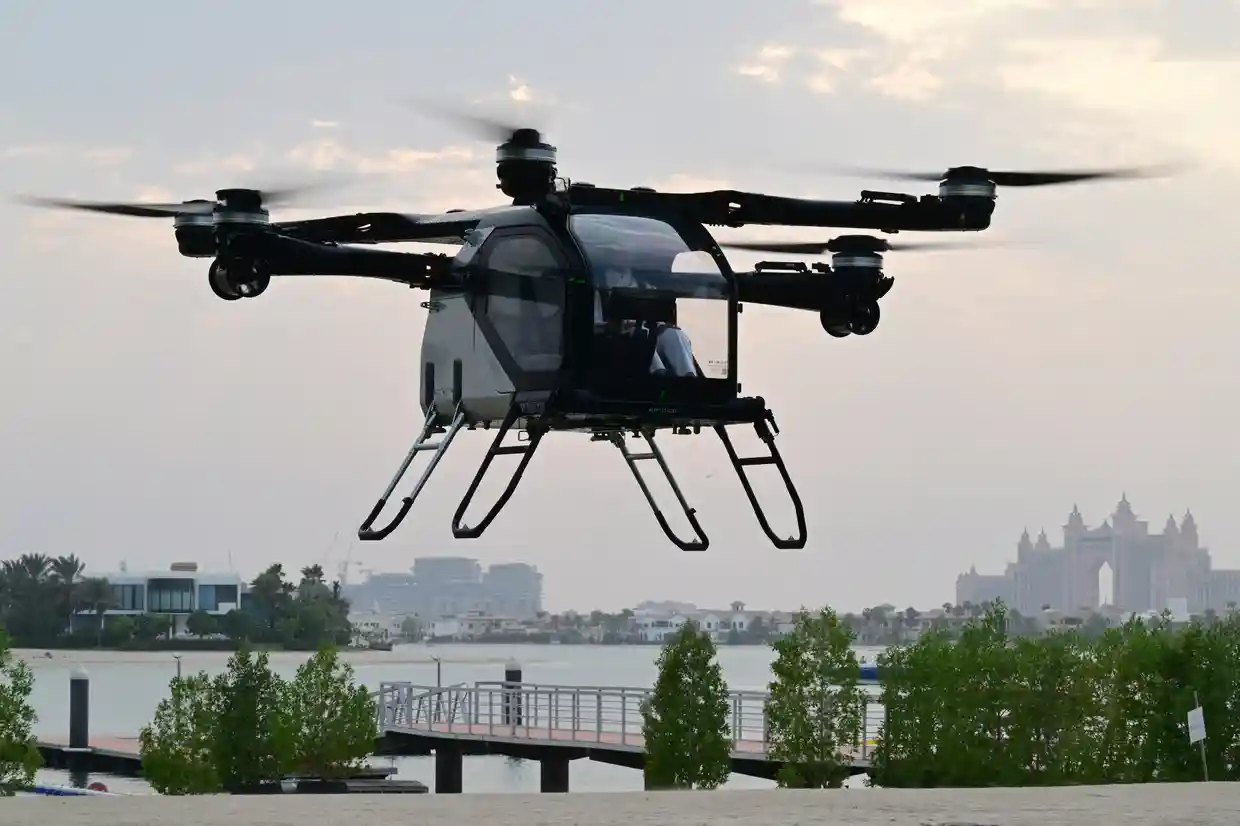
Flying cars could become available for limited recreational and emergency use in China as early as the second half of 2027, according to XPeng, the Chinese technology company developing a two-seat electric aircraft. The proposed vehicle, priced at around $300,000, is designed to take off vertically using battery-powered propellers and can also travel autonomously to a pre-programmed destination.
XPeng chief executive Deli Zhao says the aircraft has completed years of development and received approval from China’s civil aviation authorities for limited use. The initial rollout is expected to focus on approved recreational areas in rural locations and emergency services that need to reach places that are difficult to access by road.
Despite being marketed as a flying car, the vehicle does not have conventional road wheels. Instead, it resembles a compact helicopter-style drone with a passenger cockpit. Its development reflects China’s broader ambition to build a low-altitude economy around electric aircraft, drones and new forms of transportation.
However, the proposed launch does not mean flying cars will immediately become a common alternative to conventional vehicles. Restrictions on where the aircraft can operate, its relatively short flight range and the need for aviation oversight mean its initial use will remain limited.
XPeng Targets Second Half of 2027 for Flying Car Launch
XPeng is targeting the second half of 2027 for the limited introduction of its two-seat flying vehicle. Zhao said the aircraft would initially serve recreational users in approved rural locations and emergency services requiring access to difficult terrain.
The company has reportedly spent around 10 years developing the technology. Its work has included trials of flying motorbike-style vehicles at its base in Guangzhou, where engineers have been testing concepts involving compact electric aircraft and vertical flight.
According to Zhao, the vehicle has received approval from China’s civil aviation authorities for limited use. That approval is an important development for the project, although it should not be interpreted as unrestricted permission to fly anywhere in China or as evidence that the aircraft is ready for mass-market transportation.
The first stage is expected to concentrate on controlled environments where operating conditions and flight permissions can be managed. Recreational parks and emergency-response operations are among the intended applications.
The company’s proposed timeline will depend on the practical requirements of bringing the aircraft into service, including operating restrictions and the arrangements needed to support its use.
How Does the XPeng Flying Car Work?
Unlike a traditional car, XPeng’s two-seat flying vehicle does not travel on roads using wheels. It is lifted into the air by six battery-powered propellers positioned around its compact passenger cockpit.
The aircraft uses a joystick-based control system, which Zhao describes as relatively simple. It can also operate autonomously by following a pre-programmed destination, offering an alternative to direct manual control.
The cockpit is approximately the size of a Fiat 500, making the passenger compartment relatively compact. Its design is intended to accommodate two people rather than provide the space and carrying capacity associated with conventional family cars.
The aircraft’s vertical take-off system removes the need for a conventional runway. This could make it useful in locations where road access is limited, provided that suitable and authorised areas are available for take-off and landing.
Zhao, who is a trained pilot, claimed that he could teach someone to operate the vehicle in five minutes. However, this statement should be understood as his description of the simplicity of the controls, not as confirmation that users can legally or safely operate the aircraft without appropriate training or regulatory permission.
Autonomous flight is another significant feature. The ability to travel towards a pre-programmed destination could reduce the complexity of controlling the aircraft manually, although the operational limits and safeguards of this system will be important to its eventual use.
$300,000 Price Includes a Six-Wheel Transport Van
XPeng’s proposed flying vehicle carries a price tag of approximately $300,000. The package also includes a six-wheel van designed to transport the aircraft between locations.
The van is described as being roughly the size of a Ford Transit. The flying vehicle can unfold from the rear of the transport unit, allowing it to be moved on the road before being prepared for flight.
Zhao compared the unfolding process to the transformation of vehicles in the Transformers franchise. The design combines conventional road transportation with an aircraft that can be deployed when the user reaches an approved flying location.
This arrangement is different from the idea of a vehicle that can drive through ordinary streets and then take off whenever the driver chooses. XPeng’s model depends on a separate transport vehicle and designated locations where flights are permitted.
The inclusion of the van also highlights one of the practical challenges facing early flying-car products. Even if the aircraft can take off vertically, users still need a way to move it between locations and access suitable areas for operation.
Flight Range Limited to 30 Kilometres
One of the biggest limitations of XPeng’s flying vehicle is its current flight range. The aircraft can travel approximately 30 kilometres, equivalent to around 18.6 miles, on its existing battery configuration.
This range makes the vehicle more suitable for short recreational journeys and specific emergency-response applications than long-distance travel. It is not currently positioned as a replacement for conventional cars, helicopters or light aircraft across wider transport networks.
XPeng plans to improve the aircraft’s range by increasing battery energy density. Zhao said the company aims to raise the figure to 400 kilowatts per kilogram, which he expects to support a doubling of the current range.
Battery energy density is important for electric aircraft because the battery must provide enough power for take-off, flight and landing without adding excessive weight. Improving this measure can potentially increase the distance an aircraft travels or improve its overall performance.
However, the proposed range improvement remains a development target rather than a confirmed operating capability. The company has not provided a detailed public timetable for when the upgraded battery system will be ready for commercial use.
Why XPeng Is Targeting Rural Areas and Emergency Services
XPeng’s initial target markets reflect the limitations and potential advantages of a small electric aircraft. Rather than beginning with busy urban transport routes, the company plans to focus on approved recreational areas and emergency operations in locations that are difficult to reach by road.
Recreational users interested in activities such as diving, surfing, off-roading and flying are among the audiences Zhao identified. These activities often take place outside densely populated urban centres, where access to suitable open areas may be more practical.
Emergency services represent another potential application. In remote or difficult-to-access locations, a compact aircraft could provide an additional way to reach an area without depending entirely on road infrastructure.
However, the aircraft’s 30-kilometre range means its usefulness would depend on the distance involved, the availability of suitable landing locations and the nature of the emergency. It should not be assumed that the vehicle could replace helicopters or other established emergency-response aircraft.
The decision to begin with controlled environments also reflects the challenges of introducing a new category of aircraft. Safety procedures, airspace management and operational permissions will be essential before flying vehicles can be used more widely.
China’s Low-Altitude Economy Is Driving Flying Vehicle Development
XPeng’s project is part of China’s wider effort to develop what the government calls the low-altitude economy. The concept includes economic activity involving drones, electric aircraft, cargo transportation and passenger-carrying flying vehicles.
The broader strategy is built around expanding the use of airspace closer to the ground for commercial and public services. Rather than immediately introducing passenger flying cars into major cities, the proposed development path involves gradually expanding applications and infrastructure.
Cargo transportation and drone operations are among the areas expected to play an important role in the development of this sector. Passenger services could expand as aircraft technology, operating systems and regulatory arrangements develop.
The approach also reflects the practical differences between operating unmanned drones and carrying people in aircraft. Passenger vehicles require additional attention to safety, reliability, emergency procedures and the protection of people on board.
Zhao said XPeng was one of approximately 20 companies in China working on flying vehicles. The number of companies involved suggests that the sector is attracting interest from manufacturers seeking to develop new forms of electric transportation.
Competition could encourage improvements in battery technology, aircraft design and autonomous systems. However, commercial success will depend on more than engineering. Companies will also need to demonstrate that their products can operate safely, meet regulatory requirements and attract customers at prices that support sustainable businesses.
XPeng Plans International Expansion Beyond China
Although the company’s immediate focus is on limited use in China, XPeng is also looking at international opportunities. Zhao said he had signed agreements with the United Arab Emirates and countries in Southeast Asia to develop potential applications for the flying vehicle.
He also indicated that the company wants to enter the European market as soon as possible. Such expansion could give XPeng access to additional customers and markets interested in electric aviation and new transportation technologies.
However, agreements to explore or develop applications in other countries do not automatically mean that the aircraft has received permission to operate there. Each market has its own aviation rules, certification requirements and restrictions on where aircraft can fly.
European expansion would therefore require the company to address regulatory requirements in the region before offering passenger flights. Similar considerations would apply in Southeast Asian countries and the UAE.
The international ambitions also show that XPeng sees its technology as more than a product for China’s domestic market. The company is seeking opportunities in regions where interest in advanced mobility and electric aviation could create demand for new aircraft.
XPeng’s Flying Car Compared With Elon Musk’s Flying Tesla Concept
The development of XPeng’s aircraft has attracted attention amid growing interest in flying vehicles from technology and automotive companies. Elon Musk recently showcased a flying Tesla concept that uses high-powered bursts of gas to perform movements in the air.
Zhao questioned whether Musk’s demonstration represented sustained flight. He described the vehicle as hopping or jumping rather than genuinely flying, arguing that XPeng’s aircraft offers a different form of aerial transportation.
The distinction centres on how the two concepts operate. Musk’s showcased vehicle was described as using bursts of gas to twist and flip, while XPeng’s aircraft relies on multiple battery-powered propellers to lift its cockpit and travel through the air.
XPeng says its aircraft can cruise at an altitude of up to one kilometre above the ground. This is considerably below the typical operating altitudes of many conventional aircraft, but it places the vehicle within the low-altitude aviation category targeted by China’s development strategy.
Zhao said he was looking forward to a future generation of vehicles that could genuinely fly. His comments reflect the competition between companies exploring different approaches to personal aerial transportation.
However, the two concepts should not be treated as directly equivalent products. Their propulsion systems, intended uses and demonstrated capabilities differ, and the long-term commercial potential of either approach remains uncertain.
Can Flying Cars Become a Practical Alternative to Conventional Vehicles?
The prospect of flying cars has attracted public attention for decades, but turning the concept into a practical transport option involves challenges beyond getting an aircraft off the ground.
XPeng’s model demonstrates one approach: a compact electric aircraft that can take off vertically, carry two people and travel autonomously to a programmed destination. Its separate transport van and planned use in approved locations show that the company is developing a specialised mobility product rather than a conventional road car with added flying capability.
Several limitations will shape its early adoption. The current 30-kilometre range restricts the distance it can cover, while the $300,000 price makes it an expensive purchase for most consumers. Its operation is also limited to approved areas in China.
Infrastructure will be another important factor. Flying vehicles need suitable places for take-off and landing, systems for managing air traffic and procedures for responding to technical problems or emergencies.
Autonomous flight could eventually make these aircraft easier to operate, but it will also require reliable navigation, monitoring and safety systems. Regulatory authorities will need to determine how such technology can be used without creating risks for other aircraft or people on the ground.
These challenges help explain why XPeng is initially targeting rural recreational use and emergency services rather than promising immediate availability in major cities.
What Happens Next for XPeng’s Flying Vehicle?
XPeng’s next major milestone is its planned limited launch in the second half of 2027. The company will need to move from development and testing towards practical operations in the approved environments identified for its initial customers.
Battery improvements will be another important area to watch. If the company achieves its stated energy-density target and doubles the aircraft’s range, the vehicle could become more useful for recreational journeys and selected emergency-response operations.
International development will also be significant. Agreements involving the UAE and Southeast Asian countries could help the company explore opportunities beyond China, while its stated ambition to enter Europe will depend on regulatory approval and market readiness.
For now, XPeng’s aircraft remains a specialised electric flying vehicle with a limited range, a high price and strict operating restrictions. Its proposed 2027 introduction could mark an important step for China’s low-altitude economy, but it does not yet signal the arrival of flying cars as an everyday form of transportation.
The technology is moving closer to practical use, but whether it becomes a widely adopted transport option will depend on improvements in range, affordability, safety, infrastructure and aviation regulation.
For breaking news and live news updates, like us on Facebook or follow us on Twitter and Instagram. Read more on Latest Technology on thefoxdaily.com.





COMMENTS 0