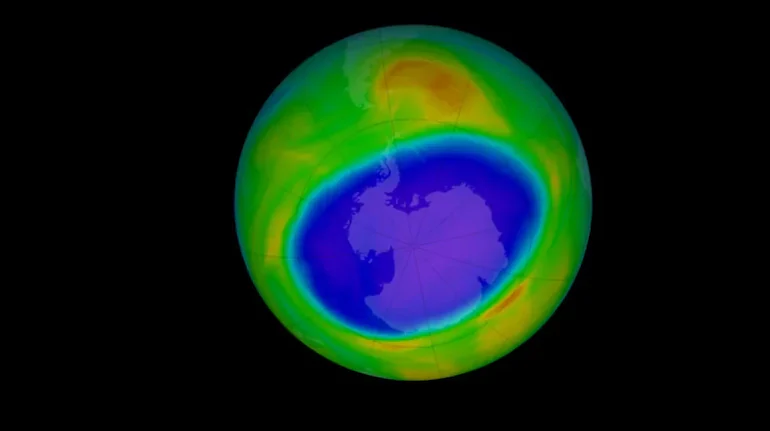
Earth’s Antarctic ozone hole reached its seventh-largest size in nearly five decades of satellite monitoring in 2026, covering approximately 10.5 million square miles (27.1 million square kilometres) at its maximum on September 18. Despite the alarming measurement, scientists say the development does not indicate that the ozone layer’s long-term recovery has reversed.
NASA and the National Oceanic and Atmospheric Administration (NOAA) attribute the unusually large ozone hole partly to atmospheric conditions, particularly a powerful and persistent polar vortex that created favourable conditions for ozone destruction over Antarctica.
The distinction between the ozone hole’s size and the severity of ozone depletion is important. Although the affected area was unusually large, measurements showed that ozone levels were not as depleted as during some of the worst years on record. Scientists also say international restrictions on ozone-destroying chemicals have prevented the 2026 hole from becoming significantly larger.
Antarctic Ozone Hole Reached 10.5 Million Square Miles
The Antarctic ozone hole reached its maximum area for 2026 on September 18, covering approximately 10.5 million square miles, equivalent to 27.1 million square kilometres. Based on the seasonal average, it ranked seventh largest in 48 years of satellite observations.
NASA and NOAA measured an average ozone-hole area of approximately 9.6 million square miles (25 million square kilometres) during the peak depletion period from September 7 to October 13. That is more than twice the size of the United States.
Scientists define the ozone hole as the region where the concentration of ozone in the stratosphere falls below 220 Dobson units. The term does not mean that ozone has completely disappeared. Instead, it describes an area where the protective ozone layer has become significantly thinner than normal.
The size of the hole changes throughout the Antarctic spring. Its maximum area, seasonal average and depth are separate measurements, meaning a year with a large ozone hole does not necessarily experience the most severe ozone depletion.
Why Did the Ozone Hole Become So Large in 2026?
Scientists identified an unusually powerful Antarctic polar vortex as a major factor behind the large ozone hole. The polar vortex is a large circulation of strong winds that forms around Antarctica during the Southern Hemisphere’s winter and spring.
It helps trap extremely cold air over the continent. These low temperatures encourage the formation of polar stratospheric clouds, which provide surfaces for chemical reactions involving chlorine and bromine compounds. When sunlight returns during the Antarctic spring, these reactions accelerate the destruction of ozone molecules.
In 2026, the polar vortex remained unusually strong and large because atmospheric weather systems that normally disturb and weaken it were less active during August and September.
These large-scale atmospheric waves usually travel upwards from the lower atmosphere and help disrupt the circulation surrounding Antarctica. Their weaker activity allowed the strongest winds to remain farther from the South Pole, expanding the region where extremely cold conditions could support ozone depletion.
As a result, ozone destruction continued across a larger area than in many recent years. The unusually persistent atmospheric conditions explain why the 2026 ozone hole became one of the largest observed since satellite monitoring began.
Why Are Scientists Not Worried About the Ozone Layer’s Recovery?
Scientists are not interpreting the larger 2026 ozone hole as evidence that the recovery process has stopped. Instead, they distinguish between short-term changes caused by atmospheric conditions and the long-term decline in ozone-depleting chemicals.
The 2026 ozone hole was unusually large in area, but it was not as deep as some of the most severe ozone holes recorded in earlier decades. NOAA measurements showed that ozone concentrations directly above the South Pole reached their lowest level for the year at 105 Dobson units on October 17.
For comparison, the lowest value recorded over the South Pole was 92 Dobson units in October 2006. This indicates that the 2026 event did not produce the same degree of ozone depletion seen during some historical extremes.
Scientists also estimate that the 2026 ozone hole could have been another 1–2 million square miles larger if ozone-destroying chemicals had remained at their peak atmospheric levels around 2000.
That difference demonstrates the impact of international action to reduce the production and use of ozone-depleting substances. Although these chemicals remain in the atmosphere for decades, their declining concentrations are helping limit the damage caused by seasonal atmospheric conditions.
What Is the Ozone Layer and Why Does It Matter?
The ozone layer is a region of the stratosphere containing relatively high concentrations of ozone molecules. It absorbs much of the Sun’s harmful ultraviolet radiation, particularly UV-B radiation, helping protect life on Earth.
Without this natural protective layer, more harmful ultraviolet radiation would reach the Earth’s surface. Increased exposure can raise the risk of skin cancer and cataracts in humans while also damaging plants, marine organisms and ecosystems.
The Antarctic ozone hole develops during the Southern Hemisphere’s spring, generally between August and November. It is a seasonal phenomenon caused by a combination of ozone-destroying chemicals, extremely cold stratospheric temperatures and returning sunlight.
Its size and intensity vary from year to year depending on atmospheric circulation and temperature. This natural variability explains why the ozone hole can expand significantly in one year even while the long-term chemical conditions continue improving.
How Did Human Activities Damage the Ozone Layer?
The major cause of ozone depletion was the release of human-made chemicals known as ozone-depleting substances. Among the most important were chlorofluorocarbons (CFCs), which were widely used in refrigerators, air conditioners, aerosol sprays, foam production and other industrial applications.
These chemicals were initially popular because they were relatively stable and useful for cooling and manufacturing. However, their stability also allowed them to remain in the atmosphere for long periods and gradually reach the stratosphere.
There, ultraviolet radiation breaks down CFC molecules, releasing chlorine atoms. These chlorine atoms participate in chemical reactions that destroy ozone molecules. A single chlorine atom can take part in repeated reactions, making these substances particularly damaging to the ozone layer.
Other ozone-depleting chemicals, including halons used in fire-suppression systems, also release substances that contribute to ozone destruction.
Because many of these compounds remain in the atmosphere for decades, stopping their production does not immediately restore the ozone layer. The chemicals already released continue influencing atmospheric chemistry long after their use has been restricted.
How the Montreal Protocol Helped Protect the Ozone Layer
The international response to ozone depletion began with the 1987 Montreal Protocol, a global agreement designed to phase out the production and consumption of substances responsible for damaging the ozone layer.
The agreement brought countries together to reduce the use of CFCs and other harmful chemicals. It was subsequently strengthened through amendments and adjustments that expanded controls and introduced restrictions on additional ozone-depleting substances.
Its impact is visible in atmospheric measurements. According to NOAA, chlorine levels in the Antarctic stratosphere originating from ozone-depleting substances have declined by approximately one-third from their peak levels in the 1980s.
The reduction has helped limit the amount of chemical material available to destroy ozone during the Antarctic spring. This is why scientists estimate that the 2026 ozone hole would have been significantly larger without international restrictions.
The Montreal Protocol is widely regarded as an important example of international environmental cooperation because it addressed the source of the problem rather than simply responding to its visible consequences.
When Will the Antarctic Ozone Layer Fully Recover?
Scientists do not expect the Antarctic ozone hole to disappear immediately. The chemicals responsible for ozone depletion have long atmospheric lifetimes, meaning their concentrations will continue declining gradually over several decades.
The latest scientific assessments project that Antarctic total-column ozone will return to its 1980 level during the 2060s, assuming continued compliance with the Montreal Protocol. The 2026 assessment places the expected recovery within that decade, although the precise timing remains subject to uncertainty.
The 1980 benchmark is important because it represents conditions before the severe ozone depletion associated with human-made chemicals became established over Antarctica. Reaching that level would indicate a substantial recovery of the protective ozone layer.
Recovery timelines differ across regions. The ozone layer over the Arctic and other parts of the world is expected to recover earlier than the Antarctic region, where extremely cold seasonal conditions make ozone depletion particularly severe.
Even after the projected recovery period, scientists will continue monitoring atmospheric ozone because changes in temperature, circulation and greenhouse gas concentrations can influence ozone levels.
Why the 2026 Ozone Hole Does Not Mean the Montreal Protocol Has Failed
The larger ozone hole in 2026 highlights an important feature of atmospheric science: environmental recovery does not always follow a smooth, year-by-year path.
Ozone concentrations respond to both chemical and meteorological conditions. The Montreal Protocol has reduced the concentration of ozone-destroying chemicals, but it cannot prevent every season from experiencing unusually cold temperatures or a strong polar vortex.
When atmospheric conditions favour ozone destruction, the hole can expand even as the overall chemical burden declines. In warmer years or seasons with weaker polar circulation, the affected area can become much smaller.
Scientists therefore examine long-term trends rather than judging recovery from a single year’s maximum area. They also compare the hole’s depth, duration and seasonal average to understand how severe the depletion actually was.
The 2026 measurements show that the ozone hole was unusually large, but the relatively higher ozone concentrations compared with historical extremes and the continued decline in ozone-depleting chemicals support the assessment that recovery remains on track.
What Happens Next?
NASA and NOAA will continue monitoring the Antarctic ozone hole through satellite observations, atmospheric instruments and measurements from research stations. These observations help scientists track changes in ozone concentration, the size of the seasonal hole and the behaviour of the polar vortex.
The 2026 event is a reminder that the ozone layer remains vulnerable to atmospheric conditions and that recovery is a gradual process. However, it also demonstrates why international controls on ozone-depleting chemicals remain important.
The key message is that a larger ozone hole in one year does not necessarily mean the protective layer is deteriorating again. The long-term decline in harmful chemicals is continuing to support recovery, even as unusual weather conditions create temporary setbacks.
Scientists expect the Antarctic ozone layer to return to its 1980 levels during the 2060s, provided countries continue following international agreements to control ozone-depleting substances. The 2026 measurements therefore represent an unusually large seasonal event, not evidence that decades of progress have been reversed.
For breaking news and live news updates, like us on Facebook or follow us on Twitter and Instagram. Read more on Latest Technology on thefoxdaily.com.




COMMENTS 0