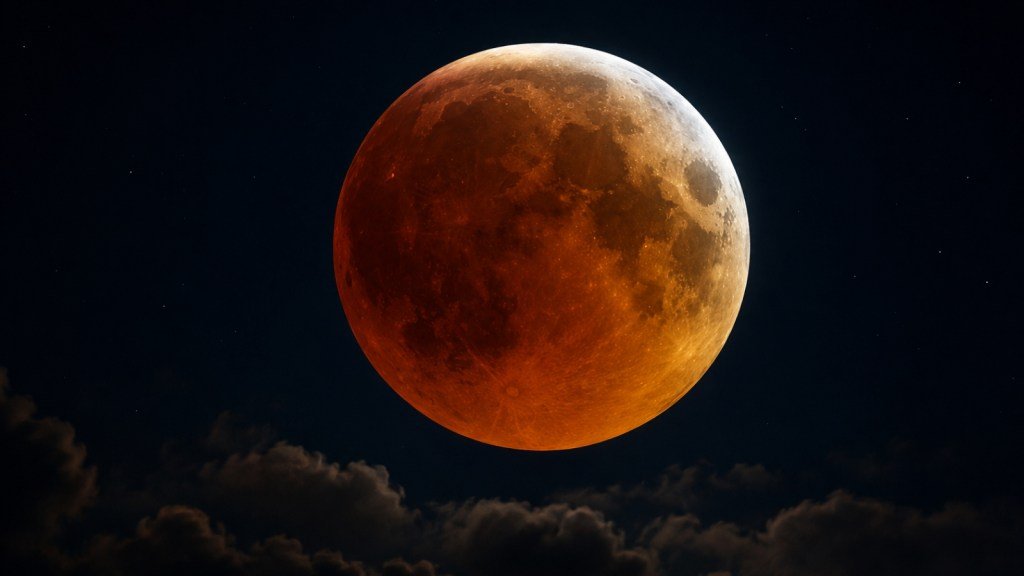
A deep partial lunar eclipse will unfold on August 27-28, 2026, as the Moon moves almost completely into the darkest part of Earth’s shadow.
At the peak of the eclipse, about 96.3% of the Moon’s surface will lie within Earth’s umbra, according to NASA. Although it will be a partial rather than a total lunar eclipse, the unusually deep coverage means the eclipsed portion could take on a prominent coppery-red colour.
The event will be visible from large parts of North and South America, along with portions of Europe and Africa. It will not be directly visible from India, because the eclipse will occur while the Moon is below the horizon there.
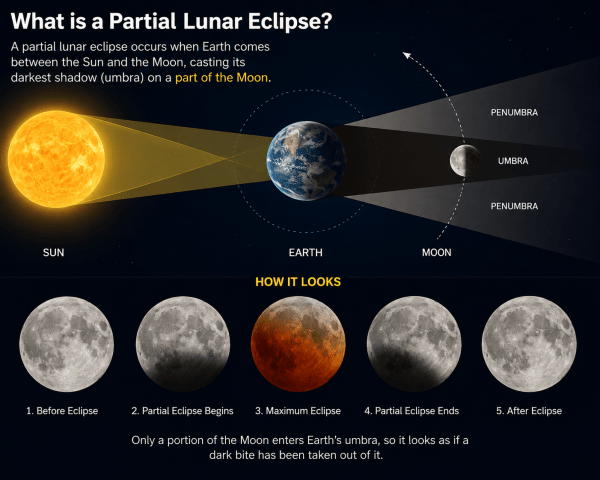
What is a partial lunar eclipse?
A lunar eclipse occurs when Earth moves between the Sun and the Moon and blocks some or all of the sunlight reaching the lunar surface.
During a partial lunar eclipse, the Sun, Earth and Moon are not aligned closely enough for the entire Moon to enter Earth’s darkest shadow, or umbra. Consequently, one part of the lunar disk remains outside the umbra and continues to receive direct sunlight while another portion becomes darkened.
For the August 2026 event, however, the Moon will pass extremely deep into the umbra. NASA estimates that 96.3% of the lunar disk will be inside the shadow at greatest eclipse.
August 2026 lunar eclipse: Date and time
In global timekeeping, the eclipse occurs on August 28. In parts of the Americas, the event begins during the evening of August 27 because of local time zones.
According to NASA, the partial phase begins at 2:34 am UTC on August 28. This is when Earth’s umbra begins visibly covering the full Moon.
The eclipse reaches its maximum at approximately 4:13 am UTC, when around 96% of the Moon’s disk will be within the umbra.
Partial lunar eclipse 2026 timings in IST
For reference, the global stages converted into Indian Standard Time are:
| Stage | Time in IST |
|---|---|
| Penumbral eclipse begins | 6:54 am |
| Partial eclipse begins | 8:04 am |
| Maximum eclipse | 9:43 am |
| Partial eclipse ends | 11:21 am |
| Penumbral eclipse ends | 12:31 pm |
Important: These are the global eclipse stages converted to IST. They do not mean that the eclipse can be seen from India at those times.
Will the August 2026 lunar eclipse be visible in India?
No, the August 2026 partial lunar eclipse will not be directly visible from India.
The eclipse takes place while the Moon is below the horizon for observers in India. As a result, even though the worldwide eclipse timings can be converted into IST, skywatchers in India will not be able to watch the Moon entering Earth’s shadow from their locations.
People in India WHO want to follow the event can instead use an online livestream.
Where will the lunar eclipse be visible?
NASA says the eclipse will be visible from much of North America and South America, as well as parts of Europe and Africa.
Observers in North and South America are expected to have some of the best opportunities because the complete sequence can be visible from those regions.
In parts of Europe and Africa, the eclipse will occur before dawn. Depending on location, the Moon may set before the later stages of the event are completed.
How to watch the lunar eclipse online
Because the eclipse will not be visible from India, online coverage will be the practical option for Indian viewers.
Several Astronomy organisations and observatories are expected to provide livestream coverage around the event. The Griffith Observatory is among the sources that Space.com has reported will livestream the eclipse.
The Virtual Telescope Project is also expected to provide telescope views from locations including Italy and Chile, with commentary from astrophysicist Gianluca Masi.
Viewers can also follow coverage from NASA, the European Space Agency and Space.com through their official online platforms, subject to the availability of livestreams closer to the event.
Why does the Moon turn red during an eclipse?
The reddish colour associated with a lunar eclipse comes from sunlight passing through Earth’s atmosphere.
When the Moon moves into Earth’s shadow, the planet blocks direct sunlight. However, some sunlight travels through the atmosphere before reaching the lunar surface.
Earth’s atmosphere scatters shorter blue wavelengths more readily, while longer red wavelengths can pass through the atmosphere and illuminate the Moon. That light is reflected back towards Earth, giving the eclipsed portion a reddish, orange or copper-like appearance.
Because the August 2026 eclipse is expected to place almost the entire lunar disk inside the umbra, the colour change could be particularly noticeable from locations where the eclipse is visible.
Is it safe to watch a lunar eclipse?
Yes. A lunar eclipse is safe to watch with the naked eye.
Unlike a solar eclipse, observing a lunar eclipse does not expose the eyes to concentrated direct sunlight. Therefore, eclipse glasses or special solar filters are not required.
Binoculars and telescopes can also be used to get a closer look at the Moon during the eclipse.
If you are watching from outdoors, choose a location with a clear view of the sky and avoid places where traffic, unstable ground or other hazards could create safety problems.
August 2026 lunar eclipse: Key facts
- Date globally: August 28, 2026
- Partial eclipse begins: 2:34 am UTC
- Maximum eclipse: About 4:13 am UTC
- Moon inside Earth’s umbra at maximum: About 96.3%
- Visibility: Much of North and South America, parts of Europe and Africa
- India: Not directly visible
- Eye safety: Safe to view without special eclipse glasses
Bottom line
The August 2026 partial lunar eclipse will be an unusually deep lunar eclipse, with almost the entire Moon entering Earth’s darkest shadow. While observers across parts of the Americas, Europe and Africa may see the event directly, people in India will miss the celestial spectacle because the Moon will be below the horizon during the eclipse.
For Indian skywatchers, online livestreams offer the best way to follow the event. And unlike a solar eclipse, no special eye protection is required when viewing a lunar eclipse.
With PTI Inputs
For breaking news and live news updates, like us on Facebook or follow us on Twitter and Instagram. Read more on Latest World on thefoxdaily.com.




COMMENTS 0