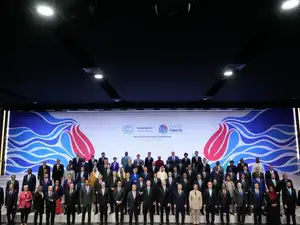
World leaders have called for stronger and faster action against Climate Change at the 31st United Nations Climate Change Conference (COP31), as governments face growing pressure to turn climate promises into measurable results. The high-level discussions began on Wednesday, November 11, in Antalya, Turkey, following a year marked by deadly floods, extreme heat and destructive wildfires in different parts of the world.
United Nations Secretary-General António Guterres urged governments to move beyond declarations and take immediate steps to reduce emissions, prepare communities for rising temperatures and provide greater financial support to countries facing climate-related risks. He also proposed a framework for international cooperation aimed at connecting climate responsibility with shared security and benefits.
However, the summit has begun amid concerns over the absence of leaders from several major polluting nations. The United States, China and India are among the countries whose heads of state or government are not scheduled to attend the leaders’ summit, creating questions about the level of political engagement from some of the world’s largest emitters.
Guterres calls on governments to act immediately on climate change
Guterres used his address at the Antalya leaders’ summit to warn that the climate crisis is advancing faster than the international response. He argued that governments already understand the scale of the problem and must now translate that understanding into practical measures.
His message focused on the gap between what countries have promised and what they are actually doing to limit global warming. Climate commitments made at previous international conferences have not yet produced emissions reductions at the scale required to meet the goals of the Paris Agreement.
Guterres called for action across four interconnected areas: moving away from dependence on fossil fuels, adapting societies to a warmer climate, increasing financial assistance for vulnerable countries and strengthening international cooperation.
He described his proposed framework as a Climate Justice Compact, based on shared responsibility, shared security and shared benefits. The proposal is intended to encourage countries to work together on problems that cannot be addressed effectively by individual governments acting alone.
The framework also reflects a longstanding disagreement in international climate negotiations. Developing countries have repeatedly argued that wealthier nations, which have contributed heavily to historical greenhouse gas emissions, should provide greater financial and technical support to countries facing severe climate impacts.
For Guterres, climate cooperation must extend beyond negotiations over individual targets. It must also address the practical needs of communities dealing with heat, floods, droughts and other consequences of a changing climate.
Fossil fuel dependence remains a central issue at COP31
Reducing dependence on fossil fuels remains one of the most difficult subjects in global climate negotiations. Coal, oil and natural gas continue to play major roles in electricity generation, transport, industry and other economic activities, making the transition away from them a complex policy and investment challenge.
Guterres has called for countries to move towards ending fossil fuel dependence rather than relying on broad promises that lack clear implementation plans. At COP31, he directly challenged the influence of the fossil fuel industry in the climate debate.
He argued that the scientific and economic case for continuing heavy reliance on fossil fuels was weakening, while climate-related damage was increasingly affecting lives and economies. His message was that governments should accelerate the transition rather than delay difficult decisions.
However, the pace of the transition remains contested. Countries differ in their energy resources, development priorities and ability to finance cleaner technologies. Governments also face questions about energy affordability, employment and the reliability of electricity supplies as they change their energy systems.
These differences make international agreement difficult, particularly when countries are expected to adopt policies that could affect their domestic economies. COP31 will therefore have to address not only the direction of climate policy but also how countries can implement it fairly and practically.
Leaders of major polluting nations absent from the summit
The absence of leaders from several major emitting countries has become one of the main talking points at COP31. The heads of state or government of the United States, China and India are not scheduled to attend the Antalya leaders’ summit.
These countries are central to global climate discussions because of the scale of their economies, energy consumption and greenhouse gas emissions. Their participation is important for negotiations involving emissions reductions, energy transitions, climate finance and international cooperation.
The absence extends beyond these three countries. According to an analysis of the leaders scheduled to attend, the heads of the five largest carbon-emitting countries China, the United States, India, Russia and Japan are not represented at the summit by their national leaders.
The analysis also found that national leaders attending the summit represented countries responsible for only about 14 per cent of global carbon dioxide emissions. The figure was based on the scheduled high-level speakers and emissions data for 2025.
Although heads of state do not directly conduct every part of the formal climate negotiations, their presence carries diplomatic importance. Leaders can signal political commitment, encourage cooperation and help resolve disagreements that may be difficult for negotiators to settle independently.
Their absence does not mean that the countries themselves are entirely missing from COP31. Government representatives and negotiating teams can still participate in the formal process. However, the lack of top-level political representation may reduce the visibility and diplomatic weight of the leaders’ discussions.
Why the absence of the United States, China and India matters
The United States, China and India have different economic structures and energy priorities, but all three have significant influence over the future direction of global emissions.
The United States is a major historical contributor to greenhouse gas emissions and has substantial influence over international climate finance, energy investment and technology development. Its absence from the leaders’ summit for a second consecutive year has attracted particular attention.
China is a major centre of manufacturing and energy consumption and plays a central role in global clean-energy supply chains. Its climate policies influence emissions trends as well as the international availability and cost of technologies such as solar panels, batteries and electric vehicles.
India faces the challenge of expanding economic opportunities, improving energy access and meeting growing electricity demand while also increasing the use of cleaner energy. Its position in climate negotiations has often emphasised the importance of development needs, fairness and support for developing economies.
Because these countries have different responsibilities and priorities, meaningful global progress requires their continued participation in negotiations and implementation. The absence of their top leaders makes it harder to present the summit as a gathering of political leadership representing the countries most central to the emissions challenge.
At the same time, attendance alone does not determine whether a country will meet its climate commitments. The more important measure is whether governments adopt policies, provide resources and achieve verifiable reductions in emissions.
Brazil’s Lula highlights the need for global environmental leadership
Brazilian President Luiz Inácio Lula da Silva was among the prominent leaders attending COP31. His participation is significant because Brazil hosted the previous UN climate conference, COP30, and has placed environmental protection and the future of the Amazon rainforest high on its international agenda.
Brazil’s role in climate discussions is closely connected to the Amazon, one of the world’s most important tropical forest regions. Forest protection is a major part of the global effort to limit climate change because forests absorb carbon dioxide and support biodiversity and regional water systems.
Lula has used international platforms to call for stronger environmental cooperation and greater responsibility from governments. His presence at COP31 also gives Brazil an opportunity to maintain its role in discussions about deforestation, climate finance and the transition towards lower-emission development.
The country faces the challenge of balancing economic development with the protection of natural ecosystems. Reducing deforestation, strengthening environmental enforcement and supporting sustainable economic activity are important parts of that challenge.
Lula’s participation comes as COP31 seeks to build on the outcomes of the previous conference and maintain political momentum around climate action. Brazil’s environmental priorities are particularly relevant to negotiations involving forests, land use and international support for countries that protect major carbon-absorbing ecosystems.
Climate disasters increase pressure for faster action
The calls for stronger climate action come after another year of damaging weather-related events. Extreme heat, floods and wildfires have affected communities in different regions, increasing pressure on governments to improve both emissions reduction policies and disaster preparedness.
Climate change does not cause every individual extreme weather event on its own. However, rising global temperatures can increase the likelihood or intensity of certain types of extreme conditions, including heatwaves and some forms of heavy rainfall.
Scientists have repeatedly warned that the consequences of continued warming will become more severe as temperatures rise. The effects can include greater pressure on water resources, agricultural disruption, damage to infrastructure and risks to public health.
For countries with limited financial resources, responding to these events can be especially difficult. A severe flood or prolonged drought can damage homes, roads, crops and livelihoods, leaving governments with significant recovery costs.
This is why climate negotiations increasingly focus on both mitigation and adaptation. Mitigation involves reducing greenhouse gas emissions to limit future warming, while adaptation involves preparing communities and infrastructure for climate impacts that are already occurring or expected to become unavoidable.
Climate finance remains a major challenge for developing countries
Climate finance is another major issue expected to shape discussions at COP31. Developing countries have argued that they need greater financial support to reduce emissions, adapt to climate impacts and recover from climate-related losses.
Many vulnerable countries face a difficult combination of rising climate risks and limited public resources. Building flood protection, improving water management, developing early-warning systems and strengthening agricultural resilience all require substantial investment.
The transition to cleaner energy also involves major costs. Governments need to expand electricity networks, modernise infrastructure and support technologies that can reduce dependence on fossil fuels.
Guterres’s proposed Climate Justice Compact places financial assistance alongside emissions reductions and adaptation. This reflects the view that climate cooperation cannot succeed if countries facing the greatest risks lack the resources to respond.
For international negotiations, the challenge is to turn broad financial commitments into funding that reaches countries and communities that need it. Questions over the amount of support, its sources and how it should be distributed have remained difficult areas of discussion at previous climate conferences.
Global warming and the Paris Agreement’s 1.5-degree target
The urgency surrounding COP31 is also linked to the Paris Agreement’s goal of limiting global warming to well below 2 degrees Celsius above pre-industrial levels while pursuing efforts to keep the increase to 1.5 degrees Celsius.
The 1.5-degree threshold has become a central reference point in climate policy because the risks associated with warming increase as global temperatures rise. Crossing that level does not mean that all climate action becomes pointless, but it would make avoiding further dangerous impacts more difficult.
Scientists have warned that the world is at risk of exceeding the 1.5-degree target, at least temporarily, without much faster emissions reductions. The challenge for governments is therefore not limited to announcing long-term net-zero goals. They must also reduce emissions in the near term.
That requires changes across electricity generation, transport, industry, buildings and land use. It also involves investment in renewable energy, energy efficiency, storage and other technologies that can reduce greenhouse gas emissions.
The gap between national climate pledges and actual emissions reductions remains a major concern. Countries may announce ambitious targets, but those commitments need to be backed by domestic laws, investment plans and measurable progress.
Why COP31 faces pressure to deliver more than promises
Annual UN climate conferences provide a platform for governments to negotiate shared goals and review progress under the international climate framework. However, repeated calls for urgent action have raised questions about whether the process is producing results quickly enough.
Previous conferences have delivered agreements and commitments on issues such as emissions, adaptation and climate finance. Yet the continued growth of climate risks has intensified criticism that implementation is not keeping pace with the scale of the problem.
At COP31, governments are under pressure to demonstrate how existing commitments will be translated into concrete measures. That includes clearer plans for reducing fossil fuel use, improving resilience and supporting countries that face disproportionate climate impacts.
The summit also needs to address differences between developed and developing countries. Wealthier nations often have greater financial and technological capacity to reduce emissions, while developing economies argue that they must retain room to expand infrastructure and improve living standards.
Finding common ground will require more than general statements about cooperation. Governments will need to address questions about responsibility, funding, energy security and the practical pace of the transition.
What COP31 could mean for the future of global climate action
The early discussions at COP31 have highlighted two connected challenges: the need for faster climate action and the difficulty of securing consistent political leadership from the countries most influential in global emissions.
Guterres’s Climate Justice Compact offers a framework built around shared responsibility, climate adaptation, financial support and cooperation. Lula’s participation has also brought attention to the importance of environmental leadership and the protection of natural ecosystems.
However, the effectiveness of the summit will ultimately depend on what governments agree to do and how those decisions are implemented. The absence of several major national leaders has added to concerns about political commitment, even as government delegations continue to take part in the negotiations.
For vulnerable communities, the stakes extend beyond diplomatic discussions. Stronger climate policies can influence their ability to cope with extreme heat, floods, droughts and other environmental pressures. Delays in emissions reductions and adaptation investment can increase the risks they face.
COP31 is therefore taking place at a moment when governments are being asked to close the gap between climate promises and real-world action. The message from Guterres and other leaders is that cooperation, finance and faster implementation must become central to the global response if countries are to limit the damage caused by a warming planet.
For breaking news and live news updates, like us on Facebook or follow us on Twitter and Instagram. Read more on Latest World on thefoxdaily.com.






COMMENTS 0