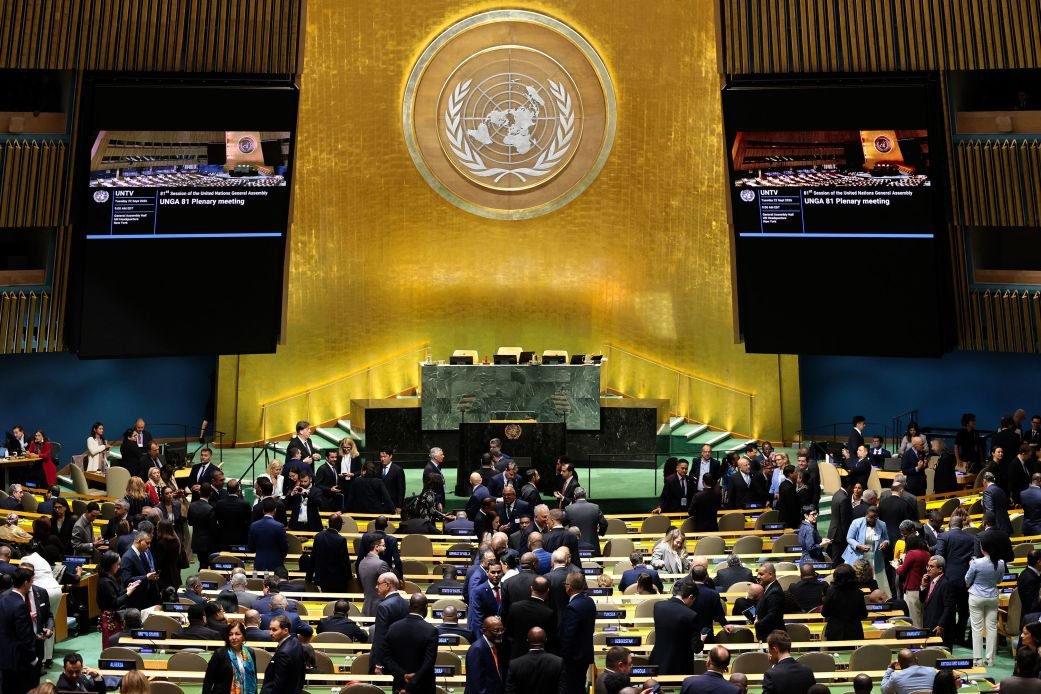
President Donald Trump used his address to the United Nations General Assembly on Tuesday to highlight what he described as major achievements since returning to office, including helping end wars, attracting investment to the United States, maintaining strong military stockpiles and reducing crime in Washington, DC.
Much of the speech followed a prepared text, but several of Trump’s assertions did not match publicly available evidence. Some claims substantially overstated the effect of US diplomacy, while others relied on figures that federal agencies and independent assessments do not support.
The discrepancies are particularly significant because the claims covered subjects ranging from international conflicts and climate science to defense readiness and domestic crime. Here is a closer examination of several of the president’s statements.
Trump’s claim that he has settled eight wars
Trump repeated one of his most frequent claims, saying: “Since I took office, it has been my great honor to settle eight wars.”
He identified conflicts involving Cambodia and Thailand, Kosovo and Serbia, Rwanda and the Democratic Republic of Congo, India and Pakistan, Armenia and Azerbaijan, and the war in Gaza. He has also previously counted the brief conflict between Israel and Iran in 2025 and a dispute between Egypt and Ethiopia among the conflicts he says he resolved.
The description of all eight as wars that Trump ended is inaccurate.
Some of the situations on Trump’s list did involve serious military tensions or armed conflict, while others do not fit the conventional description of a war during his current term.
The dispute involving Egypt and Ethiopia centered on Ethiopia’s Grand Ethiopian Renaissance Dam on the Blue Nile. Egypt has strongly objected to Ethiopia’s operation of the dam because of concerns about downstream water supplies, but the dispute itself was diplomatic rather than a war between the two countries.
Similarly, Serbia and Kosovo have experienced a long-running political and security dispute, but they were not engaged in a new war during Trump’s current term. The inclusion of that dispute as one of eight wars therefore overstates what was actually taking place.
Peace agreements do not necessarily mean wars have ended
Trump’s claim also blurs the distinction between negotiating a peace agreement, reducing hostilities and definitively ending a conflict.
The United States played a role in negotiating an agreement involving Rwanda and the Democratic Republic of Congo, but the existence of a peace agreement does not automatically mean that all violence has ended. Fighting and insecurity have remained concerns in the region.
The situation in Gaza presents a similar problem. A US-brokered ceasefire has represented a significant diplomatic development, but the existence of a ceasefire does not necessarily mean that the broader Israeli-Palestinian conflict has been permanently resolved. Continued military activity and political disagreements have complicated claims that the war has simply ended.
Trump did play a role in bringing the 2025 Israel-Iran conflict to an end. But that short conflict should also be distinguished from the broader and continuing confrontation between Israel, Iran and their respective allies.
As a result, counting eight separate “wars” as conflicts Trump settled gives a misleading impression of the number of wars definitively ended during his presidency.
Trump’s claim about global warming and climate change
Trump also criticized warnings about Climate Change while discussing concerns over artificial intelligence.
He referred to people who, he said, had predicted that “we’ll all be dead in 12 years because of global warming,” and claimed that the phrase “global warming” was later replaced by “climate change” because the planet was cooling rather than warming.
Several parts of that statement are incorrect.
First, global warming has not been replaced as a scientific term because temperatures were falling. Climate scientists continue to use both “global warming” and “climate change,” although the terms describe related but somewhat different concepts.
Global warming generally refers to the long-term increase in Earth’s average surface temperature. Climate change is broader and includes changes in temperature, precipitation, sea levels, extreme weather patterns and other effects associated with a warming planet.
NASA explains the distinction between the terms, while the United Nations Intergovernmental Panel on Climate Change has stated that human activities, primarily greenhouse-gas emissions, have unequivocally caused global warming.
The planet has continued to warm
Trump’s suggestion that the planet was cooling also conflicts with temperature records.
The World Meteorological Organization reported that the 11 years through 2025 were the warmest 11 years on record. The organization identified 2023, 2024 and 2025 as the three warmest years in the historical record, with 2024 remaining the warmest of the three.
That evidence does not support the claim that climate scientists shifted terminology because global temperatures were declining.
The scientific evidence instead shows a continuing long-term warming trend, although individual years can vary because of natural climate patterns such as El Niño and La Niña.
Did scientists say everyone would die within 12 years?
Trump’s reference to “12 years” also distorts a widely discussed climate warning.
A major 2018 report by the Intergovernmental Panel on Climate Change examined what would be required to limit global warming to 1.5 degrees Celsius above pre-industrial levels. The report emphasized that rapid and substantial reductions in greenhouse-gas emissions were needed during the following years to keep the world on a pathway toward that target.
It did not say that humanity would become extinct or that everyone would die within 12 years.
The “12 years” formulation became common in political debate as a shorthand for the urgency of reducing emissions. But the underlying scientific assessment was about the amount of action required to reduce future climate risks, not a prediction that the human population would disappear.
Trump’s claim that nobody has died from climate-related impacts is also unsupported. The World Health Organization estimates that climate change will contribute to hundreds of thousands of additional deaths annually in coming decades through factors including heat stress, malaria, diarrhea and undernutrition.
Trump’s $21 trillion US investment claim
Trump also repeated a claim about the scale of investment commitments coming into the United States, saying that his administration had “secured commitments for $21 trillion in new investments from all over the planet.”
There is no clear public evidence supporting that $21 trillion figure.
The White House has previously published lists of major investment announcements associated with Trump’s second term, but the figures cited by the administration have varied substantially and have included commitments that do not necessarily represent completed investment in the United States.
At the time of Trump’s UN speech, the White House website cited approximately $11.2 trillion in major investment announcements during his second term, considerably below the $21 trillion figure Trump used in his speech.
The distinction between an investment announcement and money actually invested is important. Companies and governments frequently announce potential projects years before the capital is deployed, and some announcements represent intentions, memoranda or broader economic arrangements rather than finalized investment.
Foreign direct investment is far below $21 trillion
Federal data also illustrates the scale of the difference. New foreign direct investment in the United States was approximately $232 billion in 2025.
That figure should not be directly compared with every investment announcement cited by the White House because the measures capture different things. Nevertheless, it demonstrates why describing $21 trillion in announced commitments as money that has already flowed into the United States would be misleading.
The White House’s broader tally has included US companies as well as foreign entities and has incorporated various types of investment and economic commitments.
Trump’s revised wording, referring to “secured commitments,” is somewhat more cautious than simply claiming that $21 trillion had already been invested. But the underlying figure still lacks sufficient public evidence to support it as a measure of actual new investment.
Trump’s claim that the US has more munitions than it could use
Trump strongly rejected reports that US military operations had depleted important weapons stocks.
He said the United States has “more munitions than we could ever possibly even think of using” and is producing weapons at levels never seen before.
The precise status of US military stockpiles is not publicly available because much of that information is classified. That makes it impossible for outside observers to independently determine the exact number of weapons currently available.
However, recent federal assessments have documented shortages and production constraints involving at least some categories of munitions.
Inspector general report identified strategic inventory shortfalls
A Defense Department inspector general report examining the period from April through June said a Pentagon acquisitions office had identified strategic inventory shortfalls resulting from munitions expenditures during the conflict.
The report also identified bottlenecks in the defense industrial base. Among the problems cited were production capacity for solid rocket motors, the availability of high-grade explosives and propellants, and difficulties recruiting skilled manufacturing workers.
The report noted that expanding production would require significant lead time, meaning that even when the government increases orders, additional weapons cannot necessarily be produced immediately.
This does not establish that the United States is broadly “out of munitions.” It does establish that at least some categories of weapons have faced inventory and production challenges, making Trump’s sweeping statement unsupported by the available evidence.
Missile-defense interceptor stocks face particular pressure
A separate Congressional Budget Office assessment found a shortfall in missile-defense interceptors and concluded that the United States would have a reduced inventory for several years.
The CBO estimated that the United States had probably used between one-half and two-thirds of its inventory of certain interceptors since June 2025.
It also concluded that rebuilding the inventory could take at least five years, even if production were increased, because of existing production rates and the difficulty of rapidly expanding manufacturing capacity.
The Defense Department has disputed claims that the United States faces an overall munitions shortage. But that position does not erase the more specific findings from federal oversight agencies about inventory depletion and production bottlenecks in particular weapons categories.
Trump’s claim that crime in Washington is down 87%
Trump also claimed that crime in Washington, DC, had fallen by 87% since he took office, saying the capital had been “riddled with crime” when he arrived and that his administration was working toward a complete reduction.
The 87% figure is not supported by the publicly available crime data.
Washington’s overall crime rate has declined, continuing a broader improvement in crime statistics seen in several major US cities. But the scale of the reduction is nowhere near 87% when measured using the city’s total reported crime.
District police data showed more than 15,000 total crimes recorded through Monday. Compared with the corresponding point in 2024, that represented a decline of roughly 23%, rather than a reduction of more than 80%.
The decline was also smaller when compared with the corresponding period in 2025.
Why Trump’s Washington crime figure is misleading
One possible explanation for the discrepancy is that the White House has referred to individual crime categories rather than overall crime.
The Washington Post reported that White House officials previously pointed to a sharp decline in arson incidents. In one comparison, arson cases fell from four incidents in 2025 to one in 2026. The White House has also highlighted the city’s falling homicide rate.
Those figures describe specific categories, however, and cannot be used to characterize the decline in total crime across Washington.
A reduction of 75% in a particular crime category, for example, does not mean overall crime has declined by 75%. The denominator and time period matter when assessing crime statistics.
Washington has experienced a substantial decline in several major categories of crime, but the available police data does not support Trump’s claim that total crime is down 87%.
What the fact checks show
The president’s UN speech contained several claims that mixed real developments with figures or descriptions that went substantially beyond the available evidence.
Trump has participated in diplomatic efforts surrounding several international conflicts, and some agreements have reduced fighting or established ceasefires. But describing every dispute on his list as a war that he personally ended does not accurately reflect the status of those conflicts.
Similarly, the scientific record does not support the claim that global warming was renamed because the planet was cooling, nor did climate scientists predict that everyone would die within 12 years. The evidence instead points to continued global warming and increasing climate-related risks.
The $21 trillion investment figure also lacks a clear factual foundation, particularly when compared with the much smaller value of documented foreign direct investment and the White House’s own lower figure for major investment announcements.
On defense readiness, publicly available federal reports provide evidence of depleted inventories and production constraints in specific categories, even though the Pentagon disputes the broader characterization of a general munitions shortage.
And while crime in Washington has declined, the city’s publicly reported data does not support an 87% reduction in total crime.
The broader lesson from the speech is that large headline numbers and sweeping descriptions require context. Whether discussing wars, climate, investment, military readiness or crime, the underlying definition, time period and data set can significantly change what a statistic actually says.
For breaking news and live news updates, like us on Facebook or follow us on Twitter and Instagram. Read more on Latest World on thefoxdaily.com.



COMMENTS 0