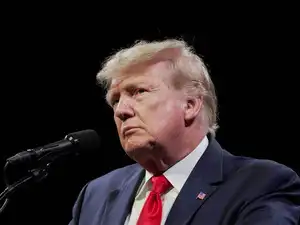
US President Donald Trump has claimed that his administration once threatened to arrest a senior executive at a major Artificial Intelligence company after receiving a report that the firm was doing something harmful with AI. According to Trump, the warning was deliberately blunt: the executive was told to prepare for jail and say goodnight to their family because an arrest could follow the next morning.
Trump recounted the episode during an interview with CBS’s 60 Minutes, using it to explain how his administration was addressing potential risks associated with rapidly advancing artificial intelligence. However, he declined to identify the executive, the company or the conduct that allegedly prompted the intervention.
The president said the individual changed their approach after receiving the warning. His account has drawn attention because it raises questions about how the US government is overseeing powerful AI developers, particularly as concerns about the technology’s safety grow alongside competition with China.
What Donald Trump Said About Threatening an AI Executive
Trump said the administration had received information about someone allegedly doing something harmful with artificial intelligence. He did not provide details about the report or explain who initially raised the concern.
Describing the response, the president said officials contacted the individual and delivered a warning that included the words: “Get ready to go to jail. Please give your wife a kiss good night.”
Trump said the message was intended to make the seriousness of the situation clear. He also recalled telling the executive to return home, spend time with their family and prepare for the possibility of being arrested the following morning.
The president described the warning as an intervention that produced an immediate change in the executive’s behaviour. According to Trump, the person subsequently changed everything after receiving the message.
However, the president did not explain precisely what was changed. It remains unclear whether the alleged intervention concerned an AI model’s development, its deployment, a particular business practice or another activity involving the technology.
Trump Refuses to Name the Executive or AI Company
One of the biggest unanswered questions surrounding Trump’s account is the identity of the person involved. During the interview, he described the individual as a leader at one of the major AI companies but refused to disclose the person’s name.
He also withheld the company’s identity. As a result, there is no confirmed basis for connecting the alleged warning to a particular technology firm or executive.
Trump’s description leaves several important details unresolved. He did not identify when the incident occurred, what specific activity triggered the report or which government officials were directly involved in contacting the individual.
Nor did he provide information about a formal investigation, criminal charges, an arrest warrant or any subsequent legal proceedings connected with the episode. His remarks establish that he says a warning was issued, but they do not independently establish that the executive committed an offence.
The president also did not provide evidence explaining how the alleged conduct was assessed or what safeguards were introduced after the executive reportedly changed their approach.
Did the AI Executive Actually Face Arrest?
Trump’s account describes a threat of possible arrest rather than a confirmed arrest or prosecution. He said the individual was warned that they could go to jail the next morning, but he did not claim that the person was subsequently taken into custody.
The distinction matters because a warning from government officials and formal criminal enforcement are different stages of a legal process. An allegation that a company or individual has engaged in harmful AI-related activity does not, by itself, establish criminal wrongdoing.
Trump also did not identify the law that the executive was allegedly suspected of violating. Without information about the conduct, the relevant legal provisions or the government’s evidence, it is not possible to assess the legal basis for the threat he described.
The president’s account therefore leaves the public without enough information to determine whether the episode involved an actual criminal investigation, an informal warning or another form of government intervention.
Trump Says the Department of Justice Is Managing AI Risks
Trump’s comments came during a broader discussion about the potential dangers of artificial intelligence and the role of government in overseeing the technology.
When questioned about concerns raised by people working in the AI industry, the president argued that the risks could be managed. He pointed to the Department of Justice as an important part of the government’s response.
His account of the unnamed executive appeared to support his argument that the administration could intervene when it received information about potentially harmful activity.
However, the president did not explain whether the Department of Justice had formally investigated the unidentified company or whether the alleged warning was delivered through the department. He also did not describe any specific enforcement framework that would apply to similar incidents.
The remarks highlight a central question in the debate over AI oversight: how governments should respond when a technology develops quickly and its potential risks are not always easy to identify or measure.
Why Trump Is Reluctant to Slow Down US AI Development
Alongside his comments about enforcement, Trump made clear that he does not want the United States to lose its competitive position in artificial intelligence.
He repeatedly framed the development of AI as a competition between the United States and China. According to the president, slowing American companies through restrictive rules could give Beijing an advantage in a technology that may have significant economic, scientific and strategic consequences.
Trump argued that if the United States does not develop advanced AI systems, China will continue advancing its own capabilities. He described the competition as a major reason for maintaining the pace of American innovation.
This position reflects the administration’s challenge of balancing two priorities. It wants companies to address safety concerns, but it also wants American businesses to continue developing increasingly capable AI systems without facing rules that could put them at a disadvantage against international competitors.
The president’s remarks suggest that he sees government intervention as necessary in certain circumstances but does not support broad restrictions that could slow the country’s technological progress.
Trump Says AI Risks Can Be Managed
Trump also questioned the scale of some warnings about artificial intelligence. During the interview, he said he did not consider the risks to be as serious as some people describe them and argued that they could be managed.
His comments differ from concerns raised by researchers and technology leaders who have called for stronger safeguards as AI systems become more capable.
Those concerns cover several areas, including the possibility of AI systems being misused, the spread of misleading information, cybersecurity threats and the difficulty of ensuring that increasingly advanced systems behave as intended.
Debates about more advanced AI also include questions about whether developers and governments can reliably anticipate the consequences of systems that may perform tasks beyond the capabilities of current models.
Trump’s position is that these risks should not prevent the United States from pursuing technological leadership. His account of the unnamed executive was presented as an example of how the government could respond to a specific concern without halting broader AI development.
However, because he did not identify the alleged misconduct or explain what changed after the warning, the episode provides limited information about how effectively the intervention addressed the underlying risk.
Would Trump Work With Democrats on AI Safety Regulations?
Despite his opposition to rules that could slow American AI companies, Trump said he was willing to work with Democrats on the issue of AI safety.
He indicated that he did not oppose guardrails in principle. His concern, as expressed during the interview, was that regulations should not leave the United States in a significantly weaker position than China.
The distinction is important because the debate in Washington is not simply about whether AI should be regulated. It also involves disagreements over the type of oversight required, how strict the rules should be and whether requirements should apply to the development, testing or release of AI systems.
Supporters of stronger safeguards argue that government oversight can help reduce risks that companies may not adequately address on their own. Others warn that complicated or restrictive requirements could increase costs, slow research and make it harder for American developers to compete internationally.
Trump’s comments indicate that he is open to discussing safeguards with Democrats, provided that any agreement does not significantly restrict the country’s AI ambitions.
China Remains Central to the US Artificial Intelligence Debate
Competition with China has become a major part of discussions about American AI policy. Both countries are seeking to strengthen their positions in advanced computing, AI research and the development of increasingly capable models.
For the United States, maintaining access to advanced computing infrastructure, attracting investment and supporting domestic technology companies are important parts of that effort. Government decisions about AI regulation can influence how quickly companies develop and deploy new systems.
Trump argued that China does not operate under the same kind of regulatory restrictions that American companies could face. He also suggested that Chinese AI development is strongly influenced by the decisions of President Xi Jinping.
His comparison reflects the administration’s concern that strict American rules could create an imbalance between the two countries. However, the broader policy debate involves more than the speed of technological development. It also includes questions about national security, public safety, accountability and the international implications of increasingly powerful AI systems.
Finding a balance between innovation and oversight is likely to remain a major challenge for policymakers as AI becomes more widely used across industries and government services.
What Trump’s Account Reveals About the Administration’s AI Approach
Trump’s story about the unnamed executive offers a glimpse into how he says his administration has approached concerns involving major AI developers. Rather than describing a broad regulatory intervention, he highlighted a direct warning that he claimed persuaded an executive to change their behaviour.
But the lack of identifying information makes it difficult to evaluate the episode. The public does not know which company was involved, what conduct was reported, whether investigators examined the matter or whether any formal action followed.
The account also leaves open questions about how the government decides when an AI-related activity crosses the line from a safety concern into a potential criminal offence. Clearer information about investigations, legal standards and enforcement procedures would be necessary to understand how such interventions operate.
For AI companies, the wider message is that the administration wants developers to take potential risks seriously while continuing to invest in American technological leadership. For lawmakers, the challenge is determining what safeguards are needed without creating rules that unnecessarily restrict research and innovation.
Key Questions Remain Unanswered
Trump’s remarks have brought renewed attention to the government’s role in overseeing artificial intelligence, but they have not resolved the central questions surrounding the alleged incident.
- Who was threatened? Trump described the individual as a leader at a major AI company but did not disclose a name.
- Which company was involved? The president refused to identify the firm.
- What was the alleged misconduct? He said someone had been reported for doing something harmful with AI but offered no specific details.
- Was anyone arrested? Trump described a warning about a possible arrest, not a confirmed arrest or prosecution.
- What changed afterward? He claimed the executive changed everything but did not explain what actions were taken.
- Will the administration support AI regulation? Trump said he was open to working with Democrats on guardrails, provided they did not undermine US competitiveness against China.
AI Safety and US-China Competition Will Remain Key Policy Issues
The episode described by Trump illustrates the competing priorities shaping the American debate over artificial intelligence. The administration wants to maintain the country’s position in a strategically important technology while responding to concerns about how powerful AI systems could be used.
Trump’s willingness to discuss guardrails with Democrats suggests that some cooperation on AI safety may be possible. However, his emphasis on competition with China indicates that he will resist measures he believes could slow American development.
For now, the identity of the executive and the nature of the alleged incident remain undisclosed. Until further details emerge, Trump’s account should be understood as his description of an alleged government intervention rather than confirmation of a specific AI-related crime or completed enforcement action.
For breaking news and live news updates, like us on Facebook or follow us on Twitter and Instagram. Read more on Latest World on thefoxdaily.com.





COMMENTS 0