US President Donald Trump has announced plans to close Washington, DC’s historic East Potomac Golf Course for 15 months to carry out a major renovation, escalating a dispute over the future of the publicly accessible recreation facility. The proposed closure is scheduled to begin on November 15, even as a federal court challenge seeks to halt redevelopment work and scrutinise the removal of hundreds of trees from the site.
Trump announced the plan on social media, describing his ambition to transform the century-old course into one of the “Best and Most Spectacular Golf Courses anywhere in the World.” He also said the renovated facility would remain open to the public and could eventually meet the standards required to host major international golf tournaments.
However, the redevelopment faces significant legal obstacles. A federal judge has temporarily halted the work, criticising the administration for beginning large-scale tree removal over a holiday weekend without providing adequate notice to the court or the people challenging the project, according to The Associated Press.
The dispute has developed into a broader test of the administration’s authority to reshape public spaces in the nation’s capital. Opponents argue that East Potomac Golf Course is part of a public recreation facility intended to serve the local community, while Trump has defended the renovation as necessary to address what he describes as deteriorating and unsafe conditions.
Trump announces 15-month closure of East Potomac Golf Course
Trump said East Potomac Golf Course, located near the White House, would close from November 15 for an extensive renovation expected to last 15 months. His announcement included an artist’s rendering of the proposed redesign, offering a visual representation of how the facility could look after redevelopment.
The president described the existing course as old, broken and poorly maintained, arguing that it required a substantial overhaul rather than minor repairs. He said the project would produce a high-quality golf facility capable of attracting major competitions.
Trump also indicated that the renovated course could potentially host prestigious events, including the US Open, the PGA Championship, the Ryder Cup and the Presidents Cup. These were presented as possibilities for the future facility, not confirmed tournament bookings.
The proposed closure would temporarily remove a public golfing destination from use while the renovation takes place. Its duration has become particularly significant because the course is accessible to Washington residents across different income levels, making affordability and public access central issues in the dispute.
Trump has not detailed every element of the proposed redevelopment in the announcement described by AP. The artist’s rendering illustrates the intended transformation, but the project’s eventual design, timeline and scope remain subject to the ongoing legal proceedings.
Importantly, the president did not address the court battle in his social media announcement. The proposed closure therefore adds a concrete timeline to a project whose legal status remains unresolved.
Why the Washington golf course redevelopment faces a lawsuit
The planned renovation has drawn opposition from individuals and organisations concerned about the future of East Potomac Golf Course as a public recreation space. Democracy Forward, the organisation representing the people challenging the project, argues that the course forms part of a national park and recreation facility intended for public use, according to AP.
The organisation has opposed the administration’s plans, raising concerns about changes to a space that has long served Washington residents. Critics fear that transforming the existing public course into a high-end golfing destination could alter its character and make it less affordable for ordinary players.
Skye Perryman, president and chief executive of Democracy Forward, said the legal challenge aims to protect the course for the local community. She indicated that the organisation would continue working with the plaintiffs to contest what it considers unlawful and harmful interference with public space.
The legal dispute is not simply about whether a golf course should be renovated. It also concerns how the federal government manages public land, whether redevelopment can proceed while a court challenge is pending and what protections apply when proposed changes involve the removal of trees and alterations to a historic recreation facility.
The plaintiffs are seeking judicial intervention to prevent the project from advancing before the court has fully considered their arguments. Their challenge has already led to emergency hearings and a temporary restriction on redevelopment work.
The case also raises questions about how the government should balance maintenance and improvements against the interests of people who use public facilities. While Trump argues that the course needs substantial work, opponents contend that redevelopment must comply with applicable legal requirements and protect the site’s public purpose.
Judge temporarily halts tree removal at the historic golf course
A federal judge last week temporarily stopped the redevelopment work until at least October 26 after criticising the administration’s handling of tree removal at East Potomac Golf Course, AP reported.
The judge objected to the government’s decision to begin large-scale tree cutting over a holiday weekend without sufficient notice to the court or the people challenging the project. The lack of advance notice became a central issue during an emergency hearing on October 12.
The court’s intervention means the administration cannot simply treat the renovation as an unrestricted construction project while the legal challenge remains active. The temporary order places limits on the work as the judge examines the circumstances surrounding the tree removal and the broader redevelopment plans.
The dispute has also prompted the court to seek testimony from senior administration officials. US District Judge Ana Reyes ordered key members of the Trump administration to testify about the recent tree-cutting work.
The court is examining whether the removal of the trees was connected to the president’s wider plans to redevelop the course. That question matters because the legal challenge concerns not only the physical changes at the site but also the administration’s actions and the process followed before work began.
The temporary halt does not, by itself, resolve the underlying dispute or permanently prevent the renovation. It preserves restrictions while the court considers the case and determines how the legal challenge should proceed.
Trump defends removal of hundreds of trees
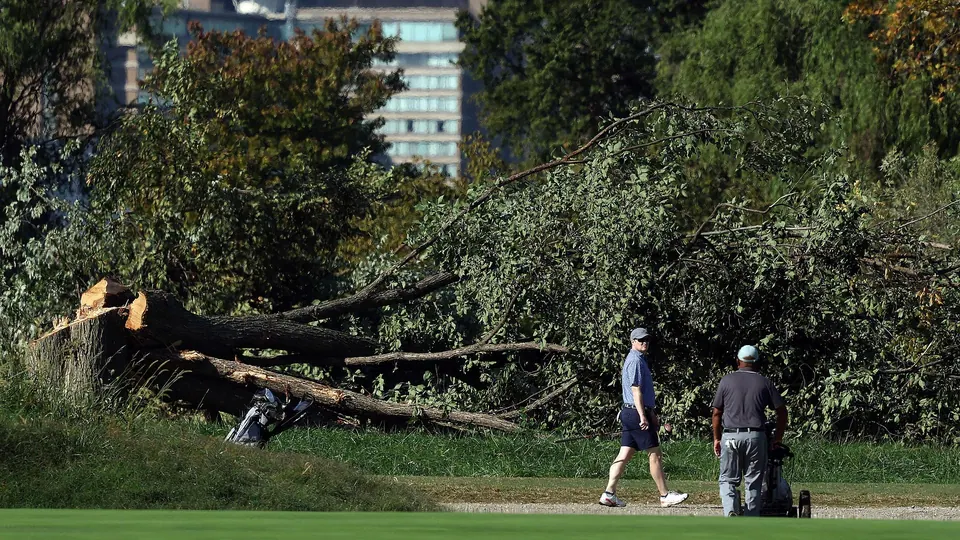
Trump has defended the National Park Service’s removal of hundreds of trees from the golf course, arguing that the site had become overgrown and unsafe.
In his comments, the president said the course originally had relatively few trees, allowing visitors to enjoy clear views of Washington. He argued that the landscape had changed over time and described the current facility as dysfunctional and unsuitable for its intended use.
Trump also claimed that diseased trees were falling and posed safety risks. In addition, he said the seawall surrounding the facility was deteriorating and collapsing, creating a potential hazard.
These statements form part of the administration’s justification for a comprehensive renovation. However, the claims about the condition of the trees and seawall should be distinguished from the court’s separate examination of whether the work was undertaken with appropriate notice and in accordance with the law.
The legal challenge has focused attention on the timing and scale of the tree removal. Opponents have questioned the decision to proceed before the court had fully considered the dispute, while the judge’s temporary order has restricted further work as the case continues.
The disagreement illustrates the competing arguments surrounding the project. Trump presents the redevelopment as a necessary effort to improve an ageing facility and address safety concerns. Opponents argue that the administration must respect legal restrictions and preserve the public character of the recreation area.
Debris from White House East Wing demolition adds to concerns
The golf course controversy has also drawn attention because debris from the demolition of the White House East Wing has been dumped on the grounds, according to the supplied report.
The East Wing was removed to make way for Trump’s proposed White House ballroom. The National Park Service said testing found lead, chromium and other toxic metals in the demolition debris.
The presence of these materials has added another dimension to questions about how the golf course grounds are being used during the broader renovation effort. Lead and chromium can pose environmental and health concerns depending on their form, concentration and exposure pathways, making appropriate testing and handling important when such substances are identified.
However, the reported test results alone do not establish the extent of any exposure risk at the golf course or whether people have been harmed. Assessing those questions would require further information about the materials, their location, the conditions of the site and any measures taken to manage them.
The debris issue also connects the golf course project to Trump’s wider programme of construction and renovation in Washington. Critics of the redevelopment have raised concerns about changes to public spaces, while the administration has presented its projects as improvements to facilities that it considers outdated or in need of major work.
The course is therefore at the centre of several overlapping issues: the future of public recreation, the removal of trees, the management of demolition materials and the legal limits governing changes to federally managed property.
Trump’s wider Washington renovation plans face legal challenges
The East Potomac Golf Course project is part of Trump’s broader effort to renovate and refurbish prominent sites in Washington, DC. Other projects mentioned in AP’s reporting include changes to the White House and the Kennedy Center for the Performing Arts.
Several of these initiatives have encountered legal challenges. They include Trump’s proposal to construct a large ballroom at the White House, the installation of his name on the Kennedy Center and plans for a massive arch in Washington.
The disputes differ in their details, but they share a wider question about the authority to alter prominent public or government-associated sites. The projects have drawn scrutiny over their planning, legal basis and potential effects on institutions and spaces with historical or civic significance.
Trump, who regularly plays golf, has been pushing to renovate East Potomac Golf Course, which is 106 years old. The facility’s age and condition are central to his argument that major improvements are necessary, while opponents emphasise its importance as an accessible public recreation area.
The president’s renovation agenda has also brought questions about how proposed changes are approved and how disagreements are handled when courts become involved. The East Potomac case demonstrates that announcing a project and setting a timetable do not necessarily settle the legal issues that determine whether work can proceed.
For the administration, the golf course renovation represents an opportunity to create a facility that Trump says could meet international competitive standards. For opponents, the central concern is whether that transformation would compromise a public asset and whether the work has been carried out lawfully.
Trump administration seeks Judge Ana Reyes’ removal
The legal dispute escalated further when the Trump administration asked on Friday for Judge Ana Reyes to be removed from the case. According to AP, the administration questioned her impartiality and accused her of what it described as “egregious” behaviour during the October 12 emergency hearing.
The request followed a three-hour hearing during which Reyes strongly criticised the government’s lawyer. The judge was frustrated that neither the court nor the plaintiffs had received adequate notice before the trees were cut down.
The administration’s request introduces a separate procedural question into the wider fight over the golf course. Instead of focusing exclusively on the redevelopment plans, the court must also consider the government’s challenge to the judge overseeing the case.
The request does not itself remove Reyes from the proceedings. The judge is expected to consider the administration’s arguments during the upcoming hearing, and the decision could affect how the litigation moves forward.
Meanwhile, the plaintiffs asked the court over the weekend to issue a longer-lasting preliminary injunction or a stay. Such measures would seek to maintain restrictions on the redevelopment while the lawsuit continues.
A preliminary injunction can preserve the position of the parties while a court considers the merits of a dispute, while a stay can pause specified actions or proceedings. Whether either measure is granted will depend on the court’s assessment of the case and the applicable legal standards.
The competing requests underline the uncertainty surrounding the project’s next steps. The administration wants to proceed with its renovation plans, while the plaintiffs are seeking stronger judicial protections to prevent further changes before the legal issues are resolved.
Will the 15-month closure proceed as planned?
Trump’s announcement establishes November 15 as the planned start date for the closure, with the renovation expected to last 15 months. However, the ongoing legal proceedings could affect whether and when the work moves forward.
The temporary court order halting redevelopment until at least October 26 is an important immediate constraint. The upcoming hearing, the administration’s request for the judge’s removal and the plaintiffs’ request for longer-lasting restrictions could all influence the timetable.
The announcement of a closure date should therefore not be treated as confirmation that the entire renovation has received final legal clearance. The court is still examining the dispute, including the circumstances surrounding the tree removal and the administration’s actions at the site.
The eventual outcome will also determine how the project balances the administration’s stated goal of modernising the facility with concerns about public access and the management of historic recreation space.
For Washington residents, the central issue is whether the course will remain accessible during the legal process and what kind of facility will emerge if the renovation proceeds. For the administration, the challenge is to advance its plans while responding to judicial scrutiny and the objections raised by the plaintiffs.
East Potomac Golf Course has become a focal point in a wider debate over public land, federal authority and Trump’s renovation agenda in the capital. Until the court resolves the outstanding issues, the proposed 15-month closure remains part of a contested redevelopment plan rather than an entirely settled project.
For breaking news and live news updates, like us on Facebook or follow us on Twitter and Instagram. Read more on Latest World on thefoxdaily.com.






COMMENTS 0