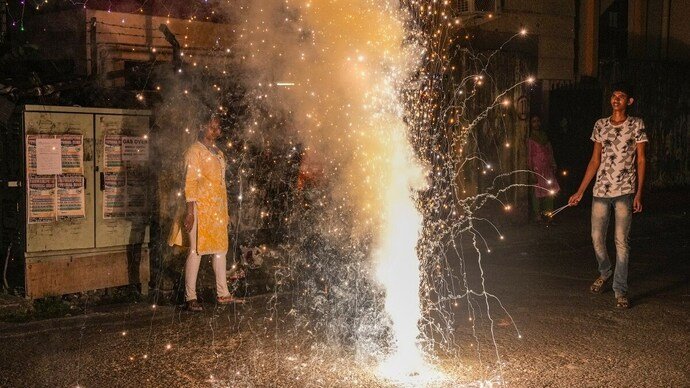
Mumbai could face stricter restrictions on firecrackers after the Bombay High Court expressed concern over more than 300 fire incidents reported during Diwali, alongside a sharp rise in noise and Air Pollution. The court has warned that it may restrict firecracker celebrations to designated grounds and permitted community events if residents continue to disregard public safety and civic responsibilities.
A bench of Justices Girish Kulkarni and Neela Gokhale made the observations on Thursday while hearing a matter concerning firecracker restrictions in the city. The judges said the reported incidents and pollution levels were alarming, adding that celebrations cannot come at the cost of public health, safety and property.
The court indicated that a broader prohibition on firecrackers across Mumbai could become necessary if existing restrictions fail to change public behaviour. The matter has been posted for further hearing and orders on December 7, when the bench is expected to consider whether additional restrictions should be imposed.
Why Is the Bombay High Court Considering a Wider Firecracker Ban?
The immediate concern is the number of fire incidents reported during Diwali. The court was informed that more than 300 such incidents had occurred in Mumbai during the festival, raising questions about the safety risks associated with widespread firecracker use in a densely populated city.
Judges observed that repeated restrictions had apparently failed to produce the expected improvement in public behaviour. Referring to the incidents, the bench said it appeared that people had not changed their approach despite earlier court orders.
The court also expressed concern over celebrations continuing late into the night. According to its observations, there was tremendous noise pollution until 3 am, affecting residents who were unable to escape the disturbance in their neighbourhoods.
The judges warned that if the situation continued, the court could consider allowing firecrackers only during organised community celebrations at permitted grounds. Such an approach would shift celebrations away from unrestricted individual bursting of firecrackers on streets and other public spaces.
The warning does not mean that a citywide ban has already been imposed. It signals that the court is considering stronger measures and will examine the issue further before issuing its next directions.
What Did the High Court Say About Pollution in Mumbai?
The bench connected the firecracker issue with Mumbai’s wider pollution problem. The judges noted that the city already struggles with vehicular and industrial pollution, making additional pollution from firecrackers a serious concern for residents.
During the hearing, the court said that reducing toxicity was necessary to make Mumbai more liveable. It stressed that public health must remain a central consideration when deciding how celebrations should be regulated.
The judges also raised concerns about the impact on elderly residents and people who may be particularly vulnerable to pollution and excessive noise. They questioned what happens to senior citizens when pollution levels rise and celebrations continue late into the night.
The court’s observations underline that the consequences of firecracker use are not limited to the people who purchase or burst them. Smoke, airborne pollutants and loud explosions can affect entire neighbourhoods, including residents who do not participate in the celebrations.
However, the bench also acknowledged that Mumbai faces several sources of pollution. Vehicular emissions and industrial activity contribute to the city’s environmental challenges, meaning firecracker restrictions would address one part of a much broader problem.
Earlier Court Orders Had Already Restricted Firecrackers on Public Roads
The Bombay High Court has passed several orders since August prohibiting the bursting of firecrackers on public roads. These restrictions were intended to address safety, pollution and the disruption caused by fireworks in shared public spaces.
The latest observations suggest that the court is concerned about whether the existing measures have been followed effectively. The reported fire incidents during Diwali and complaints about excessive noise have strengthened the possibility of additional restrictions.
The distinction between the existing orders and the proposed wider restrictions is important. The earlier directions addressed the use of firecrackers on public roads, while the court is now considering whether celebrations should be limited to permitted grounds and organised community events.
If such a measure is introduced, it could significantly change how residents celebrate festivals involving fireworks. Instead of individual celebrations across neighbourhoods, firecracker use could be concentrated at locations where organisers and authorities can manage safety and public access.
More Than 300 Fire Incidents Raise Public Safety Concerns
The figure of more than 300 fire incidents reported during Diwali was a major factor in the court’s criticism. Firecracker-related incidents can create risks in residential buildings, crowded streets, commercial areas and locations where combustible materials are present.
In a densely populated urban environment such as Mumbai, even a relatively small fire can become difficult to manage when buildings are closely spaced or emergency access is restricted. Fire incidents can also place additional pressure on emergency response services during periods when multiple celebrations are taking place.
The court emphasised that festivals cannot be celebrated in a way that damages property or puts other people at risk. Its observations reflect a broader concern about balancing individual freedom to celebrate with the responsibility to protect the wider community.
The reported number of incidents does not, by itself, establish that every fire was caused by firecrackers. However, the information presented to the court was sufficient to raise serious concerns about the overall safety situation during the festival period.
Could Mumbai Allow Firecrackers Only at Designated Grounds?
One of the most significant possibilities raised by the bench is restricting firecracker use to community celebrations at permitted grounds. Under such an arrangement, fireworks could potentially be organised at approved locations rather than being burst freely across residential streets and public areas.
The court described this as a possible solution if residents continued to show what it called a lack of civic sense and insensitivity towards others. The judges suggested that stronger restrictions might be necessary to protect the city’s population from excessive pollution and noise.
Community-based celebrations could make it easier for authorities to monitor where fireworks are used and manage crowd safety. However, the practical details would depend on the final directions, including which locations could be permitted and what conditions organisers would have to follow.
No final decision has yet been announced on whether Mumbai will move to this model. The bench has indicated that it may consider the option while hearing the matter further.
Why the Court Says Public Health Must Take Priority
The High Court’s remarks focused on the impact of pollution and noise on people who may have little control over their exposure. Elderly residents, children and people with existing respiratory or other health vulnerabilities can be particularly affected by poor air quality and prolonged noise.
Air pollution can aggravate respiratory problems, while intense noise can disrupt sleep and affect the wellbeing of people living near areas where fireworks are used. When celebrations continue until the early hours, the effects can extend beyond the festival itself by disturbing normal residential life.
The bench said that the fundamental rights of other citizens were being violated when celebrations affected their health and ability to live peacefully. Its reasoning places the issue within a wider debate over how individual activities should be balanced against public welfare.
The court’s concern is therefore not simply whether firecrackers should be allowed during festivals. It is whether their use can be regulated in a way that protects people who do not wish to participate and prevents avoidable damage to public and private property.
What Happens Next? Bombay High Court Sets December 7 Hearing
The matter has been listed for further hearing and orders on December 7. The bench is expected to consider whether the existing restrictions are sufficient or whether stricter measures are required to address firecracker-related incidents, noise and pollution.
A broader ban remains a possibility rather than an announced final decision. Until the court issues further directions, the existing orders restricting the bursting of firecrackers on public roads remain an important part of the regulatory framework discussed during the hearing.
The next hearing could clarify whether the court intends to introduce designated community celebration zones, impose a wider restriction across the city or adopt another approach to address the concerns raised.
Mumbai’s Firecracker Debate Highlights the Challenge of Balancing Festivals and Public Safety
The Bombay High Court’s warning reflects growing concern about the environmental and safety consequences of unrestricted firecracker use in a large metropolitan city. More than 300 reported fire incidents, excessive noise continuing until 3 am and concerns about pollution have prompted the bench to consider stronger intervention.
For Mumbai residents, the outcome could influence how future festivals involving fireworks are celebrated. A shift towards designated community events would represent a substantial change from widespread individual use, although the final decision has not yet been made.
The central question before the court is how to preserve the ability to celebrate festivals while protecting public health, residential peace and property. Its December 7 hearing will be important in determining whether existing restrictions remain in place or whether Mumbai moves towards a much broader firecracker ban.
For breaking news and live news updates, like us on Facebook or follow us on Twitter and Instagram. Read more on Latest India on thefoxdaily.com.



COMMENTS 0