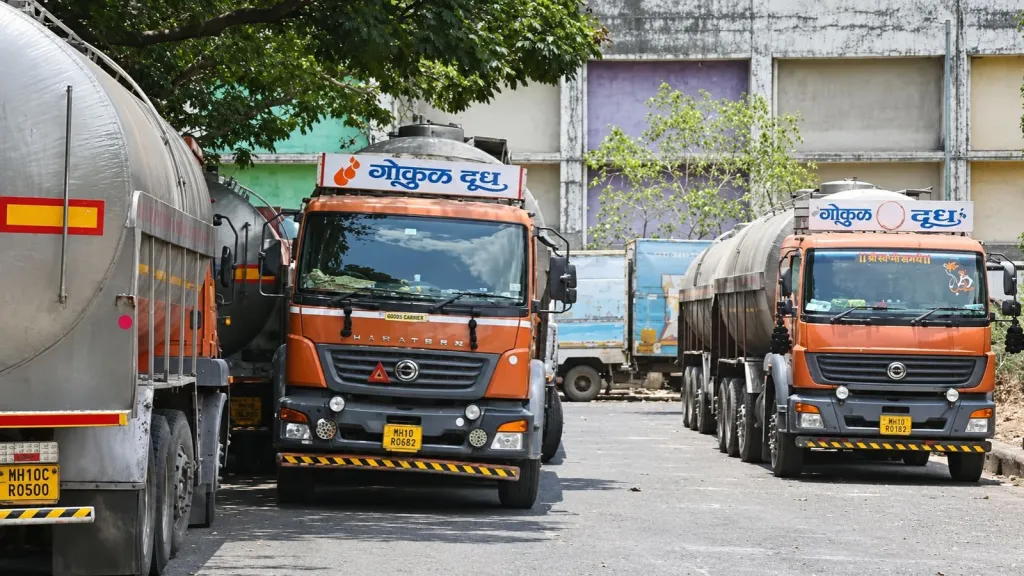
The political battle over Gokul, Maharashtra’s largest dairy cooperative, has entered a new phase. After Congress leader Satej Patil defeated a panel backed by the ruling Mahayuti alliance in the October 19 election, the state government has approved a proposal that could give it a fresh route to influence the cooperative’s board.
With an annual turnover of nearly Rs 4,000 crore and a network connecting hundreds of thousands of milk producers, the Kolhapur District Cooperative Milk Producers’ Union, popularly known as Gokul, is much more than a dairy business. It is a powerful economic and political institution in western Maharashtra, where cooperative organisations have long played an important role in rural influence and local politics.
Patil’s victory came despite the involvement of two Cabinet ministers, two MPs and 10 MLAs from the ruling alliance. His panel, the Rajarshi Shahu Shetkari Samvichari Aghadi, won 13 of the cooperative’s 25 seats, while the Mahayuti-backed panel secured 12.
However, the electoral victory has not translated into an uncontested change of leadership. The 12 directors backed by the ruling alliance have boycotted the board meeting to elect the chairman, preventing the 13-member panel led by Patil from meeting the required quorum of 14.
On Wednesday, the state Cabinet approved a proposal allowing the government to appoint five directors to the boards of apex cooperative institutions such as Gokul. Four of these nominees will have voting rights, potentially changing the balance of power within the cooperative despite the Mahayuti’s defeat at the ballot box.
The development has intensified the confrontation between the ruling alliance and Patil, who has announced that he will challenge the decision in the Bombay High Court, accusing the government of undermining the mandate given by milk producers.
Why Gokul matters in Maharashtra politics
Established on March 16, 1963, the Kolhapur District Cooperative Milk Producers’ Union is one of Maharashtra’s largest dairy cooperatives. It is popularly known as Gokul after its best-known milk brand and has developed into a major institution connecting rural producers with the dairy market.
Its financial scale is significant. Gokul recorded an annual turnover of nearly Rs 4,000 crore in 2024-25, but its influence cannot be measured through revenue alone. The cooperative is connected to nearly 4.41 lakh milk producers through 8,009 village-level primary societies spread across an estimated 1,810 villages.
This extensive network gives Gokul a presence across rural households in Kolhapur and neighbouring regions. Its operations connect farmers, village-level societies, milk collection networks and consumers, making the cooperative an important part of the region’s rural economy.
Political commentator Vasant Bhosle has highlighted the importance of Gokul’s relationship with marginal farmers and rural households. Milk payments are directly deposited into the bank accounts of women producers, giving them an important source of income within their families.
This financial connection helps explain why control over the dairy carries political significance. Its network reaches villages and households where cooperative institutions can influence local relationships, economic interests and political loyalties.
For political parties seeking to strengthen their position in western Maharashtra, control over an institution with such a large producer base offers an important organisational advantage. Gokul is therefore not simply a cooperative whose leadership changes through an internal election; it is also a major centre of influence in the region.
Why the BJP wants control of Gokul
For nearly three decades, Gokul was controlled by a panel associated with former MLA Mahadevrao Mahadik and the late Congress MLA P N Patil. That political arrangement changed in May 2021, when a panel led by Satej Patil, Hasan Mushrif of the undivided Nationalist Congress Party and Shiv Sena MP Sanjay Mandlik defeated the established leadership and took control of the cooperative.
However, Maharashtra’s political equations changed significantly after splits within the Shiv Sena and the NCP. Hasan Mushrif joined the BJP-led Mahayuti alliance but initially continued working with Satej Patil in the cooperative sector. The arrangement eventually broke down, placing the former allies in opposing camps.
For the BJP, winning control of Gokul is part of a broader effort to expand its political influence in western Maharashtra. Congress and NCP leaders have traditionally maintained strong positions in the region through cooperative institutions, including milk unions, sugar factories and other rural organisations.
These institutions provide more than economic influence. Their networks connect political leaders with village-level organisations and local communities, making them important centres of regional power. Gaining influence over Gokul would therefore represent a significant political gain for the ruling alliance.
In June, The Indian Express reported that Chief Minister Devendra Fadnavis had intervened to bring the Mahayuti constituents together ahead of the Gokul election. The ruling alliance subsequently fielded a common panel backed by ministers, legislators and MPs, with Medical Education Minister Hasan Mushrif leading the campaign.
The alliance appeared confident of securing control. Its panel, however, lost the election to Patil’s group. Among those defeated were Mushrif’s son Navid and incumbent chairman Shoumika Mahadik, the wife of BJP leader Dhananjay Mahadik.
The result was a setback for the ruling alliance, particularly because it had brought together several influential political figures to contest the cooperative election. It also strengthened Patil’s position in Kolhapur, where he has built a political base through local elections and cooperative institutions.
A former minister and Congress MLC, Patil has frequently challenged the Mahadik family, one of the region’s prominent political and business families. His victory at Gokul further reinforced his influence in the district.
The result also offered the Congress a significant political gain in Kolhapur, where the party failed to win a single Assembly seat in the 2024 elections.
How the chairman’s election became a political standoff
Although Patil’s panel won a majority of the elected seats, the election of Gokul’s chairman became the next point of confrontation.
The first major dispute emerged on October 29, when the newly elected board met to elect its chairman. All 12 directors backed by the Mahayuti stayed away from the meeting. Under Gokul’s bylaws, at least 14 directors must be present for a quorum.
With only Patil’s 13 directors attending, the meeting could not proceed with the chairman’s election. The presiding officer consequently adjourned the meeting.
The 13 directors subsequently held a separate meeting and declared Shashikant Patil Chuyekar elected as chairman. However, the dairy administration did not recognise the decision, leaving the leadership question unresolved.
Patil’s panel then approached the Bombay High Court’s Kolhapur Circuit Bench. On November 2, the court directed that a fresh meeting be convened on November 10, with notices issued to all 25 directors.
The Mahayuti has defended its decision to boycott the meeting, arguing that the quorum requirement is part of Gokul’s existing bylaws and was not introduced after the election. Its leaders maintain that the 12 directors elected on the ruling alliance-backed panel also represent the milk producers’ mandate.
In a joint letter to the media on November 3, leaders from the BJP, Shiv Sena, NCP and Jansurajya Party said Patil should not interpret his narrow victory as an endorsement of his wider political position.
They argued that milk producers had elected all 25 directors, including the 12 backed by the Mahayuti, and that these members could not be expected to attend a meeting simply to facilitate the election of a chairman from the opposing panel.
The boycott has therefore created a situation in which the panel with the largest number of elected directors cannot complete the leadership transition without the participation of its opponents.
The government’s legislative route to influence the board
The Maharashtra Cabinet’s latest decision has added another dimension to the dispute. Instead of relying only on the elected directors, the government could gain representation on the board through changes to the Maharashtra Cooperative Societies Act.
The proposal follows a letter written by senior BJP minister Chandrakant Patil to Chief Minister Devendra Fadnavis on October 16, two days before the Gokul election.
In his letter, Chandrakant Patil proposed increasing the number of government-appointed directors from two to four in cooperative institutions with an annual turnover exceeding Rs 3,000 crore. He also proposed increasing the number of institution-nominated directors from two to four, which would require amendments to the existing cooperative law.
Gokul, with its annual turnover of nearly Rs 4,000 crore, would fall within the category of institutions covered by the proposal.
The Cabinet has now approved a provision allowing the government to appoint four expert directors and one officer of the rank of Deputy Registrar to the boards of apex cooperative institutions such as Gokul.
The four expert directors would have voting rights, while the Deputy Registrar-level officer would also be appointed to the board. However, the expert directors would not be eligible to contest the election for chairperson. The provision would not apply to district cooperative banks.
The proposed arrangement could give the ruling alliance an additional presence in the cooperative’s decision-making structure. Although the four expert directors would not be able to become chairman, their voting rights could influence important board decisions and the balance among directors.
For the Opposition, the timing of the proposal is central to the controversy. The letter seeking changes was written before the election, but the Cabinet approved the proposal after the Mahayuti-backed panel lost. This has fuelled allegations that the government is seeking to alter the board’s composition after failing to secure control through the electoral process.
Why Patil is challenging the Cabinet decision
Satej Patil has strongly criticised the government’s move, describing it as unfortunate and arguing that it disregards the decision made by milk producers in the cooperative election.
He has announced that he will challenge the Cabinet decision in the Bombay High Court. His objection centres on the possibility that government-appointed directors could change the balance of power on a board whose elected composition was decided by the cooperative’s members.
Reacting to the decision on Wednesday, Patil said: “If the government’s policy is to disregard the people’s mandate and take decisions according to its own wishes, then there is no point in holding elections. It would be better to cancel all elections, appoint government nominees and let them run sugar factories, spinning mills and municipal corporations.”
His criticism reflects the larger political argument surrounding the dispute: whether the government should be able to increase its influence over a cooperative institution after its preferred panel has failed to win an election.
The Cabinet’s approval does not, by itself, settle the chairman’s election or resolve the dispute over the existing board. The proposal is directed at changing the representation structure of apex cooperative institutions, while the immediate leadership confrontation at Gokul remains unresolved.
What happens next at Gokul?
The next important development is the board meeting scheduled for November 10, following the Bombay High Court’s direction. Notices are to be issued to all 25 elected directors, giving both panels another opportunity to participate in the chairman’s election.
The outcome will depend on whether the 12 Mahayuti-backed directors attend and allow the board to meet its quorum requirement. If they continue to stay away, the leadership dispute could remain unresolved despite Patil’s panel having won the largest number of seats.
At the same time, Patil’s proposed legal challenge could bring the Cabinet-approved changes under judicial scrutiny. The scope of the government’s authority to appoint directors and the implications for cooperative institutions such as Gokul may become central questions in the dispute.
For the BJP and its allies, the objective of gaining influence over Gokul remains important because of the cooperative’s economic reach and political connections across western Maharashtra. For Patil, protecting the result of the October election is equally significant, as the victory strengthened his position in Kolhapur and gave the Congress a rare political advantage in the district.
Ultimately, the Gokul dispute highlights the continuing importance of cooperative institutions in Maharashtra Politics. With nearly 4.41 lakh milk producers connected to the dairy, the contest is not merely about who occupies the chairman’s position. It is also about who exercises influence over one of the region’s most important rural economic networks.
For breaking news and live news updates, like us on Facebook or follow us on Twitter and Instagram. Read more on Latest India on thefoxdaily.com.






COMMENTS 0