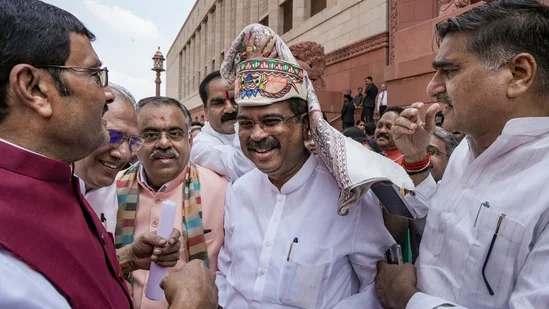
The political fallout from the NEET-UG 2026 controversy continues to dominate national discourse, with a new confrontation unfolding inside Parliament. Days after former Union Education Minister Dharmendra Pradhan resigned amid mounting pressure over alleged examination irregularities, Congress leaders strongly objected to his public felicitation in Parliament, arguing that the gesture sent the wrong message at a time when students and families were demanding accountability.
The controversy has expanded beyond the examination itself to include questions about political responsibility, institutional accountability, and public perception. While the government has defended its handling of the crisis through investigations and policy reforms, the opposition maintains that symbolic celebrations undermine the seriousness of the issues faced by millions of students.
Why the Parliament Felicitation Became Controversial
The latest political dispute emerged after Dharmendra Pradhan was welcomed by members of the ruling alliance during the Monsoon Session of Parliament following his resignation. Opposition leaders argued that honoring a minister immediately after he stepped down over a major public controversy appeared inconsistent with the demands for accountability raised throughout the NEET crisis.
Congress leaders claimed that the focus should remain on restoring confidence in India’s examination system rather than celebrating political figures connected to the controversy.
The episode quickly became one of the most discussed moments of the parliamentary session, reflecting how the NEET issue continues to influence political debate even after the minister’s resignation.
Background: Why Dharmendra Pradhan Resigned
Dharmendra Pradhan resigned as Union Education Minister following weeks of nationwide protests, political criticism, and public concern surrounding the NEET-UG 2026 examination.
The controversy began after allegations of examination irregularities prompted the government to order an investigation, cancel the original examination, and conduct a fresh test. The resignation came shortly after the revised results were declared and amid growing demands for ministerial accountability.
In his resignation letter, Pradhan stated that his decision was guided by the interests of students and the nation, emphasizing that educational reforms and student welfare should take priority over political considerations.
Timeline of Key Developments
| Date / Stage | Major Development |
|---|---|
| May 2026 | NEET-UG examination conducted across India. |
| Following weeks | Allegations of examination irregularities emerge. |
| Government response | Investigation ordered and examination cancelled. |
| June 2026 | Fresh examination successfully conducted. |
| July 2026 | Results announced after re-examination. |
| Later | Dharmendra Pradhan resigns as Education Minister. |
| Monsoon Session | Political controversy erupts over his felicitation in Parliament. |
Congress Raises Questions on Accountability
During the Lok Sabha debate, Congress leaders argued that the government’s public appreciation of the former minister conflicted with the concerns expressed by students and parents throughout the examination controversy.
The opposition maintained that the primary focus should remain on addressing examination security, ensuring justice for affected students, and strengthening institutional accountability rather than celebrating political leadership.
Congress also questioned whether existing legal and administrative measures were sufficient to prevent future examination irregularities, asserting that repeated controversies indicate a need for broader structural reforms.
The Debate Over Examination Security
The discussion inside Parliament once again highlighted broader concerns surrounding India’s competitive examination ecosystem.
Every year, millions of candidates compete in national entrance examinations that determine admissions to prestigious institutions. Because these examinations influence academic and professional futures, even isolated allegations of malpractice can significantly affect public confidence.
Education experts have consistently emphasized that protecting examination integrity requires strong coordination between examination authorities, law enforcement agencies, technology providers, and state administrations.
Government’s Reform Initiatives
Following the controversy, the government announced several corrective measures aimed at strengthening the examination process. These include enhanced investigations into alleged irregularities and a transition toward Computer-Based Testing (CBT) for future NEET examinations.
The proposed reforms are intended to improve examination security, reduce logistical vulnerabilities associated with paper-based testing, and increase transparency throughout the assessment process.
Whether these measures will fully address concerns remains a subject of political and public debate.
Opposition’s Concerns
Opposition leaders argue that legislative reforms alone may not be sufficient unless accompanied by effective implementation, institutional oversight, and swift action against organized examination malpractice.
Their criticism reflects a broader demand for stronger accountability mechanisms that extend beyond policy announcements.
- Greater transparency in investigations.
- Stronger enforcement against examination fraud.
- Faster judicial processes.
- Improved monitoring of examination centers.
- Better communication with students and parents during crises.
Comparison: Government’s Position vs Opposition’s Arguments
| Issue | Government Position | Opposition View |
|---|---|---|
| Minister’s resignation | Demonstrates responsibility and commitment to students. | Should not be followed by public celebration. |
| Investigation | Inquiry initiated and examination reconducted. | Questions remain regarding prevention and accountability. |
| Education reforms | Structural reforms including CBT announced. | Implementation will determine effectiveness. |
| Future examinations | Security measures being strengthened. | Greater transparency is still required. |
Why Public Perception Matters
One of the overlooked aspects of the controversy is the role of public perception in governance. In highly sensitive issues involving students, government actions are evaluated not only by policy outcomes but also by symbolism.
Public gestures, parliamentary proceedings, and political messaging can significantly influence how citizens interpret accountability. Even when reforms are announced, perceptions of fairness and responsibility remain central to rebuilding trust.
This explains why the felicitation became a political issue despite the minister no longer holding office.
What This Means for Students
For students preparing for future competitive examinations, the political debate is secondary to one fundamental expectation: a transparent and reliable examination process.
Students are likely to judge future reforms based on measurable improvements, including secure examinations, timely investigations, fair evaluation, and predictable admission schedules.
The controversy has reinforced the importance of institutional credibility, as confidence in national entrance examinations directly affects millions of aspirants each year.
A Broader Lesson for Education Governance
The events surrounding the NEET-UG controversy illustrate that education policy extends beyond curriculum and admissions. Effective governance also requires crisis management, transparent communication, technological modernization, and visible accountability.
Countries with trusted examination systems typically combine advanced security measures with independent oversight and rapid corrective action whenever irregularities arise. India’s ongoing reforms may increasingly move in this direction as policymakers seek to strengthen public confidence.
Future Outlook
The political debate surrounding Dharmendra Pradhan’s resignation and subsequent felicitation is unlikely to conclude quickly. Parliament is expected to continue discussing examination reforms, legal safeguards, and mechanisms to prevent future irregularities.
Attention will also remain focused on the implementation of announced reforms, including the transition toward Computer-Based Testing and other measures designed to strengthen examination security.
Ultimately, lasting public confidence will depend less on political exchanges and more on whether future examinations are conducted transparently, securely, and without controversy.
Conclusion
The criticism over Dharmendra Pradhan’s felicitation in Parliament reflects the continuing political and public sensitivity surrounding the NEET-UG 2026 controversy. While the government views its actions as part of normal parliamentary proceedings following a minister’s service, the opposition argues that accountability should remain the central focus after a crisis affecting millions of students.
Beyond the political rhetoric, the larger issue remains unchanged: ensuring that India’s examination system becomes more secure, transparent, and resilient. As reforms move forward, students, parents, educators, and policymakers will be watching closely to see whether lessons from this controversy lead to meaningful improvements that restore trust in one of the country’s most important competitive examinations.
For breaking news and live news updates, like us on Facebook or follow us on Twitter and Instagram. Read more on Latest India on thefoxdaily.com.






COMMENTS 0