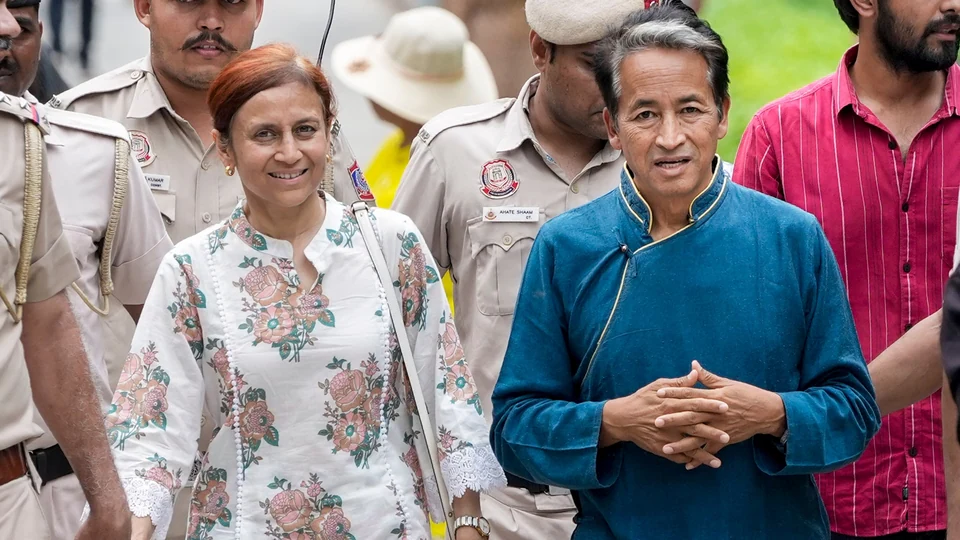
Climate activist Sonam Wangchuk and his wife, Gitanjali J Angmo, have criticised the Ladakh administration’s defence of its decision to cancel the land allotment to the Himalayan Institute of Alternative Learning (HIAL), accusing officials of delaying the execution of the institute’s lease and shifting responsibility onto the institution.
Wangchuk, the founding director of HIAL, shared an official letter dated February 19, 2021, which he said demonstrated that the administration itself had acknowledged delays in processing the lease deed. He argued that the document exposed the authorities’ own shortcomings in handling the matter.
The criticism followed the Ladakh administration’s filing of a 136-page affidavit before the High Court of Jammu and Kashmir and Ladakh. In its response to HIAL’s petition, the administration argued that the land allotment had lapsed under the law because the institute failed to pay the required land premium or execute the lease deed within the stipulated period.
The dispute centres on the cancellation of land allotted to HIAL in Leh and raises questions about the competing claims over administrative delays, compliance with lease conditions and the institute’s status as an educational institution.
Sonam Wangchuk Questions Ladakh Administration’s Role in Lease Delay
Wangchuk said he had repeatedly approached officials to complete the lease formalities for the land allotted to HIAL. According to the activist, he made five written appeals, visited government authorities 15 times and placed 30 phone calls in an effort to resolve the issue.
To support his position, he shared a letter dated February 19, 2021, in which the administration stated that the execution of the lease deed remained under process while officials awaited the finalisation of a new lease policy.
The letter said the delay affected institutions across the board, including several government institutions. It also indicated that HIAL could continue construction activities on the allotted land while the lease formalities remained pending.
Wangchuk said the correspondence contradicted the administration’s attempt to attribute the delay entirely to the institute.
“Whenever I raise my voice about injustices in Ladakh, the government media machinery gets activated to target me and our institute HIAL’s land lease. Please take the message, don’t kill the messenger,” Wangchuk said in a post on X.
Commenting on the letter, he said: “A quick look at this letter shows their own delays, if not incompetence.”
The activist’s argument is that the administration’s own written communication acknowledged that the delay was connected to the pending lease policy rather than being solely the result of HIAL’s actions. The letter is central to his response to the government’s defence, although the final legal significance of the correspondence remains a matter for the court.
Gitanjali Angmo Accuses Officials of Contradicting Their Own Records
Gitanjali J Angmo, HIAL’s co-founder and Wangchuk’s wife, also criticised the administration’s handling of the Land Dispute. She described it as “abysmal governance” and a “bureaucratic absurdity elevated to an art form”.
In a post on X, Angmo questioned why the administration was blaming the institute despite the existence of official correspondence documenting the delays.
“Perhaps they should first read their own letters before making a public spectacle of themselves…Four dates. Written correspondence. Official signatures and stamps. Their own admissions. And now they have the gall to make it appear that HIAL was responsible for the delay!” she wrote.
Angmo said HIAL had spent years working to establish an educational institution focused on the challenges facing the Himalayan region. She argued that administrative procedures and public accusations were obstructing rather than supporting that work.
“Instead of enabling such work, the administration appears determined to bury it beneath paperwork, contradictions and public accusations,” she said.
Her response echoed Wangchuk’s central contention that the administration’s correspondence should be considered when assessing responsibility for the delay in executing the lease deed.
Why Did the Ladakh Administration Cancel HIAL’s Land Allotment?
In its affidavit before the High Court of Jammu and Kashmir and Ladakh, the administration argued that the land allotment had legally lapsed because HIAL did not fulfil the conditions attached to the original order.
The affidavit stated that a 40-year lease had been allotted for 1,076 kanals and one marla of land at Phyang Thang in Leh. The original allotment order was issued on May 5, 2018, and required the institute to execute the lease deed within one year.
According to the administration, the allotment “lapsed by operation of law” on May 5, 2019, because HIAL did not execute the lease deed or pay the mandatory land premium within the stipulated period.
The government also said the institute had not paid land premium or ground rent and had failed to obtain formal possession of the property through the Tehsildar, as required under the applicable process.
The affidavit described HIAL’s writ petition as “misconceived, devoid of merit, and barred by delay and laches”. The administration maintained that the original allotment was conditional and that failure to comply with the lease requirements justified the cancellation.
The cancellation order challenged by HIAL was issued on August 21, 2025. The institute subsequently approached the high court to contest the decision.
What the 2021 Letter Says About the Lease Dispute
The February 19, 2021, letter shared by Wangchuk is a key part of his response to the administration’s claims. It stated that the execution of the lease deed was under process because officials were waiting for a new lease policy to be finalised following the formation of the Union Territory of Ladakh and the COVID-19 pandemic.
The letter also said the delay was affecting institutions across the board, including several government institutions, while allowing HIAL to continue construction on the allotted land.
Wangchuk has relied on this communication to argue that administrative delays contributed to the failure to complete the lease formalities. The administration, by contrast, has emphasised the original allotment conditions and the institute’s failure to pay the required charges or execute the deed within the stipulated one-year period.
The two positions reflect the central disagreement in the case: whether the administration’s handling of the lease process materially affected HIAL’s ability to complete the required formalities, and whether the original conditions nevertheless meant the allotment had lapsed.
The letter provides evidence of what the administration communicated in 2021, but its effect on the legal dispute will depend on how the court assesses the relevant records, conditions and timeline.
Administration Questions HIAL’s Recognition and University Status
The Ladakh administration also raised questions about HIAL’s status as an educational institution. The affidavit cited an October 2026 certification from the region’s higher Education department stating that HIAL was not a recognised university and that its courses were not affiliated with the University of Ladakh or another statutory body.
The administration argued that this situation conflicted with the main objective behind establishing an alternative university and included the point in its defence of the cancellation.
The issue introduces a separate dimension to the dispute beyond the execution of the land lease. While Wangchuk and Angmo have focused on the administration’s handling of the paperwork and the institute’s educational mission, the authorities have also questioned whether HIAL meets the recognition and affiliation requirements relevant to its stated objectives.
The affidavit records the administration’s position on the institute’s status. It does not, by itself, establish the outcome of the legal challenge or resolve the wider disagreement between HIAL and the authorities.
Administration Refers to September 2025 Protests in Its Affidavit
The administration’s affidavit also referred to the violent protests in Leh in September 2025. It cited the unrest, the Union Home Ministry’s intervention and Wangchuk’s brief detention under the National Security Act as part of what it described as a pattern of public order disruptions.
Wangchuk’s detention order was revoked in March 2026, according to the supplied report. The administration nevertheless included the events in its broader account of the circumstances surrounding the dispute.
The reference to the protests adds a political and public-order dimension to the legal proceedings over the land allotment. However, the lease dispute also involves specific administrative records, financial requirements and conditions attached to the original allotment order.
The administration’s account of the protests should therefore be distinguished from the separate questions about the lease deed, land premium and the correspondence exchanged between HIAL and officials.
What Happens Next in the HIAL Land Lease Case?
HIAL’s writ petition challenges the August 21, 2025, cancellation order, while the administration has asked the high court to reject the petition on the grounds outlined in its affidavit.
The competing arguments centre on the original allotment conditions, the requirement to execute the lease deed within one year, the payment of land premium and ground rent, and the administration’s subsequent communication about delays linked to the pending lease policy.
Wangchuk and Angmo contend that the official correspondence undermines the administration’s attempt to place responsibility on the institute. The authorities maintain that the allotment lapsed because HIAL did not meet the stipulated requirements.
The supplied information does not establish a final court ruling on the dispute. The legal outcome will depend on the proceedings and the court’s assessment of the documents and arguments presented by both sides.
Conclusion
Sonam Wangchuk and Gitanjali Angmo have sharply criticised the Ladakh administration’s defence of its decision to cancel HIAL’s land allotment, pointing to a February 2021 letter that acknowledged delays in executing the lease deed while a new lease policy was pending.
The administration has argued before the High Court of Jammu and Kashmir and Ladakh that the allotment expired in May 2019 because HIAL failed to execute the lease deed and pay the required land premium within the stipulated period. It has also raised questions about the institute’s recognition and referred to public-order events in its affidavit.
The dispute now turns on competing interpretations of the lease conditions, official correspondence and the institute’s compliance with the original allotment. While Wangchuk and Angmo accuse the authorities of shifting responsibility for administrative delays, the final legal position remains subject to the court’s consideration of the case.
For breaking news and live news updates, like us on Facebook or follow us on Twitter and Instagram. Read more on Latest India on thefoxdaily.com.






COMMENTS 0