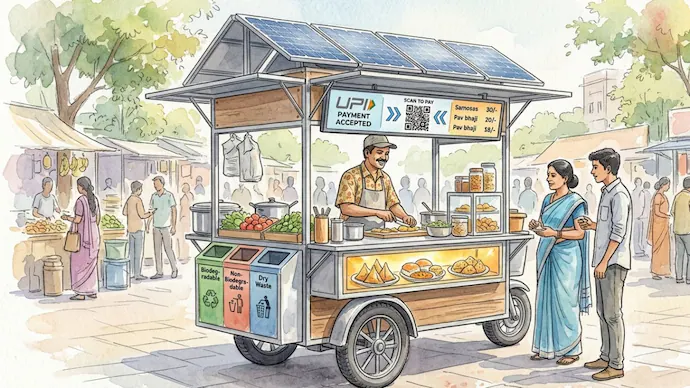
IIT Kharagpur has developed a solar-powered food vending cart designed to help street vendors improve their businesses through clean energy, digital payments and a mobile setup. The three-wheeler cart combines product display facilities with waste segregation and cashless transactions, offering vendors a way to serve customers at different locations without occupying public spaces permanently.
The Innovation was unveiled on Friday during the launch of ‘Nagar Udyam – From Street Vendor to Smart Entrepreneur’ on the institute’s campus. The initiative aims to demonstrate how Technology can improve the working conditions and business opportunities of street vendors while supporting more organised and sustainable urban livelihoods.
Conceived by IIT Kharagpur Director Suman Chakraborty, the project reflects the institute’s focus on translating technological research into practical solutions for social and economic development. It is also part of the institute’s plans to mark its platinum jubilee.
Beyond introducing a redesigned vending cart, the initiative seeks to help vendors operate more flexibly, maintain better business records and use digital tools to manage transactions. The project will be tested through IIT Kharagpur’s SETU Cloud Kitchen Connect platform.
How IIT Kharagpur’s Solar-Powered Vending Cart Works
The new food vending cart is mounted on a three-wheeler, allowing vendors to move their businesses between locations according to customer demand. Unlike a fixed stall, the mobile design can help vendors serve different customer groups throughout the day and take the cart home after business hours.
This flexibility could be particularly useful for vendors whose customers change depending on the time of day, such as those serving people near workplaces, educational institutions or other busy public areas. The cart’s mobility offers a way to adapt to demand rather than relying on a single location.
The design incorporates several features intended to improve day-to-day operations:
- Solar power: Clean energy is integrated into the vending setup, potentially reducing reliance on conventional electricity sources for compatible equipment.
- Digital payments: Cashless transaction facilities allow customers to pay digitally, making the cart suitable for businesses adopting electronic payment methods.
- Product display: A bright display helps make the products more visible to potential customers.
- Three-way waste segregation: A waste management system separates waste into three categories to support more organised disposal.
- Mobile design: The three-wheeler structure allows vendors to move between locations and take the cart home after work.
Together, these features are intended to address practical challenges associated with running a small street vending business. Mobility can provide greater flexibility over where and when to sell, while digital transactions and improved waste handling can support more organised operations.
Solar Energy Could Help Make Street Vending More Sustainable
One of the key features of the IIT Kharagpur project is its use of solar power. Street vendors often operate in locations where access to convenient electricity may be limited or difficult to arrange. Integrating solar energy into a mobile cart offers a potential alternative for powering compatible equipment.
The practical benefits will depend on the cart’s energy requirements, solar generation capacity and the equipment connected to the system. The available project details do not specify the solar panel capacity, battery storage, operating costs or the amount of electricity the cart can generate.
Nevertheless, the approach highlights how renewable energy can be incorporated into small businesses rather than being limited to large buildings or industrial installations.
For vendors, the value of such a system will ultimately depend on whether it can support reliable daily operations and reduce the overall cost of running the business. Testing the cart in real-world conditions will help establish how effectively its energy system meets those needs.
Digital Payments and Better Business Records for Vendors
The vending cart’s digital payment facilities form part of a broader effort to help street vendors adopt technology in their daily business activities. Cashless payments can give customers another way to complete purchases while helping vendors maintain more organised transaction records when the systems are integrated appropriately.
The project will be connected for testing with IIT Kharagpur’s SETU Cloud Kitchen Connect platform, which aims to provide vendors with digital identification, QR-based access, cashless payment facilities, training and improved business records.
Digital identification could help participating vendors establish a more structured presence within the platform, while QR-based access and payment facilities could simplify selected business processes. Training and better records may also support vendors as they manage transactions and organise their operations.
However, the initiative’s effectiveness will depend on how the platform is implemented, how easily vendors can use its tools and whether the systems remain accessible during everyday business operations. The project is still due to undergo testing, so its impact on vendors’ income and business efficiency has not yet been established.
SETU Cloud Kitchen Connect to Support the Pilot Project
The integration with SETU Cloud Kitchen Connect is an important part of the initiative because it links the physical vending cart with digital business services.
A mobile cart can help a vendor reach different locations, but mobility alone does not address every challenge associated with operating a small business. Vendors may also need reliable transaction systems, training and ways to maintain records as their businesses develop.
The SETU platform is intended to provide some of these supporting facilities. By combining the cart with digital identification, QR-based access, cashless payments and training, the project aims to explore a more comprehensive approach to street vending.
The pilot phase will be important in determining how these components work together. It can help establish whether vendors find the system practical, whether the technology is easy to operate and what adjustments may be required before wider adoption is considered.
IIT Kharagpur Director Explains the Vision Behind Nagar Udyam
IIT Kharagpur Director Suman Chakraborty conceived the project as part of the institute’s efforts to mark its platinum jubilee. The initiative reflects an approach in which engineering and digital technology are applied to everyday economic challenges.
Chakraborty said the goal was not simply to redesign a street cart but to create better economic opportunities for the people who depend on street vending for their livelihoods.
He emphasised the potential of a business model that allows vendors to move with demand, return home at night and use clean energy and digital finance.
“That is the kind of technology translation IIT Kharagpur stands for,” he said.
The project’s emphasis on practical use is significant because technology designed for small businesses must address the conditions in which people actually work. Equipment that is difficult to operate, expensive to maintain or poorly suited to daily routines may offer limited benefits even if its technical features are innovative.
By combining mobility, energy, payments and waste management in a single setup, IIT Kharagpur is attempting to bring several business needs together in one solution.
How the Mobile Cart Could Change Street Vendors’ Working Conditions
Street vending provides livelihoods for many people, but operating a small business in public spaces can involve practical difficulties. Vendors may need to transport their equipment, identify suitable selling locations, manage payments and handle waste while serving customers throughout the day.
The mobile design of the new cart could offer greater flexibility by allowing vendors to move their businesses instead of remaining tied to a single spot. Being able to take the cart home after work may also reduce the need to leave vending equipment occupying public space overnight.
Its potential benefits will depend on local conditions, including access to suitable vending locations, transport arrangements, safety, maintenance and applicable municipal rules. Mobility alone does not remove the regulatory requirements that govern street vending, and the project details do not establish that the cart provides automatic permission to operate in any location.
The combination of digital payments and business records could also help vendors organise their daily transactions. If the system proves easy to use, it may provide a foundation for more structured business management.
Still, improved earnings, lower operating expenses and long-term business growth remain outcomes to be tested rather than established results. The pilot’s findings will help determine how much practical value the cart delivers to the people it is designed to serve.
Waste Segregation Adds an Environmental Component
The cart’s three-way waste segregation system introduces another element to the project by making waste handling part of the vending setup.
Food vending can generate different types of waste, including food scraps, packaging and other disposable materials. Separating waste at the point where it is generated can make subsequent handling more organised, although the overall environmental benefit depends on how the separated waste is collected and processed.
The project’s waste segregation feature is intended to incorporate waste management into the vendor’s daily routine rather than treating it as an entirely separate task.
The available details do not specify the categories used by the three-way system or the arrangements for collection and disposal. Those details will matter in assessing how effectively the feature supports responsible waste management in practice.
What Happens Next for IIT Kharagpur’s Solar-Powered Cart?
The next stage is testing the vending cart through the SETU Cloud Kitchen Connect platform. This phase will provide an opportunity to assess how the mobile equipment, solar power, digital payments and supporting services perform under actual operating conditions.
Important questions include whether the cart can meet vendors’ daily energy needs, how easily it can be moved between locations, whether digital payments and record-keeping tools are convenient to use, and how the waste segregation system works during busy periods.
The experience of participating vendors will also be important. Their feedback can help identify practical problems that may not be apparent during the design stage, including maintenance requirements, training needs and the suitability of the cart for different types of vending businesses.
The project’s long-term significance will depend on whether it can offer a practical and financially viable solution for vendors rather than simply introducing new technology. If the pilot demonstrates clear benefits, the approach could provide a model for combining mobile vending infrastructure with digital business services and renewable energy.
Can IIT Kharagpur’s Initiative Turn Street Vendors Into Smart Entrepreneurs?
The Nagar Udyam initiative aims to move beyond the traditional idea of a street cart by bringing several business tools into one mobile platform. Solar power, cashless transactions, product display facilities, waste segregation and digital support are intended to help vendors manage their operations more flexibly.
The concept also reflects a broader question about technology and livelihoods: how can innovation help people who already run small businesses improve the way they work without creating unnecessary complexity or costs?
For IIT Kharagpur’s project, the answer will depend on practical results. The cart must be reliable, affordable to operate and suitable for the needs of vendors. Its digital features must be accessible, and its mobility must translate into useful business flexibility.
The testing phase will help determine whether the design meets these requirements. For now, the solar-powered vending cart represents an effort to connect engineering innovation with the everyday realities of street commerce, with the goal of helping vendors operate more efficiently and build stronger businesses.
For breaking news and live news updates, like us on Facebook or follow us on Twitter and Instagram. Read more on Latest Careers on thefoxdaily.com.






COMMENTS 0