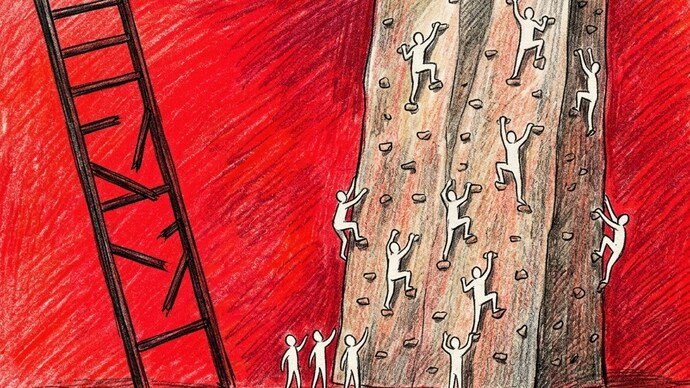
Artificial Intelligence (AI) is changing how employees build careers, gain experience and secure promotions. As companies automate routine tasks and place greater emphasis on specialised skills, the traditional corporate career ladder is giving way to more flexible and less predictable career paths.
For decades, professional growth followed a familiar pattern. Employees joined organisations in junior positions, gained experience, moved into senior roles and gradually progressed into management. Promotions and salary increases were often viewed as natural rewards for years of service and professional experience.
AI could be changing that model. Employees may increasingly need to move between departments, take on unfamiliar responsibilities, learn new technologies or develop specialised skills to advance professionally.
On November 2, Microsoft’s chief economic opportunity officer Aneesh Raman described this emerging workplace model as a “climbing wall”, where employees chart their own career paths based on their skills, interests and available opportunities, Fortune reported.
While the idea offers greater flexibility, it also raises an important question: are employees getting more opportunities to grow, or are they being left to navigate increasingly uncertain career paths on their own?
The Traditional Corporate Career Ladder Is Losing Its Rungs
The conventional idea that employees must spend several years in one position before moving into a higher role is gradually being challenged. As AI changes job responsibilities, employers are increasingly focusing on what workers can do rather than relying solely on their job titles or length of service.
Career progression may no longer depend exclusively on promotions. Moving into another department, leading a new project, developing AI expertise or taking up a specialised position could become alternative routes to professional advancement.
India’s changing Employment landscape reflects this shift. A recent report on the country’s AI skills gap highlighted growing employer demand for specialised AI capabilities, even as hiring demand weakened in some occupations exposed to AI-driven changes.
This creates a significant challenge for workers: professional experience alone may no longer guarantee the same opportunities for advancement. Employees may need to demonstrate that their skills remain relevant as organisations restructure their operations.
When AI Takes Away the First Steps of a Career
The traditional career ladder offered more than a route to promotions. It also provided employees with opportunities to learn through routine responsibilities before moving into more complex roles.
Entry-level professionals traditionally developed workplace experience through research, documentation, basic coding, administrative assignments and other routine tasks. These responsibilities helped young employees understand organisational processes and build the foundations needed for senior positions.
AI is changing this learning process by automating some of the tasks that once formed an important part of early professional experience.
India’s entry-level job market is already showing signs of pressure. A recent analysis of the country’s fresher job market found that postings for junior and entry-level positions declined by 11% in the second quarter of 2026, compared with a 5% fall in overall job postings.
The concern goes beyond the availability of fewer entry-level jobs. If routine assignments increasingly become automated, young professionals could find it harder to gain the practical experience needed to qualify for more senior responsibilities.
This creates a potential gap in the career development process. Organisations may expect employees to arrive with specialised skills and practical experience while reducing some of the opportunities through which those capabilities were traditionally developed.
Skills, Not Just Years of Experience, Could Define Career Growth
As AI transforms workplace responsibilities, continuous learning is becoming increasingly important. Employees may find that expertise in a single role is no longer sufficient when the tasks and skills associated with that position continue to evolve.
This challenge is particularly relevant in India, where access to specialised training and workplace learning opportunities remains uneven.
Findings on India’s AI skills gap from the International Monetary Fund point to an emerging divide between workers who can access specialised AI-related opportunities and those whose existing skills are becoming less aligned with employer demand.
For employees, adapting to this environment could involve developing expertise across different functions, learning to use AI tools effectively and demonstrating problem-solving abilities beyond their immediate job descriptions.
Professional growth may increasingly depend on the ability to apply existing knowledge in new situations. Employees who can combine technical capabilities with communication, critical thinking and practical decision-making may find more ways to contribute as job responsibilities change.
Who Gets an Opportunity to Climb?
The climbing-wall model suggests that employees can take several routes towards professional growth rather than following a fixed sequence of promotions. However, not everyone begins with the same access to opportunities.
Workers with access to training, supportive managers, mentorship and challenging assignments may find it easier to explore different career paths. Others could struggle to identify opportunities, particularly in organisations where promotion criteria and internal mobility policies are unclear.
This raises questions about fairness in the evolving workplace. If employees are expected to take greater responsibility for their career development, they also need access to the resources and guidance required to make progress.
Employers will therefore have an important role in ensuring that flexibility does not become an excuse for leaving career progression entirely to individual workers.
Why Companies Need Clear Career Development Policies
As organisations adopt AI and restructure teams, they will need to rethink how employees gain experience and move into new positions. Simply encouraging workers to develop new skills may not be enough if companies do not provide practical opportunities to apply them.
Transparent promotion policies, structured training programmes, mentorship and clear internal mobility systems could help employees understand how to progress within an organisation.
Companies will also need to consider how AI adoption affects early-career development. Entry-level responsibilities may change, but organisations still need ways to help junior employees build the knowledge and experience required for future leadership roles.
The traditional corporate career ladder is unlikely to disappear overnight. However, its familiar steps could become less relevant as AI changes how work is organised and how professional capabilities are valued.
The real challenge will be ensuring that the emerging career climbing wall creates opportunities for a wider range of employees. Without accessible training, transparent advancement policies and meaningful workplace experience, greater flexibility could benefit mainly those who already have the skills, networks and resources needed to navigate the changing world of work.
For breaking news and live news updates, like us on Facebook or follow us on Twitter and Instagram. Read more on Latest Careers on thefoxdaily.com.






COMMENTS 0