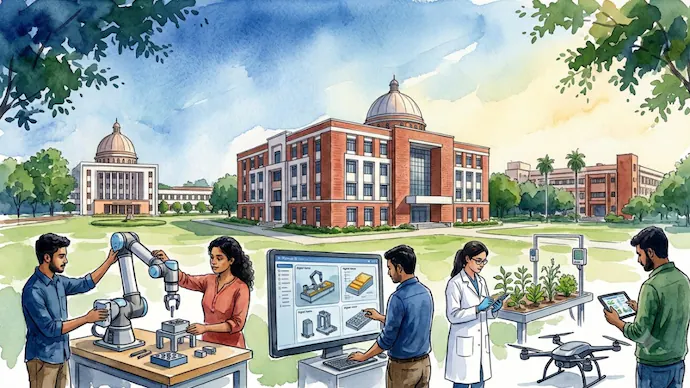
Artificial Intelligence is increasingly being used to write code, generate images, analyse information and answer questions. However, the next phase of AI development could extend beyond digital tools to systems that interact with the physical world, understand material behaviour and support complex scientific and engineering tasks.
The Indian Institute of Technology (IIT) Kharagpur is preparing to explore this frontier through a proposed ₹35-crore initiative to establish the Benjamin Gupta School of Physical AI. The dedicated academic school is intended to bring artificial intelligence together with physics, engineering, biological systems and scientific knowledge to develop applications for real-world environments.
The initiative was announced through a tripartite memorandum of understanding (MoU) involving IIT Kharagpur, its alumnus and philanthropist Vinod Gupta, and IITKGP Foundation USA. The proposed school will focus on research, interdisciplinary education and professional training to help researchers and industry practitioners apply AI to problems that require an understanding of physical systems.
The institute’s broader ambition is to develop AI systems that do more than identify patterns in datasets. By incorporating physical principles and domain-specific knowledge, the school aims to explore how AI can support more reliable applications in manufacturing, healthcare, energy, agriculture and other sectors.
What Is Physical AI and Why Is IIT Kharagpur Focusing on It?
Much of the public discussion around artificial intelligence has centred on chatbots, image generators and other software-based tools. Physical AI seeks to extend AI capabilities to systems operating in real-world environments, where physical laws, material properties, uncertainty and safety constraints can directly affect outcomes.
In manufacturing, for example, an AI system may need to account for how materials respond to temperature, pressure or mechanical forces. Understanding these factors can be important when designing systems that interact with machinery or operate under changing industrial conditions.
Healthcare presents a different set of challenges. AI-assisted medical systems need to be considered alongside biological processes and clinical knowledge. An algorithmic prediction alone may not provide sufficient context for a complex medical decision, making the integration of scientific understanding an important area of research.
IIT Kharagpur plans to investigate these challenges through research that combines AI techniques with established scientific and engineering disciplines. The proposed approach is intended to connect computational capabilities with the physical principles governing the systems in which they are applied.
Research Areas Planned for the Benjamin Gupta School of Physical AI
The proposed school is expected to focus on several research areas that connect artificial intelligence with scientific discovery, engineering systems and physical environments.
- Physics-informed machine learning: Integrating physical principles into machine-learning methods to help address problems governed by scientific laws.
- Scientific AI: Applying AI techniques to scientific research, analysis and experimentation.
- Digital twins: Developing digital representations of physical systems to support modelling, monitoring and analysis.
- Intelligent robotics: Exploring AI-enabled robotic systems that can operate in physical environments.
- Autonomous systems: Advancing systems designed to perform tasks with varying levels of independent operation.
- Advanced sensing: Investigating technologies that collect and interpret information about physical conditions.
- AI-enabled experimentation: Applying AI to support scientific experiments and research processes.
These areas reflect the institute’s intention to connect AI development with scientific knowledge and practical engineering requirements. Rather than treating AI as an isolated computational tool, the proposed school will seek to integrate it into research and applications where an understanding of the underlying physical system is important.
Physical AI Applications Across Manufacturing, Healthcare and Agriculture
The proposed school has identified several sectors in which combining artificial intelligence with physical and scientific knowledge could support new applications.
Advanced manufacturing: AI systems used in industrial settings must operate within the constraints of materials, machinery and production processes. Research combining physical modelling with machine learning could help explore applications involving industrial automation, process analysis and intelligent equipment.
Healthcare and medical devices: The integration of AI with biological and clinical knowledge could support research into medical technologies and AI-assisted systems. The emphasis is on combining algorithmic capabilities with the expertise needed to understand complex biological processes.
Energy: Physical AI research could address problems involving energy systems, equipment and the physical processes associated with energy production and use. The institute has identified energy as one of the areas in which it expects the school’s work to have potential applications.
Agriculture: Agricultural systems operate under changing environmental and physical conditions. Research connecting AI with scientific knowledge could support the development of technologies designed for agricultural applications.
Climate and environmental technologies: Understanding physical processes is important when studying environmental systems. The proposed school intends to include climate-related and environmental technologies among its application areas.
Intelligent infrastructure: Infrastructure systems involve interconnected physical components and changing operating conditions. AI research informed by engineering principles could help investigate applications involving monitoring, modelling and system management.
These are intended areas of research and application rather than a list of completed products. The practical impact will depend on how the institute develops its research programmes and translates them into technologies that can be tested and used in real-world settings.
How Will IIT Kharagpur Fund the ₹35 Crore Initiative?
The Benjamin Gupta School of Physical AI is planned with a total investment of ₹35 crore. According to the institute’s announcement, the funding will come from contributions by Vinod Gupta’s family, an anonymous alumnus and IIT Kharagpur itself.
- ₹12.5 crore: Contribution from the Vinod Gupta family.
- ₹10 crore: Contribution from an anonymous alumnus.
- Remaining ₹12.5 crore: Funding from IIT Kharagpur.
The investment is intended to support dedicated infrastructure for the Department of Artificial Intelligence and associated interdisciplinary academic and research activities.
The school will be named the Benjamin Gupta School of Physical AI in memory of Benjamin Gupta, the late son of Vinod Gupta. The naming connects the initiative with the family’s contribution to the institute’s planned research and educational infrastructure.
The funding structure brings together philanthropic contributions and institutional support. The proposed investment is intended to provide a foundation for research activities, academic programmes and collaboration across multiple disciplines.
Why the School Will Bring Together Engineering, Science and Medicine
IIT Kharagpur intends to draw on expertise across engineering, basic sciences, medicine and computing. The proposed school is expected to bring researchers, engineers, clinicians and industry practitioners together to investigate AI applications that require knowledge from more than one discipline.
This interdisciplinary approach is important because AI systems used in physical environments often encounter challenges that cannot be addressed through software expertise alone. A system designed for industrial equipment, for example, may require knowledge of materials, mechanical engineering, sensing and computational modelling.
Similarly, AI applications in healthcare need to be considered in the context of biology and clinical practice. Combining these perspectives could help researchers understand the limitations of algorithmic outputs and assess how AI tools should be used within specialised professional settings.
The institute has also identified safe, trustworthy and responsible AI as a priority. Reliability, explainability and accountability are particularly important in applications where incorrect outputs or system failures could have significant consequences.
The proposed school aims to encourage AI development that takes these requirements into account rather than treating an algorithm’s output as sufficient on its own.
AI Education Beyond Traditional Engineering Programmes
Research is only one part of the initiative. IIT Kharagpur also plans to use the school to expand how students and working professionals learn about AI and apply it within their respective fields.
Academic programmes are expected to begin in the upcoming academic session, subject to the necessary approvals. Proposed offerings include hybrid-mode Master’s programmes, executive education, professional certifications and specialised interdisciplinary learning modules.
The intended audience includes students, researchers, working professionals and graduates from engineering, physical sciences, life sciences and medicine. The programmes are designed to help participants combine their existing subject knowledge with contemporary AI capabilities.
The institute envisages the school as a finishing school for engineers, scientists and medical professionals. The objective is to develop skills that connect AI techniques with the practical and scientific knowledge required in different professions.
How Physical AI Training Could Help Professionals
The proposed educational approach reflects the idea that effective AI application requires more than familiarity with algorithms or software tools. Professionals also need to understand the systems in which those tools are used.
An engineer working with AI, for example, needs to consider how physical laws, material properties and system dynamics influence the behaviour of a solution. An AI model may identify patterns in data, but engineering knowledge remains important when evaluating whether its output makes sense in a real-world setting.
Medical professionals face a related challenge. When assessing AI-assisted diagnostic systems, they need to consider the output in the context of clinical knowledge and biological processes. Understanding the limitations of a model can be as important as knowing what it predicts.
Through hybrid learning, interdisciplinary projects, industry-linked problem-solving and laboratory exposure, the proposed school aims to prepare professionals to apply AI with a deeper understanding of their fields.
The planned programmes could also provide opportunities for people already working in technical and scientific roles to develop AI-related skills without focusing exclusively on conventional computer science training. Their actual scope and availability will depend on programme development and the required approvals.
Industry Partnerships and the Future of Physical AI Research
IIT Kharagpur plans to build collaborations with industry, healthcare institutions, research laboratories, startups and international partners. These partnerships are intended to connect academic research with problems encountered in practical settings.
Collaboration could allow researchers to investigate how AI methods perform when applied to real equipment, scientific experiments, healthcare-related technologies and other complex systems. Industry and institutional partnerships can also help identify practical requirements that may not be apparent through theoretical research alone.
The institute believes that combining AI capabilities with specialised domain knowledge could help address a skills gap between the rapid development of AI technologies and the expertise needed to deploy them reliably.
However, establishing a dedicated school does not automatically guarantee that research will translate into commercially successful or widely adopted technologies. Progress will depend on the quality of research, the development of educational programmes, collaboration with external partners and the ability to validate applications under real-world conditions.
IIT Kharagpur’s Vision for the Next Phase of Artificial Intelligence
Prof Suman Chakraborty, director of IIT Kharagpur, said the next major advance in AI would involve transforming how people understand, engineer and interact with the physical world.
He described the institute’s ambition as moving beyond the treatment of AI as a black-box solution. The approach would bring engineers, scientists and medical professionals together to combine algorithmic capabilities with a deeper understanding of their respective disciplines.
The proposed Benjamin Gupta School of Physical AI reflects this ambition by connecting AI research with engineering, scientific investigation and practical applications. Its planned work spans intelligent robotics, autonomous systems, digital twins, advanced sensing and AI-enabled experimentation, alongside educational programmes for students and professionals.
The ₹35-crore initiative is therefore intended to establish more than another AI research facility. It represents an effort to prepare researchers and professionals for applications in which artificial intelligence must operate within the constraints of physical systems and scientific principles.
Whether the school achieves that ambition will depend on how effectively it turns its research plans, infrastructure investment and proposed academic programmes into practical outcomes. Its development could provide a platform for interdisciplinary AI research, but the longer-term impact will become clearer as programmes begin and research activities progress.
For breaking news and live news updates, like us on Facebook or follow us on Twitter and Instagram. Read more on Latest Education on thefoxdaily.com.






COMMENTS 0