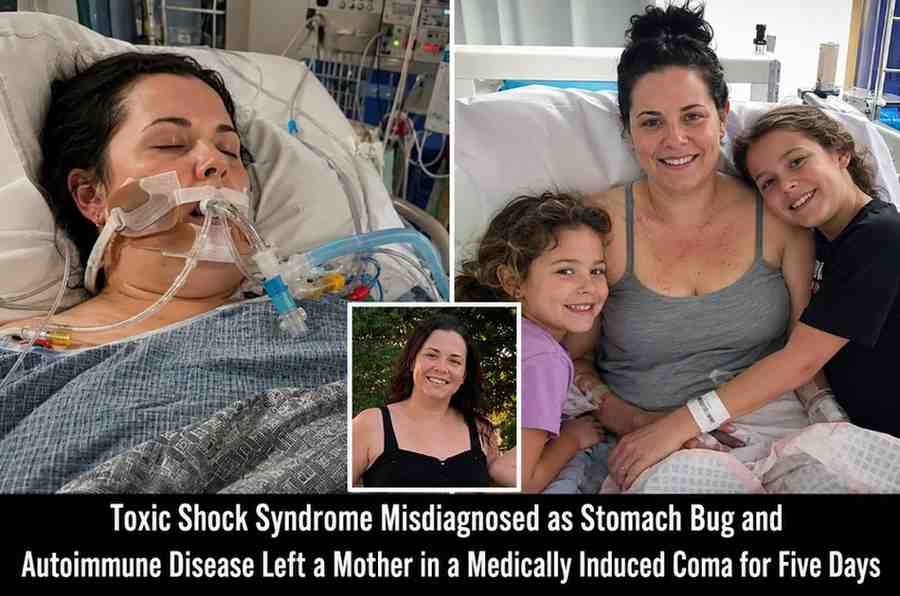
Imagine waking up one Saturday morning feeling slightly off. Maybe a stomach cramp. A low fever. You assume it’s a passing bug something you ate, or perhaps the stress of a busy week. You take some paracetamol, drink some water, and wait it out. Now imagine that by the following week, you’re unconscious in an intensive care unit, your organs shutting down, your family waiting outside a glass door and hoping you wake up.
That is exactly what happened to Audrey Leishman, a 42-year-old mother of three from Virginia Beach. What began as what she assumed was a mild stomach upset after a routine gynecological procedure rapidly cascaded into a fight for her life. Doctors were confused. Tests came back pointing in all the wrong directions. And Leishman found herself in a medically induced coma for five days before anyone truly understood what was killing her.
The diagnosis: sepsis and toxic shock syndrome (TSS) two conditions that are well-documented in medical literature, and yet still routinely misidentified, underestimated, and fatally delayed. Her story is not just a personal tragedy narrowly averted. It is a clinical warning dressed in human clothing, and it demands our full attention.
What Is Toxic Shock Syndrome and Why Does It Keep Catching Us Off Guard?
Toxic shock syndrome entered the public consciousness in the early 1980s when a wave of cases almost exclusively in young menstruating women was traced to the use of high-absorbency tampons. The crisis led to product recalls, public health campaigns, and new tampon regulations. The story seemed, to many, like a chapter that had been closed.
It hasn’t been. TSS is a rare but acute, life-threatening illness driven by bacterial toxins most commonly produced by Staphylococcus aureus or Streptococcus pyogenes (Group A Strep). These bacteria release what scientists call “superantigens” proteins that trigger a catastrophic, disproportionate immune response. Instead of a targeted defense, the body essentially declares war on itself. The result is a rapid cascade toward shock, multi-organ failure, and death.
According to NIH data, the incidence of TSS in the United States sits between 0.8 and 3.4 cases per 100,000 people making it rare enough that many physicians may see only a handful of cases in their careers. That rarity is precisely part of the problem. Rarity breeds unfamiliarity, and unfamiliarity breeds delay.
Menstrual TSS the variant most commonly associated with tampon use carries an overall mortality rate of approximately 8%, according to a 2024 literature review published in the journal Antibiotics. That number climbs steeply when diagnosis is delayed, as Leishman’s case so vividly illustrates.
From a Routine Procedure to the ICU: What Happened to Audrey Leishman
In March 2015, Leishman underwent a routine intrauterine device (IUD) removal in the hope of trying for another baby. Two days later, her first menstrual period in 18 months began and she resumed tampon use as she had done many times before. On a Friday evening, she went to sleep with a tampon in. It was an ordinary, unremarkable night.
By Saturday morning, her body was already in crisis.
The symptoms that followed were bewildering in their diversity: severe stomach cramps, an unexplained high fever, intense pain in her right elbow and left big toe, nosebleeds, diarrhea, and shortness of breath. She was so weak she could barely lift her 18-month-old son. There was no obvious injury. No apparent infection site. Nothing that pointed neatly to a single diagnosis.
At urgent care, clinicians were stumped. The joint pain and systemic inflammation pointed them toward autoimmune conditions lupus, rheumatoid arthritis, perhaps some form of vasculitis. She was tested repeatedly. Nothing confirmed. She described feeling like she was “going a little bit crazy,” confused and frightened by symptoms that seemed to make no anatomical sense together.
Eventually, she was admitted to hospital. What followed were ten days in the ICU five of which she spent in a medically induced coma as her body was kept alive while doctors worked to understand and combat what was attacking her. When the correct diagnosis finally arrived sepsis triggered by toxic shock syndrome treatment could begin in earnest.
Leishman survived. Not everyone does.
The Diagnostic Trap: Why TSS Looks Like Everything Else First
One of the most medically instructive parts of Leishman’s story is the sequence of misidentification: first a stomach bug, then an autoimmune disease. Neither is an unreasonable guess in isolation. TSS is a master of disguise, and understanding why helps explain why misdiagnosis is so stubbornly common.
The “Stomach Bug” Phase
Nausea, diarrhea, fever, and general malaise are the hallmark symptoms of dozens of common illnesses from gastroenteritis and food poisoning to influenza. In a primary care or urgent care setting, a physician seeing these complaints in an otherwise healthy adult will reasonably consider the most probable diagnoses first. TSS is far down the differential list, especially without an obvious trigger like a visible wound or a known surgical site.
The “Autoimmune Disease” Phase
Here is where the story gets particularly revealing. When joint pain especially in unusual locations like a single elbow or a single toe accompanies systemic inflammation, clinicians are trained to think about reactive arthritis, lupus, or rheumatoid arthritis. These conditions can present with migrating joint pain, fever, and fatigue. Leishman’s presentation fit that pattern convincingly enough to redirect the clinical investigation entirely.
This is not a failure of intelligence. It is a failure of pattern recognition in a rare condition. TSS often produces what clinicians call “multisystem involvement” and that breadth of symptoms, rather than narrowing the diagnosis, paradoxically widens it. The very characteristic that makes TSS so dangerous (it attacks everywhere at once) is the same characteristic that makes it so difficult to identify quickly.
The Missing Conversation
Crucially, there is evidence to suggest that Leishman’s tampon use the most likely trigger for her TSS may not have been discussed early or thoroughly enough in her initial assessments. This is a systemic issue, not an individual one. Menstrual history and current hygiene product use are not always front-of-mind for emergency physicians focused on the acute presentation in front of them. A detailed gynecological history taken at triage could have changed the diagnostic timeline significantly.
| Symptom | Stomach Bug (Gastroenteritis) | Autoimmune Flare (e.g., Lupus) | Toxic Shock Syndrome (TSS) |
|---|---|---|---|
| High fever | Possible (usually mild) | Common | Almost always present |
| Nausea / Diarrhea | Primary symptom | Occasional | Common, often severe |
| Joint pain | Rare | Primary symptom | Can occur (migrating) |
| Rapid blood pressure drop | Rare (dehydration) | Uncommon | Key diagnostic sign |
| Skin rash / redness | No | Possible (butterfly rash) | Sunburn-like rash characteristic |
| Organ involvement | Rare | Yes (kidneys, heart, lungs) | Rapid multi-organ failure |
| Speed of deterioration | Gradual (days) | Gradual to moderate (weeks) | Hours to days extremely rapid |
| Associated with tampon use | No | No | Yes key risk factor |
Sepsis and TSS: When the Body’s Defense Becomes the Weapon
Leishman was ultimately diagnosed with both sepsis and toxic shock syndrome and understanding why both terms apply simultaneously is essential to grasping the severity of what she endured.
Sepsis is the body’s dysregulated response to infection, in which the immune system rather than containing a threat begins damaging the body’s own tissues and organs. It is one of the leading causes of preventable death in hospitals worldwide, killing an estimated 11 million people globally each year. It is not a disease in itself, but a process: a runaway immune reaction that, if not interrupted, leads to septic shock and death.
TSS is a specific cause of sepsis one where bacterial toxins act as a direct ignition switch for that immune overreaction. The toxins released by Staphylococcus aureus, in particular, bypass the normal mechanisms of immune activation and stimulate a massive, uncontrolled release of inflammatory cytokines. This “cytokine storm” is what drives the fever, the blood pressure collapse, the organ damage, and the rapid clinical deterioration.
Think of it this way: if sepsis is a fire inside the body, TSS is the accelerant. Together, they create a medical emergency measured in hours, not days which is why every minute spent pursuing the wrong diagnosis carries genuine mortal risk.
It’s Not Just About Tampons: Who Is Really at Risk of TSS?
The cultural memory of TSS is firmly attached to tampon use and that association is not wrong. Menstrual TSS remains the most publicized form of the condition, and tampon use (particularly leaving them in for extended periods) remains a genuine risk factor. But reducing TSS awareness to a tampon safety message is dangerously incomplete.
Modern medical literature identifies a broad range of TSS triggers that have nothing to do with menstruation:
- Surgical wounds: Any post-operative incision can become colonized with toxin-producing bacteria, making TSS a risk even weeks after a clean procedure.
- Skin injuries: Burns, cuts, insect bites, and abrasions even minor ones can serve as entry points. TSS following cellulitis, a skin infection, has been documented in published case reports as recently as 2025.
- Nasal packing: Patients who have nasal packing placed after nosebleeds or septoplasty surgery are at elevated risk.
- Childbirth and gynecological procedures: The post-partum period and procedures like IUD insertion or removal precisely the context of Leishman’s case can create conditions favorable to bacterial growth and toxin release.
- Contraceptive sponges and diaphragms: Any retained device in the vaginal environment can become a reservoir for Staphylococcus aureus.
- Men and children: Contrary to popular perception, TSS does not exclusively affect women. Non-menstrual TSS affects males and females equally and has been documented across all age groups including children.
This breadth of risk profiles is one reason TSS continues to surprise clinicians. It is not a condition that politely announces its context.
Leishman Is Not Alone: The Broader Crisis of Missed Diagnoses in Women’s Health
While Leishman’s story centers on TSS, it connects to a much larger and deeply troubling pattern in healthcare: the systemic underdiagnosis of serious conditions in women.
Studies consistently show that women presenting with pain and systemic symptoms are more likely than men to have their concerns attributed to psychological causes, stress, or benign conditions. A Senedd (Welsh Parliament) committee report, examining cancer misdiagnosis, described a “dangerous bias” against women in which cancer concerns were “dismissed, downplayed and unheard.” This is not a fringe observation it reflects findings replicated across multiple healthcare systems and countries.
For TSS specifically, the demographic overlap with common Women’s Health complaints (menstrual cramps, fatigue, joint pain) creates a kind of diagnostic camouflage. A young woman presenting with these symptoms may face a longer diagnostic journey than a male patient presenting with symptoms of equivalent systemic severity. That delay measured in hours in a condition where hours matter enormously is a problem medicine has not yet adequately solved.
“They kept testing me for different things. Eventually, they admitted me, and I was in the ICU for a total of 10 days five of which were in a medically induced coma.” Audrey Leishman
The Symptoms That Should Never Be Ignored: A Clinical Red Flag Checklist
One of the most actionable things to come from Leishman’s story is a clearer picture of the warning signs that should prompt urgent medical evaluation or, if you are a clinician, rapid consideration of TSS in the differential diagnosis.
The classic diagnostic criteria for TSS include a combination of:
- Sudden high fever typically above 38.9°C (102°F)
- Low blood pressure (hypotension) a systolic reading below 90mmHg, especially in a previously healthy patient
- A diffuse, sunburn-like rash often described as a flat red rash covering large areas of the body
- Involvement of three or more organ systems including the gut (vomiting, diarrhea), muscles (severe pain), kidneys, liver, blood, or central nervous system
- Peeling of the skin particularly on the palms and soles, occurring one to two weeks after the acute illness
Crucially, not all of these will be present simultaneously, and some like the skin peeling only appear later. Early TSS may look like almost anything. The key clinical question to ask is: Does this patient have a possible source of bacterial toxin production? That source could be a tampon, a wound, a surgical site, a retained foreign body, or simply a superficial skin infection that has gone unnoticed.
If the answer is yes, and the patient is deteriorating, TSS must be considered immediately not after ruling out every other possibility.
When TSS Is Caught in Time: Treatment, Recovery, and What Actually Saves Lives
The good news and there is good news is that TSS is treatable, and outcomes improve dramatically with early, aggressive intervention.
The pillars of TSS treatment are:
- Source control: Removing the trigger. This means removing tampons, draining abscesses, debriding infected wounds eliminating the bacterial reservoir that is producing the toxins. This is step one, and it cannot be delayed.
- Antibiotics: Targeted antibiotic therapy to eliminate the bacteria. For staphylococcal TSS, this typically involves drugs that also suppress toxin production, not just bacterial growth.
- Fluid resuscitation: Large volumes of intravenous fluids to stabilize blood pressure and support organ perfusion.
- Intensive care support: In severe cases like Leishman’s, ICU admission for ventilatory support, vasopressors, and continuous monitoring is essential.
- Intravenous immunoglobulin (IVIG): In some severe cases, IVIG is used to neutralize the circulating toxins a targeted biological intervention that has shown promise in streptococcal TSS.
Leishman’s ten-day ICU stay, including her five days in a coma, represents the kind of intensive medical investment that TSS demands when it is caught late. Patients identified early before organ failure sets in typically require far less aggressive intervention and enjoy significantly better outcomes. The difference between “caught on day one” and “caught on day four” is, in many cases, the difference between a brief hospitalization and a coma.
The Deeper Problem: Medicine Still Teaches Rarity as an Afterthought
There is a famous teaching aphorism in medical training: “When you hear hoofbeats, think horses, not zebras.” In other words, the most common diagnosis is usually the right one. This heuristic is valuable it prevents over-testing and reduces unnecessary alarm. But it has a dangerous shadow side when applied to time-critical conditions.
TSS is a medical zebra. But it is a zebra that can kill in under 24 hours.
The problem is not that clinicians are negligent. The problem is that TSS sits in a particularly awkward diagnostic space: rare enough that it falls below the threshold of routine clinical vigilance, serious enough that any delay is catastrophic, and deceptive enough in its presentation that it actively mimics conditions that should be considered first.
What Leishman’s case argues for implicitly but powerfully is a shift in how high-stakes rare conditions are integrated into triage protocols. Rather than waiting for a clear diagnosis before escalating care, hospital systems need to build in “red flag cascades” automatic reviews triggered when a patient presents with multi-system inflammation of unclear cause, combined with any identifiable bacterial risk factor. This is not a radical idea. Sepsis protocols already operate on a similar logic. TSS deserves its own equivalent.
A Comparison That Puts This in Perspective
Consider the contrast with meningitis, another rare bacterial emergency. Public awareness campaigns for meningitis particularly the “glass test” for the meningococcal rash have been credited with saving lives by empowering ordinary people to recognize and escalate symptoms rapidly. TSS has no equivalent cultural shorthand. Most people know, vaguely, that it is connected to tampons. Very few know that it can follow a routine IUD removal, a small skin cut, or a surgical wound. That knowledge gap is not just unfortunate it is measurably deadly.
Conclusion: Survival Is Not Just Luck It Requires Better Awareness at Every Level
Audrey Leishman is alive today. She emerged from a medically induced coma, recovered from ten days in intensive care, and has since spoken publicly about her experience in partnership with the Sepsis Alliance. Her story, on one level, has a hopeful ending.
But the structural vulnerabilities her case exposes have not been meaningfully addressed. TSS remains underrecognized in clinical settings. The diagnostic delay she experienced from stomach bug to autoimmune disease before the correct answer is not an anomaly. It is a pattern documented across published case reports and medical literature for decades.
The path forward requires action at multiple levels. Clinicians need refreshed, protocol-driven awareness of TSS as a differential diagnosis whenever multi-system illness accompanies a plausible bacterial source. Triage nurses need to ask, routinely and explicitly, about tampon use, recent procedures, and wounds. And patients particularly women need to know that rapid deterioration with multi-system symptoms is never “just a stomach bug,” and that advocating loudly for escalation can literally save their lives.
Toxic shock syndrome does not wait for the right diagnosis to arrive. Treatment must begin before certainty does. That is an uncomfortable reality for a healthcare system built around confirmation before action but it is the biological reality that TSS presents, and one that medicine must learn to meet on its own terms.
The next Audrey Leishman is out there right now, sitting in an urgent care waiting room, being handed a diagnosis that is almost certainly wrong. The difference between her story and the story that ends in a funeral is whether the clinician in front of her knows to ask one more question: “Have you used a tampon recently? Do you have any wounds I haven’t examined?”
That question costs nothing. The answer could be everything.
For breaking news and live news updates, like us on Facebook or follow us on Twitter and Instagram. Read more on Latest Health on thefoxdaily.com.






COMMENTS 0