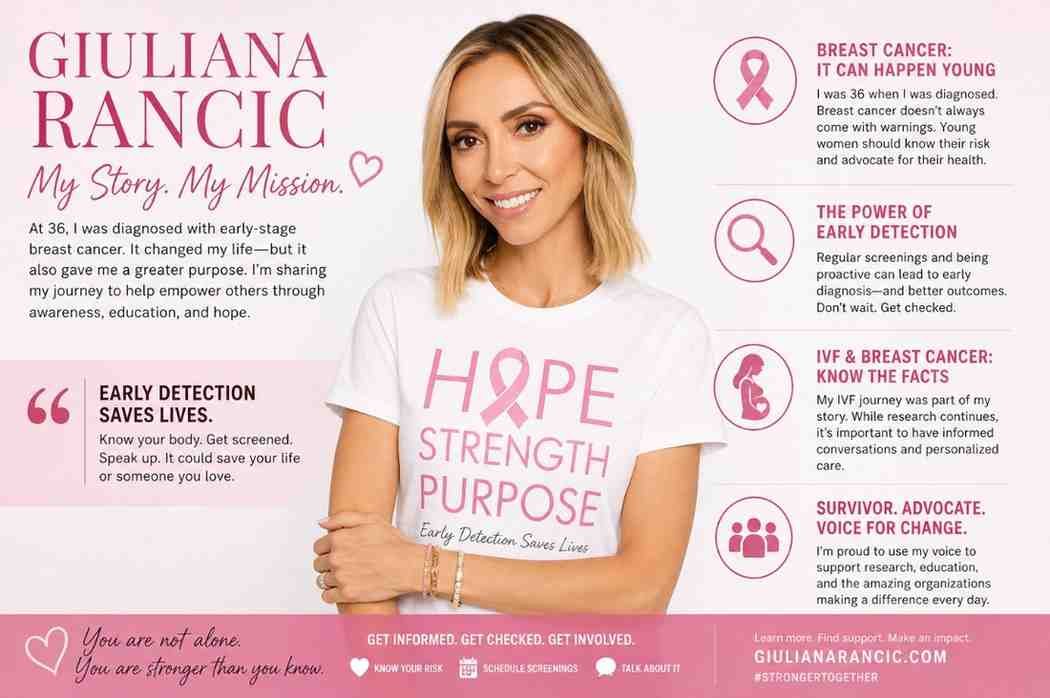
- The Hidden Risk Younger Women Face and Why Mammograms Cannot Wait
- The Emotional Complexity of a Dual Diagnosis: Infertility and Cancer at the Same Time
- From Survivor to Advocate: Building a Platform That Actually Changes Lives
- The Health Philosophy That Emerged From Surviving Cancer
- A Life Built on Immigrant Resilience and Why That Foundation Mattered
- The Systemic Lesson Hidden Inside Rancic's Story
- Giuliana Rancic's Key Life and Health Milestones
- Breast Cancer Survival by Stage: Why Early Detection Is Everything
- Conclusion: The Red Carpet Was Always Just the Background
On any given weekday morning in America, a woman under 40 is told she has Breast Cancer. She probably did not see it coming. She likely assumed she was too young to worry. She may have skipped a screening, believing mammograms were something her mother needed not her. Giuliana Rancic was once that woman. In 2011, at just 36 years old, while preparing for an IVF cycle in a hopeful pursuit of motherhood, a routine mammogram changed the entire trajectory of her life. What followed was a double mastectomy, reconstructive surgery, a courageous path to parenthood through a gestational carrier, and ultimately a second act defined not by the cancer, but by everything she chose to do because of it.
This is not simply a celebrity health story. It is a case study in the real-world stakes of early breast cancer detection, the psychological weight of facing fertility challenges and a cancer diagnosis simultaneously, and the way one woman built a life of genuine purpose from a moment of profound vulnerability. For the millions of women who are today where Rancic was in 2011 pursuing fertility treatments, avoiding mammograms, assuming youth equals safety her story is both a warning and a blueprint.
The Hidden Risk Younger Women Face and Why Mammograms Cannot Wait
There is a dangerous and persistent myth embedded in breast cancer awareness culture: that it is primarily an older woman’s disease. Statistically, this is partially true the median age of diagnosis in the United States hovers around 62. But statistics can obscure individual risk in deadly ways. Approximately 9% of all new breast cancer cases in the U.S. are diagnosed in women under 45. That translates to tens of thousands of younger women each year facing a disease that is often more aggressive in younger bodies, harder to detect in denser breast tissue, and far more likely to be caught at a late stage.
Rancic’s diagnosis did not come from self-detection or a symptom she noticed in the mirror. It came from a mammogram ordered as a precaution during IVF screening a step that many fertility clinics recommend but that is far from universal practice. The irony is striking: a fertility procedure aimed at creating life inadvertently revealed a serious threat to Rancic’s own. Had she not been undergoing IVF at that precise moment, the cancer might have gone undetected for months or even years longer, dramatically altering her prognosis.
“Do not assume you are too young. Before the age of 40, do not underestimate the power of breast self-awareness.”
— Giuliana Rancic
This is precisely the message breast cancer advocates have struggled hardest to communicate to younger demographics. The American Cancer Society now recommends that women at average risk begin annual mammograms at 40, but many women and some physicians still operate under older guidelines that placed routine screening closer to age 50. For women with dense breast tissue, a family history, or genetic risk factors such as BRCA1 or BRCA2 mutations, earlier and more frequent screening is not optional it is potentially life-saving.
What “Breast Self-Awareness” Actually Means in Practice
Rancic’s call to action centers on a concept that differs subtly but importantly from old-school monthly self-examination routines. Rather than a rigid clinical self-exam that many women skip or perform incorrectly, breast self-awareness is an ongoing, intuitive familiarity with how one’s own breasts look and feel across different times of the month, during hormonal changes, and across the natural process of aging. It means knowing what is normal for your own body so that anything abnormal registers immediately as a signal worth investigating and acting on without delay.
This matters because clinical self-exams alone are not perfect detection tools especially in younger women with naturally denser breast tissue. Self-awareness combined with regular clinical screenings and a proactive relationship with a physician is the multi-layered approach that genuinely moves the needle on catching cancer early, when treatment is most effective and survival rates are at their absolute highest.
The Emotional Complexity of a Dual Diagnosis: Infertility and Cancer at the Same Time
What is rarely discussed in the popular retelling of Rancic’s story is the particular psychological devastation of facing cancer and infertility simultaneously. These are two of the most emotionally taxing experiences any person can undergo independently. Giuliana Rancic faced them at the exact same time a compound trauma that medical professionals are only beginning to recognize and address as a distinct psychological challenge requiring specialized, coordinated support.
When a woman is undergoing IVF, she exists in a state of heightened, carefully constructed hope. The emotional architecture of fertility treatment is built entirely around possibility and the imminent future of a child. That architecture does not simply pause when cancer enters the picture. For Rancic, the transition from fertility patient to cancer patient happened within days. One week she was planning embryo transfers; the next, she was discussing the surgical removal of both breasts.
“One day I was focused on becoming a mother, and the next I was focused on surviving. I remember feeling fear, confusion, and sadness, but I also had to remind myself how strong I needed to be.”
— Giuliana Rancic
Studies consistently show that women diagnosed with breast cancer during or around fertility treatment face elevated rates of anxiety and depression compared to those who receive a cancer diagnosis in a different life context. The grief of potentially losing the ability to have biological children layered on top of the fear of cancer itself creates an emotional burden that standard cancer support structures are not always equipped to meaningfully address.
Rancic has been candid that her survival required not just medical intervention but an active emotional and spiritual scaffolding. Her faith, her husband Bill, her family, and her broader support network were not peripheral to her recovery they were absolutely central to it. This aligns with a growing body of psychosocial oncology research showing that strong social support is meaningfully correlated with better quality of life during and after breast cancer treatment.
From Survivor to Advocate: Building a Platform That Actually Changes Lives
The transition from cancer patient to cancer advocate is one that many survivors attempt but not all manage to make truly meaningful. Giuliana Rancic’s approach stands apart for one specific reason: she identified a gap that established organizations were not filling and built something purposefully designed to address it directly.
Rather than simply lending her name to existing fundraising campaigns, she created FAB-U-WISH a program that addresses a dimension of the cancer experience that research funding and awareness campaigns consistently overlook: the profound toll that treatment takes on a woman’s sense of identity, femininity, and self-image. Chemotherapy, mastectomies, reconstruction surgery, and the physical transformations they bring can leave survivors feeling deeply estranged from their own bodies and sense of self.
FAB-U-WISH grants fashion, beauty, and celebrity-themed wishes to women who are actively undergoing breast cancer treatment. It does not cure cancer. But it reminds women in the middle of the hardest chapters of their lives that they are more than their diagnosis that their identity extends far beyond the treatment room, and that the world still sees them as full, vital human beings deserving of joy.
Research in oncology psychology has increasingly validated the importance of identity preservation and dignity-centered care during cancer treatment. Women who maintain strong connections to personal style, creative expression, and pleasure during treatment consistently report better psychological outcomes. Rancic’s instinct here rooted in her own lived experience and her professional background in fashion and entertainment was both emotionally intelligent and evidence-aligned.
Beyond FAB-U-WISH, Rancic actively supports a wide range of charitable organizations:
- The Breast Cancer Research Foundation funding scientific research into prevention and treatment breakthroughs
- The Pink Agenda engaging young professionals in active breast cancer fundraising
- Operation Smile providing cleft lip and palate surgery for children around the world
- Dress for Success supporting economic empowerment and career development for women
- Mercy Home for Boys and Girls in Chicago providing critical services for vulnerable youth
- PAWS Chicago supporting animal welfare, rescue, and adoption
The Health Philosophy That Emerged From Surviving Cancer
Cancer permanently changes a person’s relationship with their own body sometimes toward fear, sometimes toward profound acceptance, and often toward a more deliberate form of self-stewardship. For Rancic, it catalyzed a fundamental reorientation in how she approaches her health: less reactive, more proactive; less about aesthetics and performance, more about sustainability and long-term vitality.
Nutrition: Whole Foods Without Obsession
Rancic’s post-cancer approach to eating centers on whole, minimally processed foods blueberries, avocados, and nutrient-dense ingredients that support cellular health and reduce systemic inflammation. But she is refreshingly honest about refusing to turn this into dietary perfectionism. She indulges. She enjoys decadent meals. She refuses to allow a cancer diagnosis to shrink the genuine pleasure she takes from food and from life itself.
“I find that my body feels best when I am fueling it from the inside out with whole foods. But as much as I try to eat healthy whole foods like blueberries and avocados, I also indulge in decadent meals sometimes. Life is short and I want to enjoy the ride.”
— Giuliana Rancic
This balance informed but not fanatical is precisely what oncology nutritionists recommend. Rigid dietary perfectionism after a cancer diagnosis can itself become a psychological burden, feeding anxiety and restriction rather than genuine health. A sustainable, pleasure-inclusive approach to nutrition is far more likely to be maintained across a lifetime and that consistency is where the real benefit lies.
Exercise: The Strategic Shift From Intensity to Longevity
In her 20s, Rancic gravitated toward high-intensity training and running-focused workouts. In her 40s and beyond, she has made a conscious shift toward what exercise scientists describe as sustainable physical activity walking, light strength training, and movement that prioritizes long-term musculoskeletal health, mental clarity, and consistency over performance metrics.
“I enjoy walking, light strength training, and staying active in ways that feel good and sustainable. It’s less about intensity and more about consistency for me these days.”
— Giuliana Rancic
This is not a retreat from fitness it is a maturation of it. Evidence increasingly supports the principle that moderate, consistent exercise across a lifetime produces better long-term health outcomes than intense exercise followed by burnout and extended inactivity particularly for cancer survivors, for whom regular physical activity is associated with measurably reduced recurrence risk.
Mental Health: Awareness Without Fear
Perhaps the most sophisticated dimension of Rancic’s post-cancer health philosophy is her articulation of the critical difference between fear and awareness. She does not live in constant fear of recurrence she lives with deliberate, empowering awareness. Post-traumatic growth research consistently shows that cancer survivors who develop an integrated narrative around their experience who fold the diagnosis into a larger story of identity rather than allowing it to define them entirely report significantly higher quality of life and better long-term psychological outcomes than those who remain locked in fear-based vigilance.
“I do not live in fear, but I live with awareness. That awareness empowers me rather than scares me.”
— Giuliana Rancic
A Life Built on Immigrant Resilience and Why That Foundation Mattered
To fully understand Giuliana Rancic’s response to cancer, it helps to understand where she comes from. Born in Naples, Italy, she immigrated to the United States at age 7, settling with her family in a small Maryland town where her father a Neapolitan master tailor built a business and a life entirely from scratch. Watching a parent create something meaningful in a new country and a new language instills a very particular psychological foundation: the belief that setbacks are not endpoints, that identity is built through persistence, and that dreams are worth whatever the journey costs.
Rancic’s rise in television joining E! News as a correspondent in 2002 and becoming solo anchor and managing editor by 2005, helping take the show to the top of the ratings within a single year was itself an immigrant success story. The same disciplined work ethic that built her broadcasting career became the emotional infrastructure that carried her through cancer treatment and recovery. These two chapters of her life are not separate stories they are the same story, told in different settings.
Now at 51, with her mother actively building her own food brand, Mama DePandi, at the remarkable age of 80 expanding from online-only sales to national grocery store retail in 2026 Rancic has living proof that reinvention is never an act of desperation but always an act of vitality.
“My mom has been an inspiration to me my whole life. Now even more so as I have witnessed her build her own brand at the age of 80 years old. She reminds me that it’s never too late to achieve your dreams.”
— Giuliana Rancic
The Systemic Lesson Hidden Inside Rancic’s Story
Most coverage of Giuliana Rancic’s breast cancer experience focuses on inspiration and rightly so. But there is a harder, more structural lesson embedded in her story that deserves serious attention. The fact that her cancer was detected during an IVF-related mammogram raises a critical and largely unaddressed clinical question: why is precautionary breast screening not standard protocol for all women undergoing IVF treatment?
Fertility treatments involving hormonal stimulation interact in complex ways with breast tissue. Some emerging research suggests that elevated estrogen levels associated with ovarian stimulation may influence hormone-receptor-positive breast cancers in women with pre-existing risk factors. While the evidence is not yet conclusive enough to drive universal policy change, Rancic’s case illustrates precisely why the intersection of reproductive medicine and oncology screening deserves far more coordinated clinical attention than it currently receives.
There is also a Healthcare access dimension worth naming directly. Rancic had the financial resources for IVF, the professional connections to access elite medical care, and a national platform to amplify her message. The millions of women without those advantages uninsured, underinsured, without access to reproductive medicine, without the cultural capital to advocate loudly within complex medical systems face these exact same risks with far fewer resources. Advocacy is most powerful when it pushes systems and institutions, not just individuals, to do better and reach further.
Giuliana Rancic’s Key Life and Health Milestones
| Year | Milestone | Significance |
|---|---|---|
| 2002 | Joins E! News as correspondent | Begins a landmark two-decade television career |
| 2005 | Becomes solo anchor and managing editor of E! News | Leads show to top ratings within a single year |
| 2011 | Breast cancer diagnosis at 36 during IVF process | Early-stage discovery via routine mammogram; undergoes double mastectomy and reconstructive surgery |
| 2012 | Son Duke born via gestational carrier | Achieves parenthood following cancer treatment |
| 2012 | Launches G by Giuliana clothing line on HSN | Most successful clothing line debut in HSN history at the time |
| Ongoing | FAB-U-WISH program active | Grants fashion, beauty, and celebrity wishes to women actively in breast cancer treatment |
| 2026 | Mama DePandi expands to national grocery stores | Family Italian food brand reaches national scale; her mother builds a business at age 80 |
Breast Cancer Survival by Stage: Why Early Detection Is Everything
| Detection Stage | 5-Year Survival Rate | What This Means |
|---|---|---|
| Localized (early stage) | 99% | When caught early, breast cancer is overwhelmingly survivable |
| Regional (spread to nearby tissue) | 86% | Still highly treatable, but survival odds begin to decline |
| Distant (metastatic) | 29% | Late detection dramatically reduces survival probability |
| Women under 45 affected | ~9% of all cases | Younger women are not immune not even close |
Conclusion: The Red Carpet Was Always Just the Background
Giuliana Rancic is not a symbol. She is a woman who had cancer, made hard and courageous choices, built something genuinely meaningful from the aftermath, and has used her platform consistently to point other women toward knowledge and resources that might save their lives. The specific details of her story belong to her alone.
But the lessons are universal and urgent. Youth is not a shield against breast cancer. Early detection is not merely a slogan it is the single most powerful variable in survival outcomes. Facing cancer and infertility simultaneously is a specific and profoundly underrecognized form of trauma that demands better clinical and psychological support structures. And healing is never just physical it is psychological, relational, and purposive.
Looking forward, the most enduring version of Rancic’s legacy will not be measured in awareness campaigns alone. It will be measured in whether her story motivates the medical establishment toward more proactive, earlier, and more equitable breast cancer screening standards for younger women across all income levels and backgrounds. It will be measured in whether institutions begin treating the intersection of reproductive medicine and oncology screening as the urgent clinical conversation it has always deserved to be.
The red carpet was always just a backdrop. The real, lasting work happens in the doctor’s office, the treatment room, and in the quiet moment when a woman decides to schedule the screening she has been putting off and in doing so, writes a completely different ending to her story.
“Taking care of yourself is one of the greatest acts of self-respect.”
— Giuliana Rancic
For breaking news and live news updates, like us on Facebook or follow us on Twitter and Instagram. Read more on Latest Health on thefoxdaily.com.






COMMENTS 0