Primary Keyword: many forms of malnutrition
LSI Keywords: undernutrition vs overnutrition, public health nutrition strategies, obesity epidemic India, micronutrient deficiency, double burden of malnutrition, child stunting and wasting, diet-related diseases, nutrition policy 2026
Introduction: A Global Crisis with Two Opposite Faces
The phrase “many forms of malnutrition” captures one of the most complex public health challenges of our time. While some populations still struggle with lack of food and essential nutrients, others face the consequences of excess calories without nutrition.
Who: Governments, health organizations, and communities worldwide.
What: A dual crisis of undernutrition and overnutrition.
When: Intensifying in recent years, highly visible in 2026.
Where: Across both developing and developed nations, often within the same country.
Why: Changing diets, urbanization, inequality, and lifestyle shifts.
How: Through evolving, multi layered public health strategies.
This is no longer a simple issue of hunger it’s a complex nutritional imbalance affecting millions.
Understanding the Many Forms of Malnutrition
1. Undernutrition: The Traditional Challenge
Undernutrition occurs when the body does not get enough nutrients to function properly.
- Stunting: Poor growth and development in children
- Wasting: Low weight for height, often due to acute hunger
- Underweight: General lack of adequate nutrition
Impact: Weak immunity, developmental delays, and increased mortality risk.
2. Micronutrient Deficiency: The “Hidden Hunger”
Even when calorie intake is sufficient, lack of essential vitamins and minerals can cause serious health issues.
- Iron deficiency (anemia)
- Vitamin A deficiency (vision problems)
- Iodine deficiency (thyroid issues)
Insight: This form of malnutrition often goes unnoticed but has long-term consequences.
3. Overnutrition: The Modern Epidemic
Overnutrition refers to excessive intake of calories, often from processed and unhealthy foods.
- Obesity and overweight
- Type 2 diabetes
- Cardiovascular diseases
Reality: It is possible to be overweight and still malnourished.
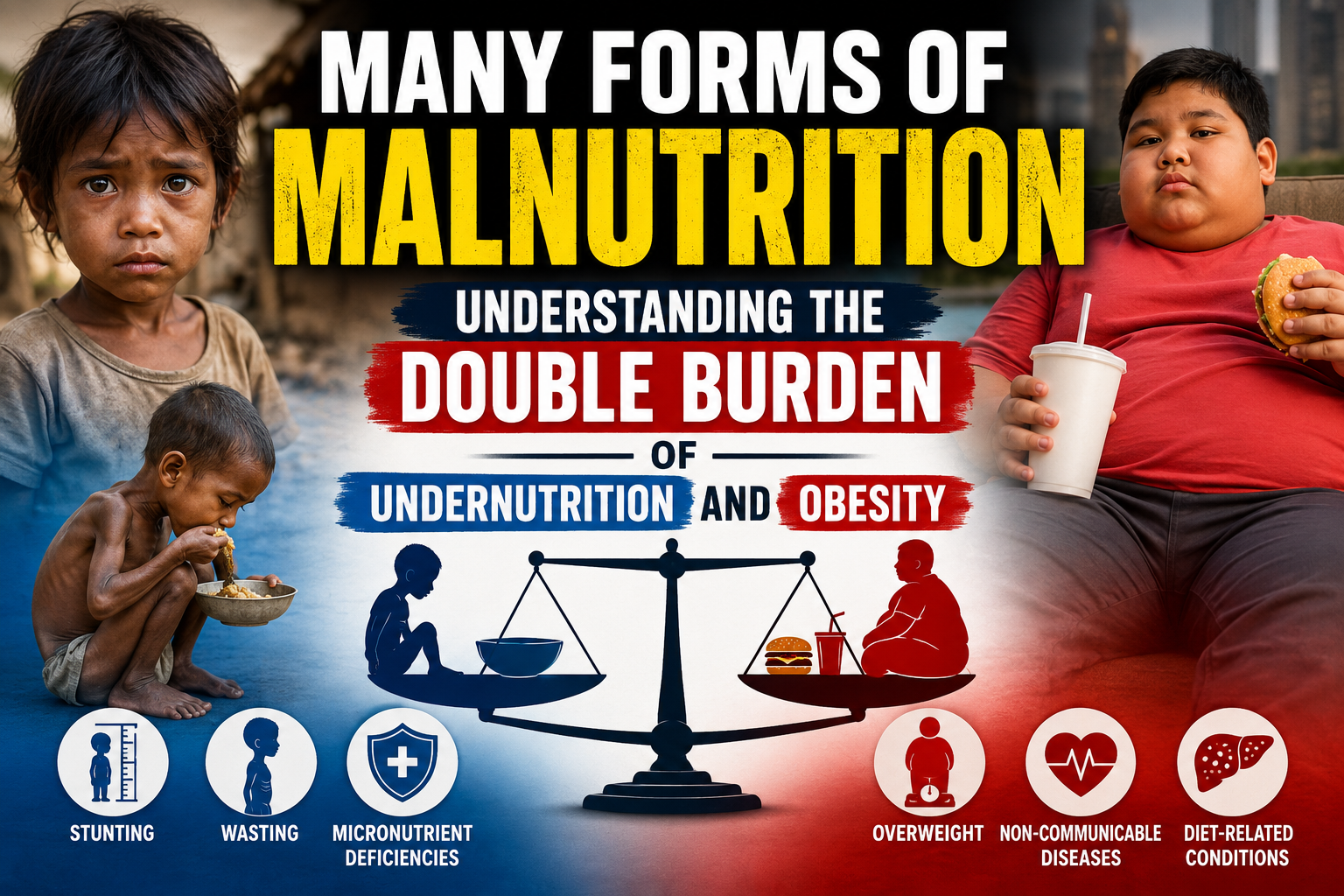
The Double Burden: When Both Problems Coexist
Many countries, including India, now face a double burden of malnutrition.
- Undernutrition in rural or low-income populations
- Obesity and lifestyle diseases in urban areas
Key challenge: Designing policies that address both extremes without worsening either.
Why Malnutrition Is Changing in 2026
1. Urbanization and Lifestyle Shifts
More people are moving to cities, adopting sedentary lifestyles and processed diets.
2. Food Environment Changes
Ultra-processed foods are becoming more accessible and affordable than nutritious options.
3. Economic Inequality
Access to healthy food is still uneven, leading to both scarcity and excess.
4. Climate Change Impact
Food production disruptions are affecting availability and nutritional quality.
Comparison: Undernutrition vs Overnutrition
| Aspect | Undernutrition | Overnutrition |
|---|---|---|
| Cause | Lack of food/nutrients | Excess unhealthy calories |
| Common Groups | Children, low-income populations | Urban populations, sedentary lifestyles |
| Health Impact | Weak immunity, stunting | Obesity, chronic diseases |
| Visibility | Often visible | Sometimes normalized |
Evolving Public Health Strategies
1. Integrated Nutrition Programs
Governments are combining food security with nutrition education to tackle multiple issues at once.
- School meal programs
- Maternal and child nutrition schemes
2. Fortification of Foods
Staple foods are enriched with essential nutrients to combat deficiencies.
- Iron-fortified grains
- Iodized salt
3. Promoting Healthy Diets
Campaigns encourage balanced eating habits and reduce dependence on processed foods.
4. Regulation of Junk Food
Policies are being introduced to limit unhealthy food marketing, especially to children.
5. Use of Technology and Data
AI and digital tools are helping track nutrition trends and identify at-risk populations.
Deep Analysis: Why a One Size-Fits-All Approach Fails
Traditional nutrition programs often focused only on hunger. But today’s reality demands a more nuanced approach.
Insight: Solving malnutrition requires understanding local contexts—what works in rural areas may not work in urban settings.
- Behavior change is as important as food availability
- Cultural food habits must be considered
- Policy must balance affordability and nutrition
Real-World Impact: Why This Matters to Everyone
- Children’s development and future productivity
- Healthcare system burden due to chronic diseases
- Economic growth and workforce health
Big picture: Nutrition is not just a health issue—it’s a national development priority.
Future Outlook: What Comes Next?
- Personalized nutrition using AI
- Greater focus on preventive healthcare
- Stronger collaboration between governments and private sector
- Shift toward sustainable and nutritious food systems
Conclusion: Addressing All Forms of Malnutrition Together
The challenge of many forms of malnutrition requires a balanced, forward thinking approach. Tackling undernutrition without addressing obesity—or vice versa will not solve the problem.
The future of public health lies in integrated strategies that ensure not just enough food but the right kind of nutrition for all.
For breaking news and live news updates, like us on Facebook or follow us on Twitter and Instagram. Read more on Latest Health on thefoxdaily.com.






COMMENTS 0