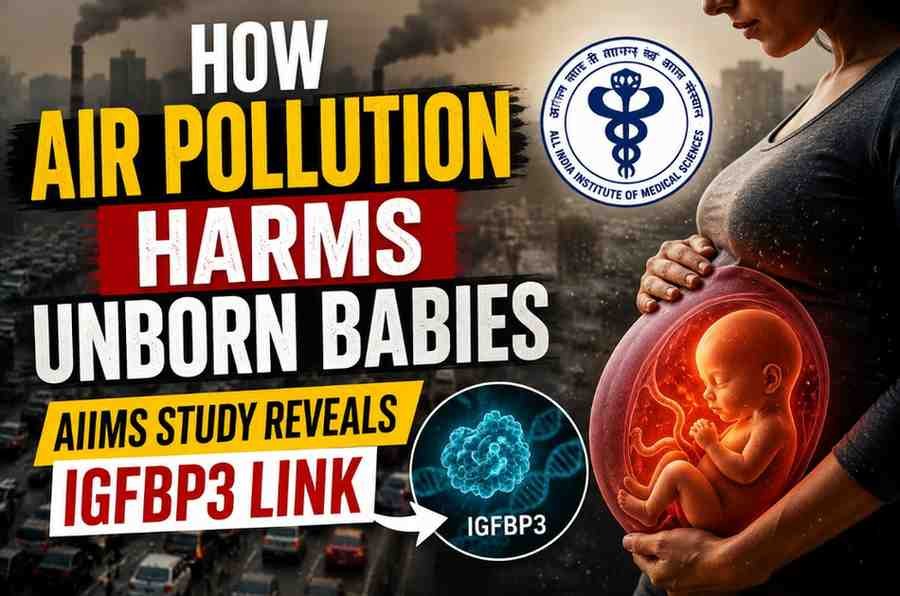
India is home to some of the most polluted urban air on the planet. Delhi’s annual average PM2.5 levels routinely exceed the World Health Organization’s safe limit of 5 micrograms per cubic metre by more than ten times. For the millions of women who conceive, carry, and deliver babies in such environments, the implications have been quietly alarming for years. Epidemiological data have long associated high PM2.5 exposure during pregnancy with preterm birth, low birth weight, and preeclampsia. What was missing was the how the molecular story that connects a particle inhaled in a traffic jam to a baby born too small or too soon.
That gap is now significantly narrower. The AIIMS Delhi team, led by Professor Subhradip Karmakar from the Department of Biochemistry, conducted what is arguably one of the most comprehensive multi-platform investigations into urban particulate matter’s effect on placental and foetal health undertaken in South Asia. Their findings, spanning cell line experiments, placental explant models, rodent studies, human cohort data, and multi-omics profiling, converge on a single, striking conclusion: urban particulate matter dismantles foetal growth by silencing a protein that the developing baby depends on.
Crossing the Last Barrier: How PM Reaches the Foetus
For decades, the placenta was considered a formidable defensive wall protecting the developing foetus from environmental toxins. That assumption has been progressively eroded. The AIIMS study confirms what a growing body of international research has also shown that both PM2.5 (particles smaller than 2.5 micrometres) and PM10 (particles smaller than 10 micrometres) can breach the placental barrier entirely. Once inhaled, fine particles penetrate the lung’s alveolar walls, enter the maternal bloodstream, travel to the uterus, and deposit within placental tissue placing them in direct contact with the cellular machinery that sustains foetal life.
This is not a theoretical pathway. Belgian researchers had previously photographed black carbon particles embedded on the foetal side of human placentas using laser-based microscopy. The AIIMS team builds on that foundation, demonstrating through both cell line work and explant studies that urban particulate matter triggers a cascade of damage in trophoblast cells the specialised placental cells responsible for invasion of the uterine wall, formation of new blood vessels, and transport of nutrients to the foetus. When trophoblasts are compromised, everything downstream suffers.
The IGFBP3 Discovery: A Molecular Smoking Gun
The most consequential finding from the AIIMS study is the identification of Insulin-like Growth Factor Binding Protein 3 (IGFBP3) as a critical molecular target of urban particulate matter. Using transcriptomic analysis essentially a genome-wide reading of which genes are switched on or off in response to pollutant exposure the researchers found IGFBP3 to be one of the most significantly downregulated genes in placental tissue exposed to urban PM.
Why does this matter enormously? IGFBP3 is a key regulator of Insulin-like Growth Factors (IGFs), which are among the most important hormones governing foetal growth. IGFs essentially act as the biological throttle for how fast and how robustly a developing foetus grows in the womb. IGFBP3 modulates how available these growth factors are to foetal tissues. When IGFBP3 is suppressed, the entire IGF signalling axis is thrown into disarray, and the foetus is effectively deprived of the growth instructions it needs.
The mechanism by which particulate matter suppresses IGFBP3 is equally important. The AIIMS team traced it through the inflammatory pathway: urban PM increases the production of the pro-inflammatory cytokine Interleukin-1 Beta (IL-1β), which then activates a signalling protein called STAT1. This IL-1β/STAT1 axis, in turn, suppresses the expression of IGFBP3. In short, pollution triggers inflammation, inflammation shuts down a growth-regulating protein, and the foetus pays the price. This is a novel, mechanistically validated pathway not a correlation, not an association, but a chain of cause and effect with identified molecular actors.
A Multi-Dimensional Assault on the Placenta
Beyond the IGFBP3 finding, the study paints a vivid and troubling picture of how broadly urban particulate matter disrupts placental biology. The researchers documented impaired trophoblast invasion meaning the placenta cannot anchor itself as deeply or securely into the uterine wall as it should. Angiogenesis, the process by which the placenta builds its own blood vessel network to supply the foetus, was also compromised. Nutrient transport pathways the molecular pumps that ferry glucose, amino acids, and vitamins across the placenta were disrupted. At the cellular level, the endoplasmic reticulum (the organelle responsible for protein folding and cellular stress responses) showed signs of dysfunction, and epigenetic modifications heritable changes to gene expression that can outlast the exposure itself were detected.
The rodent studies added another dimension of alarm. Pregnant rats exposed to urban PM produced smaller litters, showed placental abnormalities visible on structural examination, and their offspring demonstrated growth arrest both before and after birth. Neurodevelopmental alterations were also observed in postnatal animals suggesting that the damage from in-utero PM exposure does not end at birth but may shape brain development in ways that persist through childhood and beyond.
Human cohort data from populations living in high PM-exposure regions reinforced the clinical relevance of the laboratory findings: elevated rates of low birth weight were consistently observed, anchoring the mechanistic discoveries in real-world outcomes.
The Gut Microbiome Connection: An Unexpected Dimension
One of the more surprising findings in the AIIMS study involves the gut microbiome. The researchers detected evidence of gut microbiome dysbiosis a disruption in the normal community of intestinal bacteria in their rodent models exposed to urban particulate matter. This connects PM exposure to metabolic disturbances through an entirely separate biological route, suggesting that the effects of air pollution on pregnancy outcomes may partially operate through the maternal gut-immune axis. This is a relatively unexplored frontier in reproductive toxicology, and the AIIMS team’s identification of it as a possible contributor opens an entirely new avenue for both investigation and intervention.
Why This Study Stands Apart From Previous Research
Much of the existing research on PM and pregnancy has been epidemiological tracking population level patterns between pollution levels and pregnancy outcomes. Valuable as that work is, it cannot establish mechanism. A smaller body of laboratory research has probed specific cellular pathways, but typically in isolated systems using a single experimental model. What distinguishes the AIIMS study is its deliberate use of multiple converging platforms: cell lines, placental explants, animal models, proteomics (the study of all proteins expressed in a tissue), transcriptomics (gene expression profiling), and human cohort data were all deployed in parallel. When findings are replicated across this many different methods, the conclusions carry substantially greater weight.
The identification of a single unifying molecular mechanism IGFBP3 suppression mediated by IL-1β/STAT1 inflammation across these multiple platforms elevates this from an observational study to a mechanistic roadmap. That is precisely what the field needed.
| Research Platform Used | Key Finding | Clinical Implication |
|---|---|---|
| Cell line models (trophoblasts) | PM impairs invasion, angiogenesis, nutrient transport; triggers ER stress and epigenetic changes | Placental function is compromised even at the cellular level |
| Placental explant models | Urban PM increases pro-inflammatory cytokines and oxidative stress | Directly validates findings in human tissue context |
| Rodent studies (in vivo) | Reduced litter size, foetal growth arrest, placental abnormalities, postnatal neurodevelopmental changes | Whole-organism confirmation of multi-organ impact |
| Transcriptomic analysis | IGFBP3 identified as the most significantly downregulated gene after UPM exposure | Identifies a druggable/monitorable molecular target |
| Proteomic analysis | Inflammatory signature and altered metabolic networks in placental tissue | Suggests metabolic programming effects on the foetus |
| Gut microbiome analysis | Dysbiosis detected in PM-exposed rodents | Opens a gut-immune-pregnancy axis for investigation |
| Human cohort data | Elevated low birth weight rates in high PM-exposure populations | Real-world validation of laboratory findings |
What This Means for Pregnant Women in Polluted Cities
The practical stakes of this research are highest in cities where clean air is a privilege rather than a baseline. Delhi, Mumbai, Lahore, Dhaka, Beijing, and dozens of other megacities across the Global South have pregnant populations breathing air that would trigger emergency responses in Western Europe. The AIIMS findings mean that for these women, the risk to their unborn children is not abstract it is molecularly specific, occurring at the level of placental gene expression and growth hormone regulation, trimester by trimester, breath by breath.
The study’s authors explicitly flag prevention as an urgent priority. While individual-level interventions N95 masks, indoor air purifiers, limiting time outdoors during high-pollution periods offer partial protection, they are insufficient and inaccessible to the majority of affected women. The research underscores the necessity of systemic policy action: stricter vehicular emission standards, accelerated phase-out of solid-fuel cooking and heating, real-time air quality monitoring near hospitals and maternity clinics, and PM2.5 exposure limits that are integrated into antenatal care guidelines.
From a clinical standpoint, the identification of IGFBP3 as a biomarker of pollution-related foetal risk is significant. It raises the prospect of blood or placental tissue tests that could flag pregnancies at elevated risk due to PM exposure, enabling targeted monitoring and early intervention for women in the highest-exposure environments. Whether IGFBP3 levels in maternal or foetal blood could serve as a practical clinical indicator will require further study, but the AIIMS team has provided the mechanistic justification to pursue exactly that.
A Global Problem With an Indian Lens
It is particularly fitting that this research comes from India. The country accounts for a disproportionate share of the global burden of low birth weight and preterm birth, and its cities consistently appear near the top of global air quality rankings for entirely the wrong reasons. AIIMS Delhi’s contribution is not only scientifically important it is geopolitically significant. For too long, the mechanistic science of pollution-related foetal harm has been conducted primarily in Western institutions, on data from European or North American populations, and sometimes using PM compositions that do not reflect the chemical reality of South Asian urban air. The AIIMS study uses urban particulate matter from an Indian urban context, making its findings directly applicable to the populations most at risk.
This matters because PM is not a uniform substance. The chemical composition of particles varies significantly by geography, source, and season. Particles from biomass burning in northern India during winter months carry a different toxic profile than diesel exhaust particles in London or wildfire smoke in California. Research grounded in local PM exposure is therefore both more accurate and more actionable for the populations it concerns.
The Road Ahead: From Mechanism to Medicine
The discovery of the IL-1β/STAT1/IGFBP3 axis as a mechanistic pathway connecting PM exposure to foetal growth impairment opens several doors simultaneously. First, it provides a target for pharmacological research could anti-inflammatory agents that block IL-1β signalling during high-exposure periods protect placental IGFBP3 expression? Some biologics that inhibit IL-1β are already in clinical use for inflammatory conditions; their safety in pregnancy and potential as protective agents in high-pollution environments deserves urgent investigation. Second, it highlights IGFBP3 as a candidate biomarker for pollution-associated pregnancy risk. Third, it strengthens the case for IGF-axis supplementation strategies in pregnancies complicated by extreme PM exposure.
None of these are immediate clinical tools translating a molecular discovery into a therapeutic intervention takes years of further research and clinical trials. But without the molecular clarity that the AIIMS team has now provided, none of those paths could even be mapped.
Conclusion: Clean Air Is a Prenatal Health Issue
The AIIMS Delhi study arrives at a moment when the science of environmental health is maturing from association to mechanism. We no longer simply know that dirty air harms foetuses we now understand a significant part of how it does so, at the level of specific proteins, specific signalling pathways, and specific cellular processes that can be studied, monitored, and potentially targeted. The IGFBP3 protein, now identified as a molecular casualty of urban air pollution, becomes a symbol of a much larger truth: that the air quality of a city is not merely an environmental or infrastructure issue. It is a prenatal health policy decision with consequences that play out in neonatal wards, in the growth curves of children, and in the chronic disease burden of the next generation.
India’s scientists have provided the world with a molecular map of a crisis hiding in plain sight. The next question is whether policymakers, clinicians, and urban planners will use it.
For breaking news and live news updates, like us on Facebook or follow us on Twitter and Instagram. Read more on Latest Health on thefoxdaily.com.






COMMENTS 0