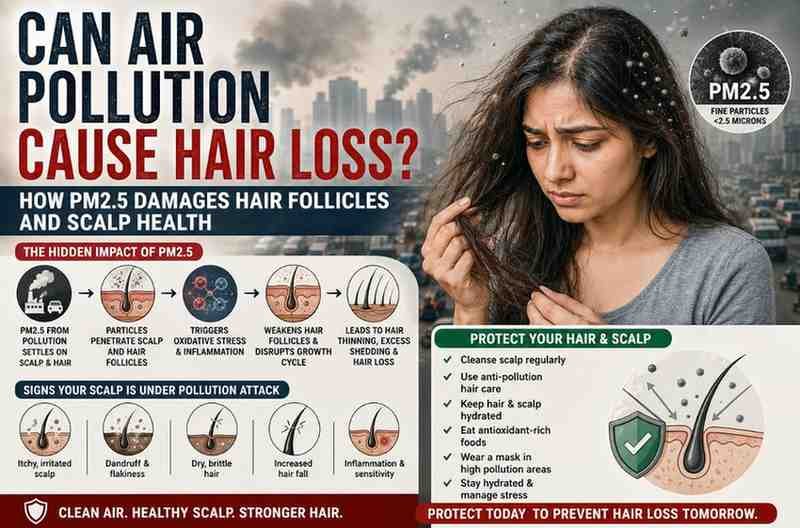
Every time you step outside in a smog-heavy city, you’re not just breathing in trouble you may be wearing it on your scalp too. For years, the conversation around PM2.5 (fine particulate matter measuring 2.5 micrometers or smaller) has centered on lungs, hearts, and life expectancy. But a growing body of dermatological research suggests these same airborne particles are quietly infiltrating hair follicles, disrupting the proteins responsible for hair growth, and accelerating thinning in people who have never had a genetic predisposition to baldness.
Who is affected? Essentially anyone living in a moderately-to-heavily polluted city. What is happening? Fine particulate matter is penetrating scalp skin and hair follicles, reducing key growth proteins. When did this become clear? Landmark research first presented in 2019 at a major European dermatology congress, followed by a wave of confirmatory lab and clinical studies through 2025. Where is the risk highest? Densely populated, traffic-heavy, industrial regions with high PM2.5 and PM10 readings. Why does it matter? Because hair loss linked to environment, unlike genetic pattern baldness, may be preventable — if people know what’s causing it. How does it happen? Through oxidative stress, follicle inflammation, and disruption of a protein called beta-catenin that hair needs to grow and anchor properly.
The Science: How PM2.5 Physically Reaches Your Hair Follicles
To understand why pollution and hair loss are connected at all, it helps to appreciate just how small PM2.5 particles are. At 2.5 micrometers or less in diameter, they are roughly 30 times thinner than a human hair. That size isn’t incidental it’s exactly what makes them dangerous. Particles this fine don’t just sit on the surface of skin or hair; they are small enough to slip into hair follicle openings and travel to depths of 200 to 500 micrometers beneath the scalp’s surface, well past the skin’s natural barrier.
Once inside, the particles don’t just sit there passively. Laboratory research using human follicle dermal papilla cells the cells at the base of each hair follicle responsible for regulating hair growth cycles found that exposure to PM10-like dust and diesel exhaust particulate significantly reduced levels of beta-catenin, a protein essential for hair follicle formation and the signaling that keeps hair in its active growth phase. The same studies found dose-dependent drops in three other proteins: cyclin D1, cyclin E, and CDK2, all of which help follicle cells divide and regenerate. In simple terms: the higher the pollution exposure, the more these growth-signaling proteins were suppressed.
A Two-Front Attack: Follicle Damage and Fiber Damage
What makes PM2.5 particularly disruptive to hair health is that it doesn’t attack in just one way it wages a two-front war on the hair system.
- Inside the follicle: Oxidative stress from pollutant exposure damages the dermal papilla cells that regulate the hair growth cycle, potentially pushing more follicles into the resting (telogen) phase prematurely, which shows up months later as increased shedding.
- On the hair shaft itself: Pollutants degrade the cuticle, cortex, and keratin proteins that give hair its strength and shine, leading to brittleness, breakage, dullness, and a straw-like texture — separate from, but often occurring alongside, actual follicle-level hair loss.
This distinction matters clinically. A person might be experiencing pollution-related breakage (hair snapping off mid-shaft) rather than true hair loss (follicles shutting down), and the two require different remedies. Confusing them is one reason people often waste money on the wrong treatments.
It’s Not Just About Genetics Anymore
For decades, hair loss conversations were dominated almost entirely by genetics and hormones specifically dihydrotestosterone (DHT), the hormone responsible for androgenetic alopecia, the most common form of pattern baldness in both men and women. Pollution adds a new, environmental layer to that picture, and the interaction between the two may be worse than either factor alone.
Some trichologists now report that chronic pollutant exposure appears to elevate scalp inflammation in ways that can worsen DHT sensitivity in follicles already genetically predisposed to miniaturize. In other words, pollution may not be the root cause of baldness for most people, but it could be the accelerant turning a slow-motion genetic process into a faster one. This is a critical nuance missing from most consumer coverage of the topic: pollution rarely acts alone, but it substantially raises the aggravation factor for people who were already vulnerable.
| Pollution Effect | Underlying Mechanism | Visible Sign |
|---|---|---|
| Follicle protein disruption | Reduced beta-catenin, cyclin D1/E, CDK2 | Increased shedding, slower regrowth |
| Scalp inflammation | Oxidative stress from particulate buildup | Itching, redness, dandruff, tenderness |
| Cuticle degradation | Free radical damage to keratin structure | Brittleness, dullness, split ends |
| Sebum overproduction | Scalp’s protective response to pollutant buildup | Greasy roots, clogged follicles |
Why This Is a Bigger Story Than It Looks
Most coverage of this topic stops at “pollution is bad for hair” and moves on. But there are three angles worth paying much closer attention to.
1. The Urban-Rural Hair Loss Gap Is an Under-Studied Public Health Signal
If particulate matter measurably suppresses hair growth proteins in lab conditions, it raises an obvious question that hasn’t been adequately answered: are hair loss rates meaningfully different between residents of high-PM2.5 megacities and comparable rural populations, independent of genetics? Dermatology has extensive data linking pollution to skin aging and eczema flare-ups, but population-level hair density studies segmented purely by air quality zones remain thin. This is a research gap that deserves far more attention, especially in rapidly industrializing regions where PM2.5 levels regularly exceed WHO guidelines by five to ten times.
2. Pollution-Linked Hair Loss May Be More Reversible Than People Assume
Here’s the more hopeful angle competitors tend to bury: unlike androgenetic alopecia, which is progressive and largely permanent without medical intervention, pollution-driven follicle stress appears to respond to reduced exposure and improved scalp hygiene. Clinical case observations describe people with heavy environmental exposure construction dust, traffic pollution, sweat buildup seeing meaningful reductions in shedding within a few months of consistent scalp cleansing routines and lifestyle changes, without needing pharmaceutical intervention. That’s a meaningfully different prognosis than genetic hair loss, and it’s a distinction worth knowing before anyone panics or spends money on the wrong treatment.
3. Indoor Pollution From Beauty Products Is an Overlooked Compounding Factor
Ironically, some of the products people use to fix hair damage may be adding to the pollution burden. Recent air-quality research on salon environments found that common hair and nail products release volatile organic compounds and fine particulates indoors at concentrations that can rival outdoor pollution hot spots, particularly in poorly ventilated salons. For anyone visiting a salon frequently for chemical treatments, blowouts, or styling, indoor particulate exposure may be adding to — not subtracting from — their outdoor pollution load, an angle almost never mentioned in typical coverage of this issue.
Real-World Impact: Who Should Actually Be Worried?
Not everyone needs to panic about their commute causing baldness. Risk appears to scale with a combination of exposure intensity, exposure duration, and individual susceptibility (including genetics and existing scalp conditions). People at higher relative risk include:
- Daily commuters in high-traffic, high-PM2.5 corridors (motorcyclists and cyclists face higher direct exposure than car commuters)
- Outdoor workers in construction, delivery, or traffic-adjacent jobs
- Residents near industrial zones, cement plants, or major highways
- People who already have thinning hair, since inflamed or weakened follicles may be more vulnerable to added oxidative stress
- Salon professionals with frequent indoor exposure to VOCs and product particulates
For everyone else, occasional exposure on a smoggy day is unlikely to cause noticeable hair loss on its own it’s chronic, cumulative exposure that appears to matter most, similar to how PM2.5’s cardiovascular and respiratory harms build up over years, not single bad-air days.
What Actually Helps: Evidence-Backed Protection, Not Marketing Claims
Given how commercialized this topic has become, it’s worth separating genuinely useful habits from product marketing dressed up as science.
- Wash regularly, but not excessively. Two to three washes per week with a gentle, sulfate-free shampoo is generally sufficient to clear particulate buildup without stripping natural oils that protect the scalp barrier.
- Cover your scalp in high-pollution conditions. A breathable hat or scarf during heavy traffic hours or high-AQI days physically blocks a portion of particulate deposition.
- Rinse hair after heavy outdoor exposure, particularly after commuting through traffic or construction dust, rather than letting particulates sit on the scalp overnight.
- Support the scalp barrier internally with adequate hydration, antioxidant-rich foods, and omega-3 fatty acids, which may help offset some oxidative stress at a cellular level.
- Be skeptical of “pollution-proof” hair products promising to fully block particulate damage most can reduce surface buildup and add a protective barrier, but none can override chronic high-level exposure or genetic predisposition.
- See a dermatologist or trichologist if shedding is persistent, since pollution is rarely the sole cause, and ruling out thyroid issues, iron deficiency, or hormonal factors is essential before assuming environment is to blame.
The Bigger Picture: A Predictable Trend as Cities Get Denser
If current urbanization and air-quality trends continue, particularly across fast-growing cities in South and Southeast Asia, it’s a reasonable prediction that dermatology and trichology clinics in high-pollution metros will report a gradual rise in “diffuse thinning” cases with no clear genetic or hormonal explanation cases that increasingly get attributed to cumulative environmental stress once other causes are ruled out. This mirrors what happened with pollution-linked skin aging research a decade ago: initially dismissed as a minor cosmetic concern, it’s now a standard part of dermatological consultations in major cities. Hair health is likely on the same trajectory, just a few years behind.
Conclusion: A Small Particle With an Outsized Reach
PM2.5 has earned its reputation as one of the most dangerous pollutants for human health, but its reach into hair biology is a relatively new and underappreciated chapter of that story. The science is still evolving, and pollution should be understood as an aggravating factor rather than the sole cause of most hair loss cases. Still, the mechanism is real and increasingly well-documented: fine particulate matter can physically enter hair follicles, suppress the proteins hair needs to grow, and damage the hair shaft itself.
The encouraging takeaway is that unlike genetic hair loss, pollution-related thinning appears to respond to relatively simple interventions cleaner scalp hygiene, reduced direct exposure, and awareness of indoor pollutant sources most people never think to check. As global air quality remains a pressing public health issue, hair health may become one more reason alongside lungs and hearts to take the fight against particulate pollution seriously.
For breaking news and live news updates, like us on Facebook or follow us on Twitter and Instagram. Read more on Latest Health on thefoxdaily.com.






COMMENTS 0