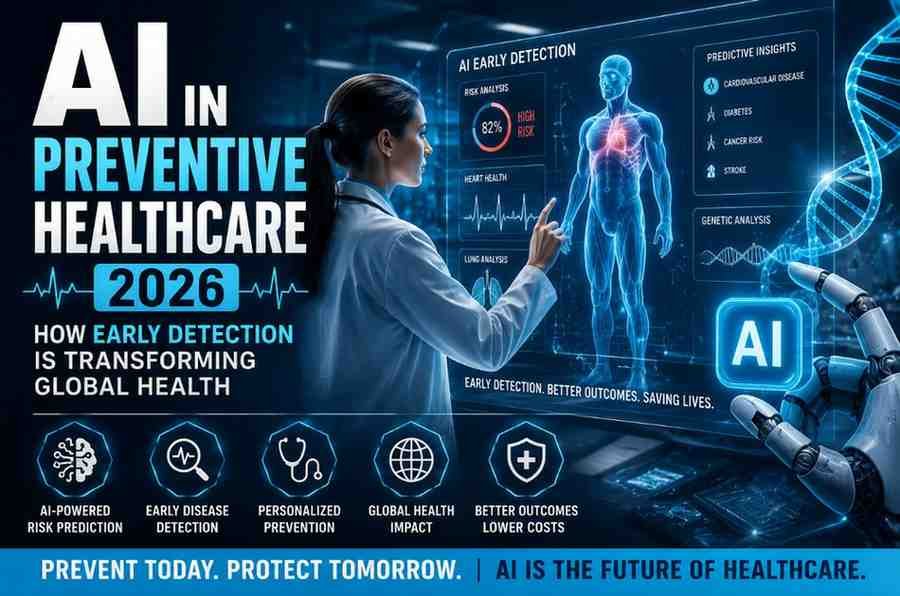
Primary Keyword: AI in preventive healthcare
LSI Keywords: artificial intelligence healthcare 2026, AI early disease detection, AI cancer screening tools, predictive healthcare analytics, mass health screening India AI, machine learning diagnosis, preventive medicine technology, future of healthcare AI
Introduction: The Big Shift from Cure to Prevention
For decades, healthcare systems around the world have largely focused on treating diseases after symptoms appear. But in 2026, a major transformation is underway. Artificial Intelligence (AI) in preventive healthcare is shifting the paradigm from reactive treatment to proactive early detection.
Who is driving this change? Governments, tech companies, hospitals, and researchers.
What is changing? AI is being used to predict and detect diseases before symptoms arise.
When is this happening? Rapidly accelerating in 2025–2026.
Where is it most impactful? Globally, with large-scale adoption in countries like India.
Why does it matter? Early detection can save lives and reduce healthcare costs.
How does AI do it? Through data analysis, pattern recognition, and predictive modeling.
This shift could redefine not just how we treat illness but how we understand health itself.
What Is AI in Preventive Healthcare?
AI in preventive healthcare refers to the use of algorithms and machine learning models to identify health risks before they become serious conditions. Instead of waiting for symptoms, AI analyzes vast amounts of data to detect early warning signs.
- Medical imaging (X-rays, MRIs)
- Electronic health records
- Wearable device data
- Genetic information
Simple idea: AI connects patterns humans might miss and does it faster.
Why AI in Preventive Healthcare Is Trending in 2026
1. Explosion of Health Data
With smartphones, wearables, and digital health records, massive amounts of health data are now available. AI thrives on this data to generate insights.
2. Rising Cost of Healthcare
Treating advanced diseases is expensive. Preventing them early is significantly more cost-effective.
3. Demand for Scalable Solutions
Countries with large populations, like India, need scalable healthcare solutions—AI enables mass screening efficiently.
4. Advances in Machine Learning
Modern AI models can now detect patterns with high accuracy, sometimes rivaling medical experts.
Insight: AI is not replacing doctors it is enhancing their ability to make faster, more accurate decisions.
Key Applications of AI in Preventive Healthcare
1. AI in Cancer Screening
AI-powered imaging tools can detect early-stage cancers in mammograms, lung scans, and other diagnostics.
- Identifies tumors earlier than traditional methods
- Reduces human error
- Speeds up diagnosis
Impact: Early detection dramatically improves survival rates.
2. Disease Prediction and Risk Assessment
AI models analyze patient history, lifestyle, and genetic data to predict diseases such as:
- Heart disease
- Diabetes
- Stroke
Example insight: AI can flag high-risk individuals years before symptoms appear.
3. Mass Health Screening in India
India is emerging as a global leader in AI-driven preventive healthcare.
- AI tools are used in rural and urban screening programs
- Helps detect diseases in underserved populations
- Supports government health initiatives
Why it matters: AI bridges the gap between limited doctors and large populations.
4. Wearables and Continuous Monitoring
Devices like smartwatches track vital signs in real time.
- Heart rate monitoring
- Sleep tracking
- Early alerts for irregularities
Trend: Healthcare is moving from hospital-based to home-based monitoring.
Comparison: Traditional Healthcare vs AI-Driven Preventive Healthcare
| Aspect | Traditional Approach | AI-Driven Preventive Approach |
|---|---|---|
| Focus | Treatment after symptoms | Early detection and prevention |
| Speed | Slower diagnosis | Rapid analysis |
| Accuracy | Dependent on human judgment | Data-driven precision |
| Accessibility | Limited in rural areas | Scalable and widespread |
| Cost | High long-term costs | Reduced overall costs |
Deep Analysis: Why This Shift Matters
The move toward AI-driven prevention is not just technological it is philosophical.
Old model: Wait for illness → Treat → Repeat
New model: Predict risk → Prevent → Maintain health
This transformation has three major implications:
- Healthcare becomes proactive instead of reactive
- Patients become participants in their own health monitoring
- Systems become more efficient and less burdened
Insight: The real power of AI is not in curing disease but in preventing it altogether.
Challenges and Limitations
1. Data Privacy Concerns
Handling sensitive health data raises ethical and security issues.
2. Algorithm Bias
AI models may produce biased results if trained on incomplete datasets.
3. Infrastructure Gaps
Not all regions have access to digital healthcare systems.
4. Trust and Adoption
Patients and doctors must trust AI recommendations for widespread adoption.
Reality Check: Technology alone is not enough—implementation matters.
Real-World Impact: What It Means for You
- Earlier diagnosis of serious diseases
- Reduced medical expenses over time
- Personalized health insights
- Improved quality of life
Example: A simple wearable alert could prevent a major cardiac event.
Unique Insight: AI Is Turning Healthcare into a “Continuous Process”
Traditionally, healthcare was episodic—you visit a doctor when sick. AI is changing this into a continuous system where your health is monitored in real time.
New reality:
- Health tracking becomes daily
- Risk detection becomes constant
- Intervention becomes timely
This is a fundamental shift in how humans interact with healthcare systems.
Future Outlook: What’s Next for AI in Preventive Healthcare?
- Integration with genetic testing for personalized medicine
- More accurate AI diagnostic tools
- Expansion of AI in rural healthcare systems
- Stronger regulations for safety and ethics
Prediction: Within the next decade, AI could become the first point of contact in healthcare—before a doctor visit.
Conclusion: A Smarter, Preventive Future
The rise of AI in preventive healthcare marks one of the most important shifts in modern medicine. By focusing on early detection and prediction, AI has the potential to save millions of lives and transform healthcare systems worldwide.
Final Thought: The best treatment is prevention and AI is making that possible at scale.
Future Outlook: As technology evolves and adoption grows, preventive healthcare powered by AI will become the foundation of global health systems, not just an innovation.
For breaking news and live news updates, like us on Facebook or follow us on Twitter and Instagram. Read more on Latest Health on thefoxdaily.com.


COMMENTS 0