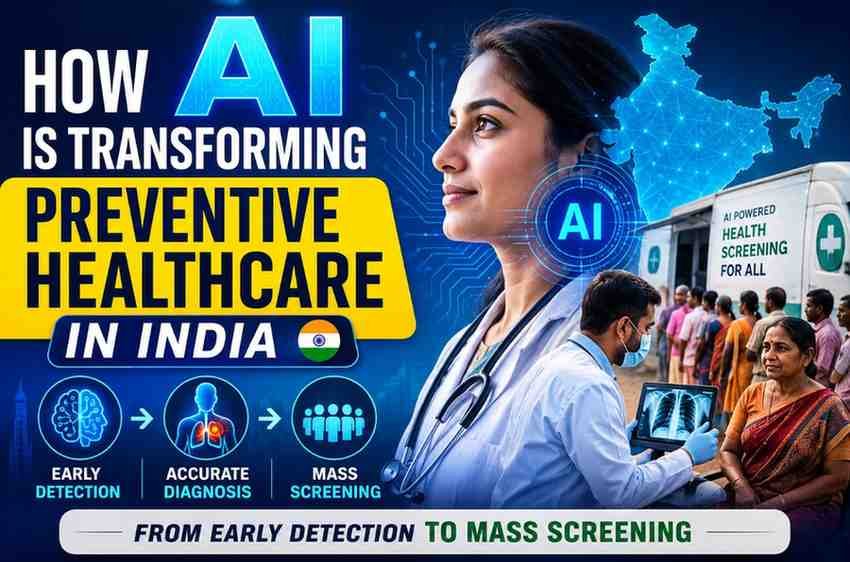
The numbers behind this shift are not abstract. Non-communicable diseases diabetes, cardiovascular conditions, cancer, chronic respiratory illness account for more than 60 percent of all deaths in India. The vast majority of these deaths are preceded by years of silent, detectable disease progression. High blood sugar before blindness. Arterial plaque before a heart attack. Precancerous lesions before a tumour. The tragedy is not just that people are dying it is that in most cases, earlier detection would have changed outcomes dramatically.
This is exactly where AI excels. Machine learning algorithms trained on millions of medical images, patient records, and biomarker datasets can detect patterns that are invisible to the human eye and do so consistently, at scale, without fatigue. What once required a specialist in a tertiary hospital can now, increasingly, be performed by a trained health worker with a tablet in a primary health centre 300 kilometres from the nearest city.
India’s preventive healthcare market reflects growing awareness of this potential. The sector is projected to expand significantly through 2030, driven by rising health consciousness, digital adoption, and the mounting economic burden of late-stage disease treatment — which costs multiples more than early intervention. This is not a niche trend; it is a structural realignment of how a billion-plus-person nation approaches its own survival.
The Programmes Already Running: India’s AI Health Deployments in Action
Tuberculosis: Teaching an Algorithm to Hear What a Doctor Might Miss
India bears the world’s highest TB burden. Eliminating the disease by 2025 was an ambitious national goal, and while it was not fully met on schedule, the tools being deployed in pursuit of it have produced measurable results. The ‘Cough Against TB’ (CATB) AI solution uses acoustic analysis of cough sounds to screen for pulmonary tuberculosis in community settings — no X-ray required, no laboratory, no specialist.
The impact is quantifiable. In the areas where CATB has been deployed, TB case detection improved by 12 to 16 percent above what conventional screening methods were capturing. Between March 2023 and November 2025, the tool screened over 1.62 lakh individuals. These are not people who would have otherwise walked into a hospital — many of them had no symptoms severe enough to prompt a clinic visit. The algorithm found them first.
Alongside CATB, the NIDAAN platform uses AI to analyse chest X-rays for more than 30 abnormalities simultaneously, strengthening diagnosis and treatment monitoring at scale. Together, these tools are building a TB detection infrastructure that does not depend on the availability of a radiologist in every district — a critical advantage in a country where specialist distribution remains severely uneven.
Diabetic Retinopathy: Saving Sight Before It Is Lost
Diabetic retinopathy is the leading cause of preventable blindness in India, and it is almost entirely avoidable if caught early. The problem has always been scale. India has approximately 101 million people living with diabetes, and the retina specialist-to-patient ratio makes systematic screening through conventional means practically impossible.
AI has entered this gap with force. MadhuNetrAI, the first government-backed AI-assisted community screening programme for diabetic retinopathy in India, launched in December 2025 and had already assisted over 7,100 patients across 38 healthcare facilities within weeks. The system works simply: a health worker scans the patient’s retina using a portable device, the AI evaluates the image, and patients identified as high-risk are flagged for urgent specialist care. No ophthalmologist required at the point of screening.
The clinical evidence is compelling. A multicentric study validating India’s AI Diabetic Retinopathy Screening System (AIDRSS) across thousands of patients found the algorithm achieved 92 percent sensitivity and 88 percent specificity overall and 100 percent sensitivity for detecting the most advanced, sight-threatening stages of the disease. For a condition that is asymptomatic in its early stages, this level of detection accuracy is not just impressive; it is potentially sight-saving for millions.
eSanjeevani: The Telemedicine Platform That Quietly Became a Giant
eSanjeevani is India’s national telemedicine platform, and its scale is staggering. Between April 2023 and November 2025, it enabled 282 million consultations — a number that dwarfs the entire population of many countries. Of these, approximately 12 million consultations were directly assisted by AI-enabled diagnostic recommendations through an integrated Clinical Decision Support System (CDSS).
The CDSS analyses patient symptoms and medical histories to provide differential diagnosis recommendations to doctors in real time, improving consultation quality and consistency across thousands of health and wellness centres. For an overworked doctor seeing 60 patients a day in an understaffed rural clinic, this is not a luxury it is a clinical safety net.
The One Health Data Infrastructure Making This Possible
None of these AI tools operate in isolation. They run on a digital backbone that India has spent years building. The Ayushman Bharat Digital Mission has created 799 million digital health IDs as of August 2025, establishing a unified health identity for citizens that allows medical records, diagnostic results, and treatment histories to flow across institutions and platforms.
This data infrastructure is what gives AI in Indian healthcare its compounding potential. Each consultation, each screening result, each diagnostic image fed into these systems makes the algorithms more accurate and more contextually calibrated to Indian disease patterns, Indian imaging conditions, and Indian patient demographics. The loop between data collection and model improvement is now active at national scale.
The IndiaAI Mission and its Centres of Excellence at institutions like AIIMS Delhi, PGIMER Chandigarh, and AIIMS Rishikesh are accelerating this further, funding research, validation, and deployment of the next generation of AI health tools. The government’s SAHI and BODH validation platforms, emphasised in 2026, are adding the quality-assurance layer that ensures AI tools meet safety and accuracy standards before deployment a crucial step that has been missing in many countries’ AI health rollouts.
The Unique Angle: AI Is Not Just Diagnosing It Is Redesigning Who Can Diagnose
Most coverage of AI in healthcare focuses on the technology itself the algorithms, the accuracy rates, the datasets. What is consistently underexamined is the deeper structural transformation these tools enable: the democratisation of diagnostic capability.
In traditional healthcare hierarchies, early detection of serious disease required a specialist. A diabetic retinopathy screen needed an ophthalmologist. A TB diagnosis required a radiologist or microbiologist. Cancer screening needed an oncologist. Each of these gatekeepers was scarce, concentrated in urban centres, and expensive to access. AI does not replace these specialists but it means that a trained community health worker, armed with the right tools and a reliable internet connection, can perform the screening function that previously required years of specialised training.
This is not a small shift. It is a fundamental redistribution of diagnostic capacity from the top of the healthcare pyramid to the base. And in a country where the base the village, the primary health centre, the Anganwadi worker is where the majority of health outcomes are actually determined, this redistribution matters enormously.
| AI Health Initiative | Disease Target | Scale / Impact (as of late 2025) | Key Technology |
|---|---|---|---|
| Cough Against TB (CATB) | Pulmonary Tuberculosis | 1.62 lakh individuals screened; 12–16% additional case yield | Acoustic AI cough analysis |
| NIDAAN / qXR | Tuberculosis + lung conditions | Detects 30+ chest abnormalities from X-rays at scale | Deep learning image analysis |
| MadhuNetrAI | Diabetic Retinopathy | 7,100+ patients screened across 38 facilities | Portable retina imaging + AI grading |
| eSanjeevani CDSS | General primary care | 282 million consultations; 12M with AI-assisted diagnosis | AI clinical decision support |
| Media Disease Surveillance | Outbreak monitoring | 4,500+ outbreak alerts generated | AI-powered epidemiological surveillance |
| Arogya Aarohan | Oral cancer risk assessment | Under validation at AIIMS; multiple states | AI risk scoring from clinical images |
The Challenges That Cannot Be Papered Over
Intellectual honesty demands acknowledging that India’s AI healthcare story, impressive as it is, has significant unresolved chapters.
The infrastructure gap at the facility level is real and largely unacknowledged in policy announcements. AI diagnostic tools require consistent electricity, reliable internet, functioning equipment, and digitised patient records to deliver on their promise. A substantial proportion of India’s public health facilities still maintain records on paper, with equipment that lacks structured maintenance programmes. The brilliant algorithm trained in a Bengaluru data centre can do nothing useful on a broken scanner in a power-cut rural clinic.
Data quality and representational bias are equally serious concerns. AI models trained predominantly on data from urban tertiary hospitals may perform less accurately on patients from different ethnic backgrounds, different environmental exposures, and different comorbidity profiles. Ensuring that India’s AI health tools are validated on the populations they are actually meant to serve not just on the patient populations that happen to attend large academic hospitals is a scientific and ethical imperative.
Privacy and consent frameworks for health data at scale also remain underdeveloped. As hundreds of millions of digital health IDs accumulate sensitive medical information, the regulatory infrastructure to protect that data must keep pace with the speed of collection.
What the Next Five Years Could Look Like: A Prediction
The trajectory of AI in Indian preventive healthcare over the coming half-decade points in a clear direction, even if the pace of progress is uncertain. Predictive risk scoring using combinations of wearable data, electronic health records, and lifestyle information to identify individuals likely to develop chronic conditions before symptoms appear will move from pilot programmes to mainstream deployment. AI-powered rural micro-clinics, operated by trained community health workers supported by remote physicians and AI diagnostic tools, will become the primary care model for India’s most underserved populations. Cancer screening, currently concentrated in tertiary hospitals, will begin moving to district and primary levels through AI-assisted pathology and radiology tools.
The compounding effect of 799 million digital health IDs generating longitudinal health data will also, over time, create the world’s largest population health dataset calibrated to a single national context. That is a scientific resource of extraordinary value both for refining AI tools and for generating insights into disease causation, progression, and intervention effectiveness that no other country can match at this scale.
Conclusion: The Shift Has Already Happened What Remains Is the Scaling
The narrative around AI in healthcare often defaults to future tense what it will do, what it might achieve, what promise it holds. In India, that future tense is increasingly inaccurate. The shift from reactive treatment to AI-enabled prevention is not coming. It is here, unevenly distributed but undeniably real, in the cough analysis algorithms screening slum populations for TB, the portable retinal scanners catching diabetic eye disease in village health centres, and the clinical decision support tools helping an overworked doctor make a better diagnosis in a one-room primary health facility.
The challenges ahead infrastructure gaps, data quality, equity of access, regulatory frameworks are not small. But they are the challenges of scaling something that demonstrably works, not the challenges of proving that something works at all. That is a different and more tractable problem, and it is the problem India’s AI healthcare ecosystem now faces.
The country that once could not afford prevention at scale has built the tools to make prevention the default. The question now is not whether AI will transform Indian healthcare. It is how quickly and how equitably that transformation reaches everyone who needs it.
For breaking news and live news updates, like us on Facebook or follow us on Twitter and Instagram. Read more on Latest Health on thefoxdaily.com.



COMMENTS 0