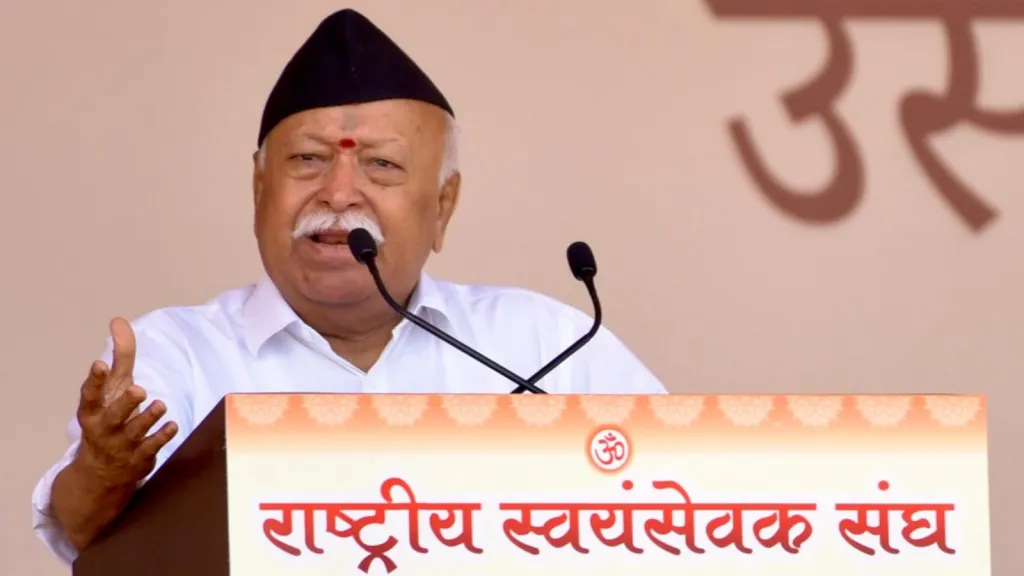
Rashtriya Swayamsevak Sangh (RSS) chief Mohan Bhagwat has said that attempts to bring about regime change will not succeed in India, accusing global powers of trying to weaken the country and undermine its existing social and political order.
Speaking at the RSS’s annual Vijayadashami celebrations at Reshimbagh ground in Nagpur on Tuesday, Bhagwat referred to unrest in France, Albania, Nepal and Bangladesh to argue that replacing a government does not necessarily improve conditions within a country. He described the developments as part of what he called a “storm from the West”.
Bhagwat’s remarks focused on political instability, foreign influence, national identity and the role of public protests. He alleged that some international forces wanted to prevent India from becoming stronger because its growing influence could challenge their own position.
He also urged people to approach demonstrations with the aim of resolving problems rather than creating divisions in society. According to the RSS chief, protests are inevitable when grievances persist, but they should lead to constructive outcomes instead of hostility or disorder.
The address placed national unity and social cohesion at the centre of Bhagwat’s message. He argued that movements seeking to dismantle existing systems could exploit dissatisfaction and social differences, while maintaining that India had progressed in recent decades under what he described as sound policies and leadership.
What Mohan Bhagwat said about regime change
Bhagwat used examples of political unrest in several countries to question the assumption that replacing a government automatically resolves a nation’s difficulties.
“Look at what happened in France or Albania or Nepal or Bangladesh. They say changing the regime will change the situation. But that has never happened anywhere,” he said.
He then described the developments as a wider challenge to established systems, stating that “this storm has risen from the West, which is against every form of systemic conduct.”
His remarks reflected his view that political upheaval does not necessarily address the underlying causes of public dissatisfaction. Instead, he suggested that changing governments without resolving deeper problems could leave societies facing similar difficulties.
Bhagwat’s statement was a political assessment rather than a detailed examination of the circumstances in each country he mentioned. France, Albania, Nepal and Bangladesh have different political systems, histories and reasons for public mobilisation. The examples were grouped together in his speech to support his broader argument about regime change and instability.
His comments also raised a distinction between replacing political leadership and addressing the problems that lead people to demand change. A government can change without necessarily resolving economic, social or institutional grievances, just as changes in policy or leadership can sometimes form part of a wider reform process.
Bhagwat’s central argument was that political change alone should not be treated as a complete solution. He urged people to focus on the broader condition of society rather than assuming that removing those in power would automatically improve the situation.
Bhagwat says India’s progress and youth’s national pride concern global powers
Bhagwat also argued that India had made progress over recent decades through what he described as sound policies and leadership. He presented the country’s development as a reason for concern among forces that, according to him, wanted to limit India’s growing influence.
The RSS chief placed particular emphasis on the younger generation, saying that increasing national pride among young Indians was a source of concern for those seeking to weaken the country.
He alleged that some external forces were supported by individuals and leaders who wanted to dismantle India’s existing order. According to Bhagwat, these efforts sought to take advantage of social differences and dissatisfaction to create divisions within the country.
He also suggested that India’s growing strength could challenge the position of powerful countries. Expressing this view, Bhagwat said: “They want India but also don’t want India to be powerful, kyonki unke badappan ko dhakka lagega.” The Hindi phrase means that India’s rise could affect their sense of superiority or dominance.
These statements reflected Bhagwat’s interpretation of international power dynamics. His remarks did not identify specific governments or provide detailed evidence for the allegations of coordinated efforts to weaken India.
The broader argument was that national development and social unity should remain priorities, particularly when India faces domestic disagreements or international competition. Bhagwat presented greater national confidence as a positive development and urged people not to allow dissatisfaction to undermine social cohesion.
Why Bhagwat warned against protests that create social divisions
Alongside his criticism of alleged foreign interference, Bhagwat addressed the role of protests and public movements in a democratic society. He acknowledged that problems persist and that demonstrations are an inevitable response to grievances, but argued that their purpose should be to find solutions.
“Problems persist, and agitations happen. But agitations should aim at solutions. It should not lead to ill-will in society. We should not allow cheap publicity to overcome our intellect and wisdom. Not agitation but the rise of society as a whole provides solutions,” he said.
The statement outlined his view that demonstrations should be judged by whether they help resolve problems rather than deepen hostility between groups.
Bhagwat alleged that forces seeking to weaken India exploited social differences, encouraged feelings of victimhood and dissatisfaction, and attempted to distance people from the wider community. He warned that such tactics could foster hatred towards the existing system and contribute to disorder.
His argument was that grievances should be addressed without allowing them to become sources of lasting social division. He called for collective social progress as a means of resolving problems, rather than relying exclusively on agitation or attempts to replace those in power.
At the same time, the distinction between peaceful protest, political opposition and actions intended to create disorder remains important when assessing public movements. Bhagwat’s remarks expressed his position on the purpose of agitation; they did not establish that all protests or demands for political change are driven by the motives he alleged.
Regime change and the question of political stability
Bhagwat’s remarks raise a broader question about the relationship between political leadership and a country’s underlying problems. A change of government does not, by itself, guarantee that economic difficulties, institutional weaknesses or social tensions will disappear.
However, the effectiveness of political change depends on the circumstances. Elections, changes in leadership and public movements can also provide mechanisms for responding to grievances, changing policies and holding governments accountable.
For this reason, the examples Bhagwat cited should be considered in their individual contexts. Political unrest in France, Albania, Nepal and Bangladesh has unfolded under different circumstances, and the consequences of changes in leadership cannot be reduced to a single explanation.
His speech instead advanced a wider argument: that lasting progress requires more than replacing a government and that social cohesion is necessary to address problems effectively.
The emphasis on stability and collective development also reflects the RSS chief’s concern about the potential for social differences to be used for political purposes. He argued that dissatisfaction could be manipulated in ways that increase distrust and weaken the country’s social fabric.
Whether political change leads to better outcomes ultimately depends on the policies adopted, the institutions involved and the extent to which the concerns of citizens are addressed. Bhagwat’s comments placed the focus on social development and national unity rather than regime change as an end in itself.
What Bhagwat’s speech means for the RSS’s public message
The address at the RSS’s 101st anniversary celebrations brought together several recurring themes in Bhagwat’s public messaging: national identity, social unity, India’s international position and the responsibilities of citizens during periods of political tension.
By describing unrest in several countries as a “storm from the West”, Bhagwat connected developments abroad with his concerns about India’s own social and political environment. He alleged that external forces were attempting to exploit dissatisfaction and weaken the country, while presenting national pride and collective progress as responses to those challenges.
His remarks also stressed that protests should not deepen hostility within society. The message was directed at how citizens and political actors respond to problems, with Bhagwat arguing that solutions should take priority over confrontation and publicity.
The speech combined criticism of alleged international interference with a call for domestic cohesion. Its central message was that India’s progress should be protected through social responsibility and a focus on resolving grievances, rather than through movements that, in his view, risk creating further divisions.
However, his allegations about global powers and their intentions remain claims made by the RSS chief. The speech did not provide detailed evidence identifying the actors involved or establishing a coordinated international effort to bring about regime change in India.
Conclusion
RSS chief Mohan Bhagwat has said that regime change will not happen in India, arguing that replacing governments does not automatically resolve a country’s problems. Speaking at the organisation’s 101st anniversary celebrations in Nagpur, he referred to unrest in France, Albania, Nepal and Bangladesh and described the developments as a “storm from the West”.
Bhagwat alleged that some global powers wanted to weaken India because its growing influence could challenge their position. He also argued that social differences and public dissatisfaction could be exploited to create hostility and disorder.
Alongside those claims, the RSS chief called for protests to focus on solutions rather than division. He said lasting progress depended on the rise of society as a whole and highlighted what he described as growing national pride among young Indians.
His speech presented national unity and social development as alternatives to political upheaval. The central question remains how countries can address public grievances while preserving social cohesion, political accountability and the institutions needed to resolve disputes.
For breaking news and live news updates, like us on Facebook or follow us on Twitter and Instagram. Read more on Latest India on thefoxdaily.com.






COMMENTS 0