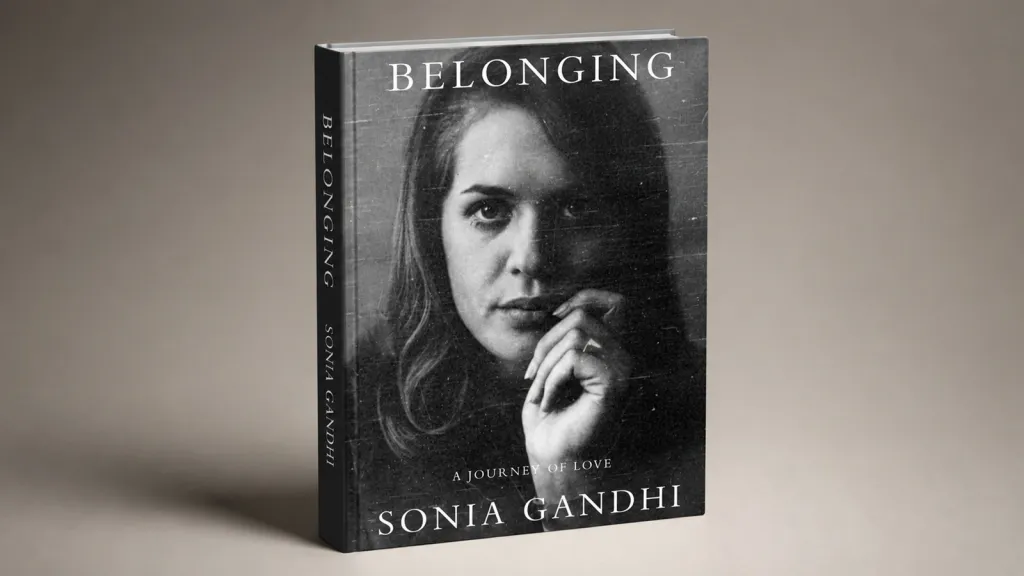
Sonia Gandhi’s long-awaited memoir, Belonging: A Journey of Love, will be published on November 10, bringing together the personal experiences, family tragedies and political events that shaped one of the most prominent figures in modern Indian Politics.
The 544-page book is set to be published in hardcover and ebook by Alfred A Knopf, while Penguin Random House will release the audio edition. The memoir promises an unusually personal account from a political figure WHO spent much of her public life maintaining a guarded private identity.
For Sonia Gandhi, the decision to write about her life was not simply an exercise in documenting political history. She has described the process as an emotional return to experiences and losses that she had kept deeply private for years.
The memoir follows her life from childhood in post-war Italy to her meeting with Rajiv Gandhi in Cambridge, her arrival in India, her relationship with Indira Gandhi and the tragedies that transformed the Gandhi family. It also examines her eventual entry into politics and her decision in 2004 not to become prime minister despite the Congress-led alliance winning the general election.
At a broader level, Belonging is positioned as both a family story and a personal account of India’s political and social transformation over several decades.
When will Sonia Gandhi’s memoir Belonging be released?
Belonging: A Journey of Love will be released on November 10.
The book will be available in hardcover and ebook formats through Alfred A Knopf. Penguin Random House will publish the audio edition, giving readers another way to access Gandhi’s account of her life.
Knopf has announced an initial print run of 100,000 copies, underlining the publisher’s expectation that the memoir will attract substantial attention in India and internationally.
Jordan Pavlin, executive vice president, publisher and editor-in-chief at Knopf, said the publishing house was honoured to publish the memoir and described it as an account of Gandhi’s life, resilience, family and history.
The scale of the first printing also reflects the unusual position of the author. Sonia Gandhi has been at the centre of Indian public life for decades, but has generally revealed relatively little about her private experiences compared with the enormous amount written about her family and political Career.
Why Sonia Gandhi decided to write the memoir
Gandhi has said that writing the book required her to confront memories she had kept private for much of her life.
In a statement released by Knopf, she explained that heartbreak and loss pushed her into public life even though she had previously been determined to protect her privacy.
That observation provides an important lens through which to read the memoir. Her political journey did not begin with an early ambition to seek public office. Instead, it developed after a series of extraordinary personal events placed her family at the centre of India’s political life.
Gandhi has described the writing process as an act of opening herself up and sharing experiences she had previously kept deep inside.
That makes Belonging different in emphasis from a conventional political autobiography. Rather than presenting her life solely through elections, offices and political decisions, the memoir is framed around relationships, grief, loyalty, identity and the meaning of home.
From post-war Italy to India
Sonia Gandhi was born Sonia Maino in Italy and spent her childhood in the post-war period. Her early life, according to the memoir’s description, was rooted in the relative simplicity of a small-town Italian upbringing.
That background became an important contrast to the life she would eventually lead in India.
The memoir begins in Cambridge, England, in 1965, when Sonia Maino was 19 years old. It was there that she met Rajiv Gandhi, who was studying in Cambridge at the time.
The relationship that began between the two young people eventually led to marriage and transformed the course of Sonia’s life.
Moving to India meant entering a completely different social and cultural environment. She became part of the Nehru-Gandhi family and the household of Indira Gandhi, who was already one of the country’s most important political figures.
For someone who had grown up in Italy, adapting to India involved learning a new language, customs and social environment. The memoir describes her efforts to learn Hindi, wear saris and become comfortable with Indian Food and culture.
These details offer a glimpse into an aspect of Sonia Gandhi’s life that is often overshadowed by her later political career: the process of becoming part of a country that was initially foreign to her.
Her relationship with Indira Gandhi
One of the significant relationships explored in Belonging is Sonia Gandhi’s connection with her mother-in-law, former prime minister Indira Gandhi.
By marrying Rajiv Gandhi, Sonia became part of one of India’s most politically influential families. Indira Gandhi was not simply a family member but a national political leader whose decisions shaped the country during a turbulent period.
The memoir therefore provides an opportunity to view Indira Gandhi from a perspective different from conventional political biographies: that of a daughter-in-law living within her family.
According to the publisher’s description, Gandhi seeks to move beyond simplified narratives about her family. She argues that many existing accounts have not fully captured the motivations, actions and human weaknesses of the people involved.
That focus on human complexity appears to be central to the memoir. Rather than portraying the Gandhi family only through its political influence, she says she wants to acknowledge the personal qualities and vulnerabilities behind the public figures.
Three deaths that changed the Gandhi family
Few aspects of Sonia Gandhi’s life can be separated from the tragedies that struck her family.
Rajiv Gandhi’s younger brother, Sanjay Gandhi, died in a plane crash in 1980. The death had a profound impact on the Gandhi family and changed the political circumstances surrounding Rajiv, who subsequently became increasingly involved in public life.
Four years later, Indira Gandhi was assassinated on October 31, 1984, by two of her Sikh bodyguards.
Her death abruptly pushed Rajiv Gandhi into the position of prime minister. It also placed Sonia Gandhi and her young family at the centre of an extraordinary national moment.
Rajiv Gandhi remained prime minister until 1989. He later returned to active campaigning and was assassinated in 1991 while campaigning for the general election in Tamil Nadu.
For Sonia Gandhi, these were not simply historical events. They were deaths within her immediate family, experienced while the family’s private grief unfolded alongside enormous public attention.
The memoir’s focus on love and loss is therefore closely connected to these events. They help explain why Sonia Gandhi’s eventual political role cannot easily be understood without considering the personal tragedies that preceded it.
Why Sonia Gandhi initially resisted politics
Despite being married into India’s most famous political family, Sonia Gandhi did not immediately enter politics.
For years after Rajiv Gandhi’s assassination, she remained outside active electoral politics. Her eventual decision to enter public life came after sustained pressure from Congress leaders and supporters.
When she finally entered politics in the late 1990s, her presence rapidly became one of the defining features of the Congress party’s national strategy.
She eventually became Congress president and played a central role in rebuilding the party’s national coalition during the early 2000s.
Her political career, however, remained closely tied to the question of whether she wanted power for herself or was acting out of a sense of responsibility towards the party and the Gandhi family’s political legacy.
That tension is likely to be one of the central themes of Belonging.
The 2004 decision that changed Sonia Gandhi’s political legacy
One of the most consequential moments covered by the memoir is the 2004 general election.
The Congress-led United Progressive Alliance emerged as the grouping capable of forming the government, and Sonia Gandhi was widely expected to become prime minister.
Instead, she declined the position.
Manmohan Singh subsequently became prime minister, while Sonia Gandhi remained a central political figure as Congress president and chairperson of the United Progressive Alliance.
Her decision remains one of the most discussed moments of her political career because it separated party leadership and political influence from the formal office of prime minister.
In Belonging, that episode is placed within a much broader story about duty, identity and the meaning of public service.
For readers trying to understand Sonia Gandhi’s political choices, the memoir could provide additional insight into how she personally viewed the decision rather than simply how political observers interpreted it at the time.
‘Belonging’ is also a story about identity
The title itself points to one of the memoir’s central questions: where does a person belong after spending a lifetime between different countries, cultures and identities?
Sonia Gandhi began life in Italy, met Rajiv Gandhi in Britain and ultimately built her family and political life in India.
Her transition to India was not simply geographical. It involved learning a new language, adopting unfamiliar customs and becoming part of a family whose history was inseparable from the country’s political development.
Gandhi describes the evolution as a journey from the simplicity of childhood in Italy to the complexity of her life in India.
She ultimately describes India as the “beautiful country of my belonging”, suggesting that the concept of belonging is not determined only by birthplace.
That makes the memoir relevant beyond politics. It touches on questions familiar to people who move between countries, cultures and families and gradually develop a sense of home in a place that was not their birthplace.
A personal view of six decades of Indian change
Another major feature of Belonging is its historical scope.
Gandhi has lived through more than six decades of dramatic change in India, from the political and economic environment of the 1960s to the highly competitive electoral landscape of the 21st century.
As a member of the Nehru-Gandhi family and later a political leader herself, she witnessed events from an unusually close distance.
The publisher describes the memoir as offering a perspective on India’s post-independence history as well as its contemporary political struggles. It also presents the book as an account of the country’s economic and social transformation.
Her perspective is inherently personal. It is not intended to function as a neutral history of India, but rather as a recollection of the events she witnessed and the people she knew.
That distinction is important. Memoirs can provide details and emotions that conventional historical accounts cannot, but they also represent an individual’s memory and interpretation of events.
What readers can expect from the 544-page memoir
The book’s length gives Gandhi considerable space to move beyond a simple political chronology.
Based on the publisher’s description, readers can expect the memoir to combine several strands:
- Her childhood and upbringing in post-war Italy.
- Her meeting with Rajiv Gandhi in Cambridge in 1965.
- Her marriage and transition to life in India.
- Her relationship with Indira Gandhi and the wider Gandhi family.
- The deaths of Sanjay Gandhi, Indira Gandhi and Rajiv Gandhi.
- Her eventual entry into the Congress party and national politics.
- Her decision to decline the prime minister’s office after the 2004 election.
- Her reflections on India’s political, social and economic transformation.
- Questions of identity, loyalty, family, duty and belonging.
This combination gives the memoir a scope that extends beyond Sonia Gandhi’s own political career.
Why the memoir is likely to attract political attention
Sonia Gandhi has been the subject of intense political debate for decades, but much of the public discussion around her has focused on elections, the Congress party, the Gandhi family and her role in government.
A first-person memoir changes the nature of that conversation.
Readers will have an opportunity to compare Gandhi’s own account of important moments with the established public record and with accounts written by political observers, journalists and historians.
The most closely examined sections are likely to be those dealing with her relationship with Rajiv Gandhi, Indira Gandhi’s assassination, Rajiv Gandhi’s political career and assassination, her decision to enter politics and her 2004 decision to step aside from the prime minister’s post.
Any personal reflections on those events could influence how future accounts of the Gandhi family’s political history are understood.
What makes ‘Belonging’ different from a conventional political autobiography?
The framing of the book suggests that Gandhi does not intend to present herself simply as a former Congress president or the widow of a former prime minister.
The emphasis is instead on the emotional thread connecting the different stages of her life.
Gandhi has described that thread as one of love and loyalty. The concept allows the memoir to connect apparently separate events: her childhood in Italy, her relationship with Rajiv, her integration into India, the loss of family members and her eventual acceptance of political responsibility.
That approach could make the book especially significant because the public image of Sonia Gandhi has often been defined by political arguments, while her personal voice has been less prominent.
Belonging offers her an opportunity to address that gap directly.
What to know before the November 10 release
| Detail | Information |
|---|---|
| Book | Belonging: A Journey of Love |
| Author | Sonia Gandhi |
| Length | 544 pages |
| Release date | November 10 |
| Hardcover and ebook publisher | Alfred A Knopf |
| Audio publisher | Penguin Random House |
| Initial print run | 100,000 copies |
A memoir shaped by love, loss and public duty
Sonia Gandhi’s Belonging arrives with an unusual promise: to tell the story of a woman who spent much of her early life trying to remain outside politics but was ultimately drawn into public life by family tragedy and circumstance.
Her journey spans continents, generations and some of the most consequential episodes in India’s modern political history. Yet the book’s central idea is not simply political power.
It is belonging.
Gandhi’s account moves from childhood in Italy to marriage in India, from private family life to national politics and from personal grief to public responsibility. Along the way, she reflects on people whose lives have been documented extensively but whose private motivations and vulnerabilities, she argues, are often harder to see.
That makes the November 10 release more than another political memoir. It is an attempt by one of India’s most recognisable political figures to explain how she experienced the events that shaped her life and how, over time, a country she entered as an outsider became the place she came to call home.
For readers interested in Indian politics, the Gandhi family or the country’s post-independence history, the most valuable parts of the book may ultimately be those where the political and personal stories overlap.
For breaking news and live news updates, like us on Facebook or follow us on Twitter and Instagram. Read more on Latest World on thefoxdaily.com.






COMMENTS 0