Prime Minister Narendra Modi has completed 25 years at the helm of a government, marking a political milestone that the Bharatiya Janata Party (BJP) and its National Democratic Alliance (NDA) partners are commemorating through events across the country.
Modi’s journey as the head of a government began on October 7, 2001, when he took oath as the chief minister of Gujarat. He remained in that position for more than 12 years before moving to the national stage and becoming the BJP’s prime ministerial candidate ahead of the 2014 lok Sabha election.
Since becoming prime minister in 2014, Modi has led the NDA to victories in three consecutive Lok Sabha elections. The BJP is using the 25-year milestone to highlight the evolution of his political career, from his years in Gujarat to his tenure at the Centre.
From Gujarat Chief Minister to Prime Minister
October 7, 2001, marked the beginning of Modi’s uninterrupted tenure as the head of a government. His first assignment was as Gujarat chief minister, a position he held for more than 12 years before moving to national politics.
In 2014, Modi led the BJP into the Lok Sabha election as its prime ministerial candidate. The party secured a majority, allowing him to form the government at the Centre. He returned to office with a larger mandate in 2019 and was again elected prime minister after the 2024 Lok Sabha election.
His three consecutive terms have made the Gujarat-to-Delhi transition a central part of the political narrative surrounding the 25-year milestone. The BJP and the Union Cabinet have sought to connect policies and administrative initiatives associated with his Gujarat tenure with programmes later implemented or expanded nationally.
How the BJP Is Marking 25 Years of PM Modi’s Leadership
The BJP has turned the milestone into a nationwide public programme rather than limiting the celebrations to a single event. The month-long Seva Sankalp Abhiyan, launched on Modi’s birthday on September 17, has included blood donation drives, cleanliness programmes, welfare outreach, exhibitions, cultural programmes and other public-service activities.
On the milestone day, BJP organisations across states are holding programmes designed to highlight Modi’s political journey. These include torch marches, motorcycle and cycle rallies, exhibitions and public gatherings.
In Delhi, the main Seva Jyoti programme is being held at the Indira Gandhi Stadium Complex. BJP workers and supporters from organisational units across the capital are expected to participate in the programme.
The format of the celebrations reflects the BJP’s attempt to present the 25-year period not simply as an anniversary of Modi’s political career but as a broader account of governance, public service and policy initiatives associated with his leadership.
Modi Marks Milestone With Temple Visit
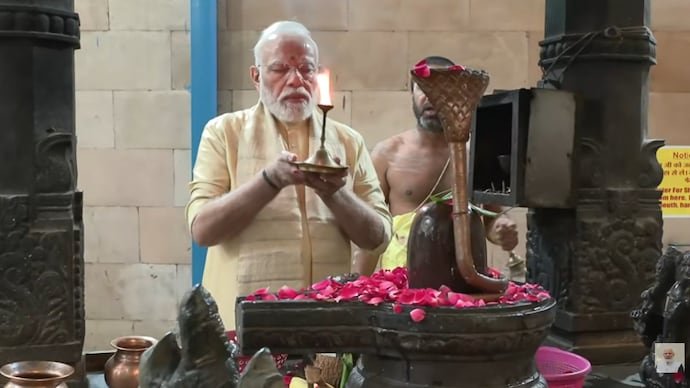
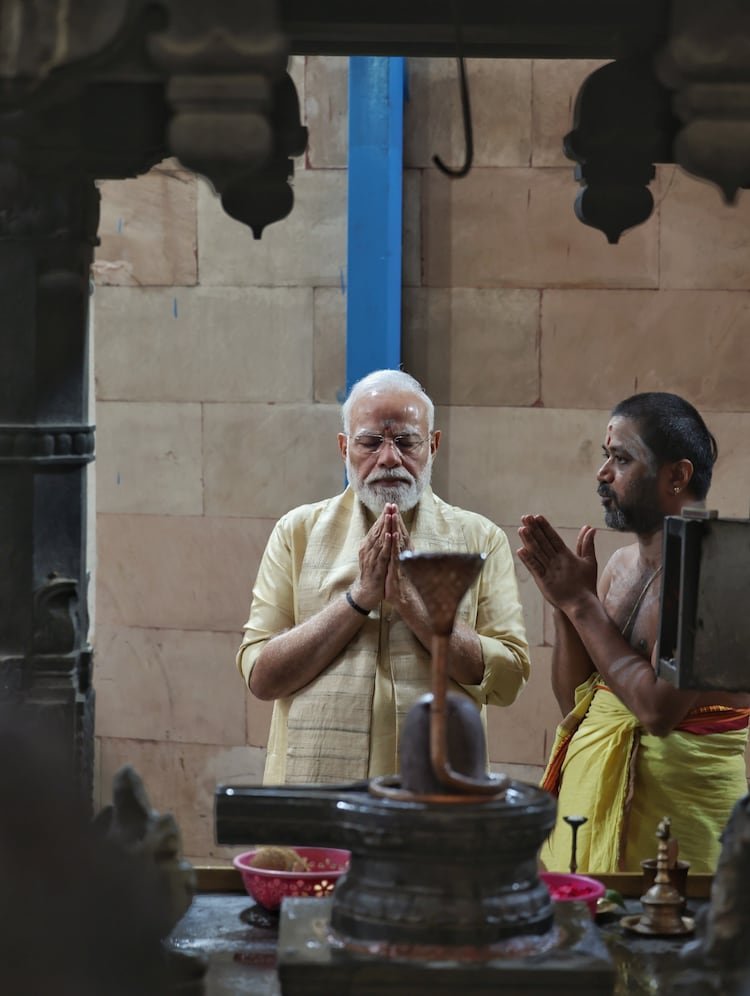
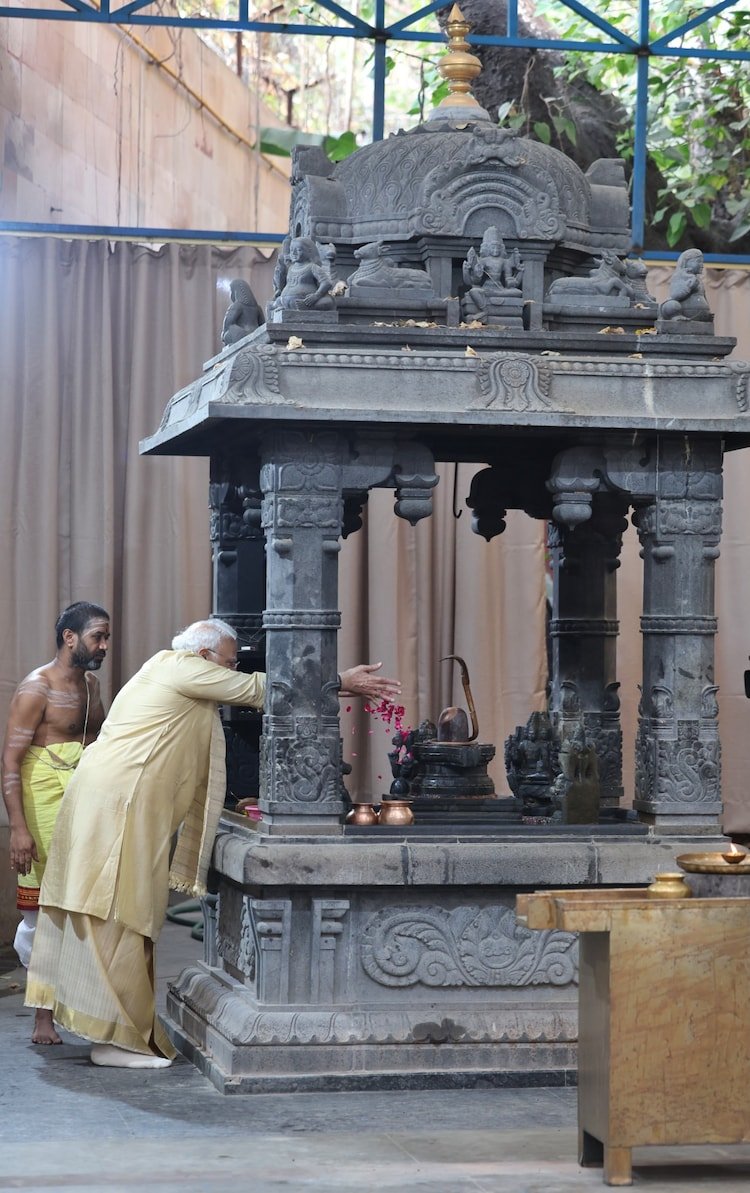
On Wednesday, Modi offered prayers and performed aarti at Shri Vinayak Mandir in Sarojini Nagar, Delhi, as he marked 25 years of uninterrupted leadership as the head of a government.
During the occasion, Modi prayed for the well-being of India‘s 140 crore people and renewed his pledge to serve the country with “utmost dedication”. The temple visit formed part of a day of events surrounding the political milestone.
The BJP’s nationwide programmes are being held alongside official recognition from the Union government and public messages from leaders of the NDA.
Union Cabinet Hails Modi’s ‘Unbroken’ Leadership
The Union Cabinet formally congratulated Modi at its meeting on Tuesday for completing 25 years of continuous leadership as the head of a government.
Information and Broadcasting Minister Ashwini Vaishnaw said the Cabinet resolution was more than a customary tribute. The resolution described Modi’s political journey through the principle of “Nation First and Citizen First” and highlighted welfare, infrastructure, economic reforms, Technology and national security as major themes of his tenure.
The Cabinet resolution cited nearly 60 crore Jan Dhan accounts, more than 4 crore houses and PM-KISAN transfers exceeding Rs 4 lakh crore. It also referred to the government’s claim that 25 crore people have moved out of poverty.
Among the policy changes highlighted were the Goods and Services Tax, expansion of digital payments, UPI, reforms in welfare delivery and the replacement of colonial-era laws.
SWAGAT and Jyotigram: Gujarat Initiatives With a National Legacy
The BJP’s account of Modi’s 25 years also places emphasis on initiatives introduced during his time as Gujarat chief minister.
The Union Cabinet resolution specifically pointed to the SWAGAT grievance-redressal system and the Jyotigram scheme. SWAGAT allowed citizens to raise grievances that were reviewed through an administrative mechanism in which Modi personally examined complaints.
SWAGAT received the United Nations Public Service Award in 2010. Its approach was later cited as an inspiration for PRAGATI, the central government’s platform for reviewing stalled projects and addressing implementation bottlenecks.
The reference to these programmes is significant to the BJP’s presentation of Modi’s political journey because it links his Gujarat administration with governance mechanisms subsequently expanded at the national level.
Technology and Welfare Delivery at the Centre
The Cabinet resolution also framed Modi’s tenure around the expansion of technology-driven governance and digital infrastructure.
Jan Dhan bank accounts, Aadhaar identification and mobile connectivity were highlighted as components of a system that expanded digital welfare delivery. UPI was cited as another major transformation, particularly in the way digital payments became part of everyday economic activity.
The resolution also referred to India’s technological and industrial development, including highways, railway electrification, electronics production, defence manufacturing and semiconductor production.
India’s development of Covid vaccines and the Chandrayaan-3 landing near the Moon’s south pole were also cited as examples of the country’s technological capabilities during Modi’s tenure.
Security and National Policy Remain Central Themes
National security is another major element in the Union Cabinet’s assessment of Modi’s 25 years at the helm of government.
The resolution referred to the 2016 surgical strikes, the 2019 Balakot air strikes and 2025 Operation Sindoor. It also highlighted the removal of Article 370, One Rank One Pension, the creation of the Chief of Defence Staff and government action against Maoist violence.
These issues represent some of the major security and institutional decisions associated with the Modi government’s tenure. Their inclusion in the anniversary messaging shows how the BJP is presenting national security alongside welfare, technology and economic policy as defining areas of the period.
India’s Global Role and the 2047 Vision
The Cabinet resolution also highlighted India’s international engagement during Modi’s tenure. It referred to India’s participation in forums such as the G20 and BRICS, its advocacy for the Global South and the inclusion of the African Union in the G20.
The resolution also mentioned Vaccine Maitri and noted that Modi has received state honours from 36 countries.
The BJP is connecting these elements of India’s international profile with its broader vision of a developed India by 2047. The 25-year milestone therefore serves as an opportunity for the party to link Modi’s political career with a longer-term national development narrative.
NDA Leaders Join the Celebrations
The anniversary is being presented as an occasion involving the wider NDA alliance rather than the BJP alone. Several leaders from allied parties have publicly congratulated Modi and participated in programmes marking the milestone.
Andhra Pradesh Deputy Chief Minister Pawan Kalyan and minister Nara Lokesh have praised Modi’s record while referring to initiatives including Digital India, UPI, Make in India, Startup India and Aatmanirbhar Bharat.
Maharashtra Deputy Chief Minister Eknath Shinde has also congratulated Modi. TDP chief N Chandrababu Naidu, LJP leader Chirag Paswan and other NDA leaders participated in celebrations in Varanasi earlier.
The participation of alliance leaders allows the BJP to frame the milestone around both Modi’s individual political journey and the coalition that has supported his government at the Centre.
Delhi Traffic Restrictions for Seva Jyoti Programme
The large-scale programme in Delhi is also expected to affect traffic movement in central parts of the capital.
The Delhi Traffic Police has announced restrictions from 5 am to 1 pm on several important roads, including Bahadur Shah Zafar Marg, JLN Marg, Mahatma Gandhi Marg, IP Marg and Vikas Marg.
Traffic will also be regulated around Shanti Van Crossing, Rajghat, Bhairon Marg, Geeta Colony Flyover, IP Flyover, Salimgarh Bypass, W-Point, Delhi Gate and the Rajghat-Kisan Ghat and Power House Road stretch.
Depending on operational requirements, traffic will not be permitted on Secretariat Road and Velodrome Road from 6 am onwards.
Commuters have been advised to avoid affected stretches between 5 am and 1 pm wherever possible. Parking restrictions will also apply, and vehicles parked on affected roads may be towed and prosecuted.
A 25-Year Political Journey Spanning Two Levels of Government
Modi’s 25 years as a head of government cover two distinct phases: more than a decade in Gujarat followed by more than a decade at the Centre.
The BJP’s anniversary campaign is designed to present these phases as part of one continuous political journey. Gujarat is being highlighted as the starting point of Modi’s experience in government, while his years as prime minister are being associated with nationwide welfare programmes, economic and technological changes, infrastructure development, national security and India’s international engagement.
The distinction between the two phases is also important for understanding the scale of the milestone. Modi did not enter national executive office directly. His political career at the head of a government began with his appointment as Gujarat chief minister in 2001, followed by his transition to national leadership in 2014.
What the 25-Year Milestone Represents for the BJP
For the BJP, the anniversary provides an opportunity to consolidate a narrative around continuity in leadership and the expansion of policies from state-level governance to the national level.
The party’s events, exhibitions and service programmes are bringing together political supporters, government achievements and public outreach under the Seva Sankalp Abhiyan. The participation of NDA leaders adds an alliance dimension to the celebrations.
The milestone also comes with a focus on the future. By linking Modi’s record to the goal of a developed India by 2047, the BJP is presenting the 25-year journey as part of a longer political and policy framework.
Twenty-five years after Modi first took charge of a government in Gujarat, his political career has therefore moved from state administration to three consecutive terms as prime minister. The nationwide events marking the occasion are intended to showcase that journey, the policies associated with it and the broader political alliance that has backed his leadership at the national level.
For breaking news and live news updates, like us on Facebook or follow us on Twitter and Instagram. Read more on Latest India on thefoxdaily.com.

COMMENTS 0