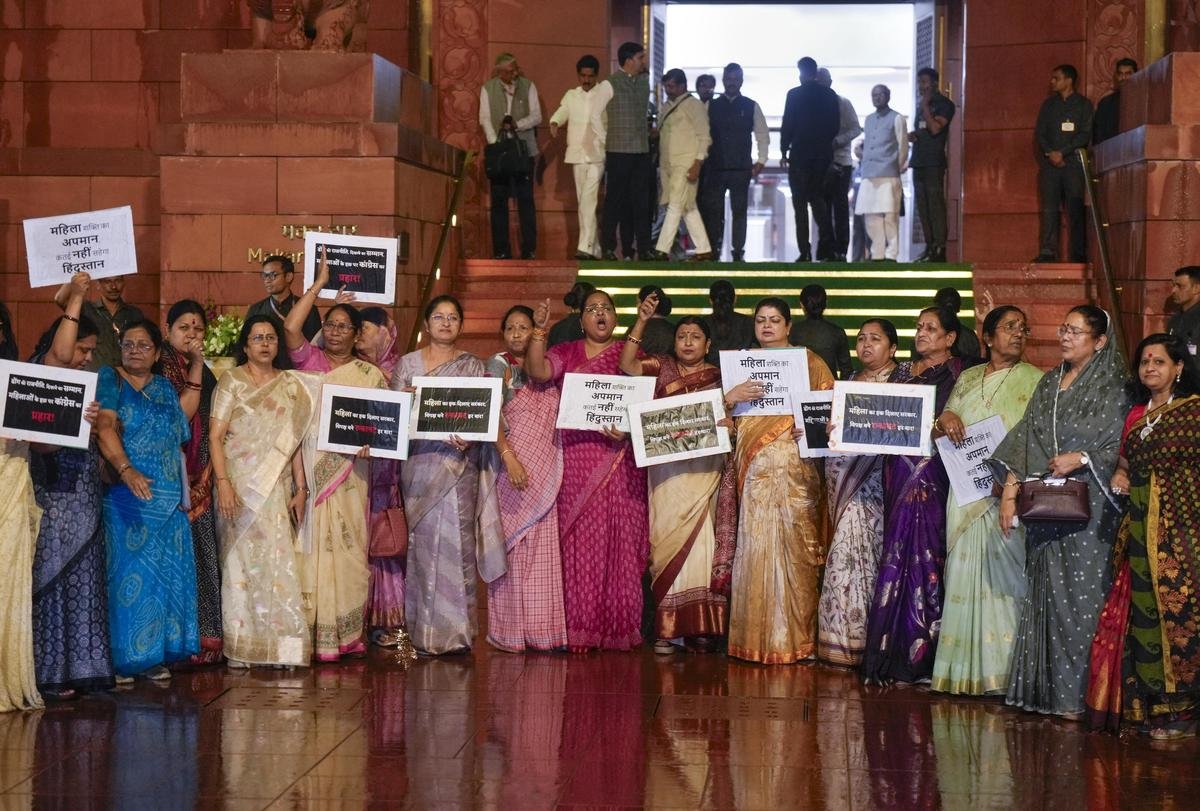
National Commission for Women (NCW) chairperson Vijaya Rahatkar has said women in India should be recognised as leaders rather than merely participants in public life. She expressed confidence that the Nari Shakti Vandan Adhiniyam, which provides for 33 per cent reservation for women in the Lok Sabha and state legislative assemblies, would be implemented after consensus is built among stakeholders.
In an interview with the Press Trust of India (PTI), Rahatkar pointed to women’s experience in Panchayati Raj institutions as evidence that they can perform leadership responsibilities effectively. She said the expansion of women’s representation in local bodies had demonstrated the value of providing equal opportunities in decision-making.
Her remarks have renewed attention on the gap between the passage of the Women’s Reservation Act and its eventual implementation. Although the legislation has established a framework for greater representation, its rollout is linked to a future census and delimitation exercise.
Women’s Leadership in Panchayati Raj Institutions
Rahatkar referred to the 73rd and 74th Constitutional Amendments, which introduced constitutional provisions for women’s representation in rural and urban local government institutions. The amendments provided for at least one-third reservation of seats for women in Panchayats and municipalities, creating opportunities for women to participate directly in local decision-making.
According to the NCW chief, the introduction of reservation initially prompted doubts about whether women would be able to manage responsibilities in elected institutions. She said women gradually learned how local governance systems operated and demonstrated their ability to lead.
Rahatkar also highlighted how several state governments subsequently increased women’s reservation in local bodies to 50 per cent. She said women’s representation in some state legislative and local institutions had gone beyond the reserved share because women were also winning seats in the general category.
Her comments underline an important distinction between reserved representation and electoral participation beyond reserved seats. A reservation policy can create opportunities for women to enter elected institutions, while victories in open constituencies can provide another indication of their presence in political life.
However, representation figures vary across states and institutions. The experience of Panchayati Raj bodies cannot automatically be treated as evidence that women’s representation in Parliament and state assemblies has reached similar levels.
What Is the Nari Shakti Vandan Adhiniyam?
The Nari Shakti Vandan Adhiniyam is the commonly used name for the Constitution (106th Amendment) Act, 2023, also known as the Women’s Reservation Act. It provides for reserving one-third of the seats for women in the Lok Sabha, state legislative assemblies and the Delhi Legislative Assembly.
The legislation was passed by Parliament in September 2023 and received presidential assent. It marked a major constitutional step towards increasing women’s representation in national and state-level legislatures.
The reservation also covers seats already reserved for Scheduled Castes and Scheduled Tribes, with one-third of those reserved seats to be allocated to women belonging to these categories.
Importantly, the law does not provide for the immediate introduction of the quota in an election simply because it has been passed. Its constitutional provisions link implementation to a delimitation exercise conducted after the publication of relevant figures from the first census taken after the Act’s commencement.
This condition has made the timing of implementation a central issue in discussions about the legislation. The distinction between passing a law and putting its reservation provisions into effect is essential to understanding why the quota has not yet translated into reserved seats in parliamentary and assembly elections.
Women’s Reservation Act Came Into Force in April 2026
The Union government appointed April 16, 2026, as the date on which the provisions of the 106th Constitutional Amendment Act would come into force. The notification brought the legislation into operation, but it did not mean that the 33 per cent reservation immediately became applicable to elections.
The law’s implementation mechanism remains linked to the census and subsequent delimitation process. Delimitation involves redrawing constituency boundaries and determining the allocation of seats in legislative bodies.
Under the original framework, the relevant exercise must take place after the figures from the first census conducted after the Act’s commencement are published. The reservation can then be implemented through the constitutional process prescribed by the legislation.
This means that the commencement of the Act and the start of women’s reservation in elected legislatures are two separate stages. The April 2026 notification fulfilled the first step, while the remaining constitutional and administrative requirements still have to be completed.
Why the Proposed 816-Seat Lok Sabha Expansion Failed
The implementation of women’s reservation became a major parliamentary issue in April 2026, when the government introduced proposals to amend the existing framework and accelerate the introduction of the quota before the 2029 Lok Sabha elections.
The proposals included increasing the strength of the Lok Sabha from its existing 543 seats to 816 seats. The government also sought to use the 2011 Census as the basis for a delimitation exercise that would help operationalise women’s reservation earlier than under the original arrangement.
The proposed changes were intended to alter the process connecting the reservation law with delimitation and constituency allocation. However, the Constitution (131st Amendment) Bill, 2026, failed to secure the required two-thirds majority in the Lok Sabha.
During the vote, 298 members supported the Bill, while 230 voted against it. With 528 members participating in the division, the proposal needed 352 votes to reach the two-thirds threshold required for a constitutional amendment.
Following the Bill’s defeat, the government withdrew the associated Delimitation Bill, 2026, and the Union Territories Laws (Amendment) Bill, 2026. As a result, the proposed legislative route for expanding the Lok Sabha and advancing the women’s quota through that package did not move forward.
The development was significant because the proposed changes had been presented as a way to bring women’s reservation into effect ahead of the 2029 general elections. The failure of the amendment meant that the original implementation conditions under the 2023 law remained relevant.
The parliamentary debate also reflected disagreements over the proposed delimitation process and the use of the 2011 Census. While the government argued that the changes would facilitate implementation, opposition parties raised concerns about linking women’s reservation with constituency restructuring. These disagreements formed part of the wider debate surrounding the failed amendment. :chatgpt-content-reference{index=”0″}
Why Delimitation Matters for Women’s Reservation
Delimitation is the process of redrawing electoral constituency boundaries and adjusting the allocation of seats to reflect population-related requirements. It determines the geographical areas represented by elected members and plays an important role in the organisation of parliamentary and state assembly elections.
For the Women’s Reservation Act, delimitation is particularly important because the legislation links the introduction of the quota to a future delimitation exercise. The process will determine the constituencies and seats to which the reservation provisions apply.
The connection between delimitation and the census has therefore become a major factor in determining when women will receive the promised representation in the Lok Sabha and state assemblies.
According to the original constitutional framework, the relevant delimitation exercise must follow publication of the figures from the first census conducted after the commencement of the 2023 amendment. The government cannot simply begin applying the quota to parliamentary and assembly elections without completing the required process.
The proposed 2026 amendments sought to change parts of this arrangement, but their failure means the original conditions remain central to implementation.
Why Greater Representation of Women in Legislatures Matters
Women’s representation in elected institutions is an important part of inclusive democratic decision-making. Legislatures make decisions on areas such as education, healthcare, employment, public safety, infrastructure and social welfare. Increasing the number of women representatives can broaden the range of experiences and perspectives present during these discussions.
However, representation is not only about meeting a numerical target. It also involves ensuring that elected representatives have the opportunity to participate meaningfully in legislative debates, committee work, policymaking and constituency development.
Rahatkar’s remarks about women in Panchayati Raj institutions reflect this broader argument. She said women had demonstrated their ability to perform leadership responsibilities when given opportunities, challenging assumptions that they could not manage elected positions effectively.
Greater representation at the national and state levels could also create more opportunities for women to participate in decisions that affect their communities. It may encourage wider political participation and help build a stronger pipeline of women leaders across different levels of government.
At the same time, the effectiveness of reservation will depend on more than the number of seats allocated. Political parties, legislative institutions and government bodies will also need to support women’s participation through fair opportunities, effective training and meaningful involvement in decision-making.
What Vijaya Rahatkar Expects From the Implementation
Rahatkar expressed confidence that discussions among stakeholders would help build consensus around the implementation of the Nari Shakti Vandan Adhiniyam. She said women would be able to make significant contributions in the Lok Sabha and state legislative assemblies once the reservation becomes operational.
Her position is based partly on the experience of women’s participation in local governance, where reservation policies have created opportunities for women to enter elected institutions and develop leadership experience.
She also stressed that women had demonstrated dedication and fairness while carrying out responsibilities in leadership positions. In her view, the next step is to ensure that women receive comparable opportunities in national and state legislatures.
Her comments come at a time when the implementation timeline remains a subject of public and parliamentary discussion. The failure of the proposed 2026 constitutional amendment has left the original census-linked and delimitation-linked framework in place.
The Road Ahead for Women’s Political Representation
The Nari Shakti Vandan Adhiniyam represents a significant constitutional commitment to increasing women’s representation in India’s legislative institutions. However, its practical impact will depend on completing the steps required under the law.
The debate following the failed 2026 amendment has demonstrated that implementation involves questions beyond the reservation percentage itself. Census data, delimitation, the allocation of constituencies and parliamentary consensus all have a role in determining how and when the quota will take effect.
For women aspiring to enter national and state politics, the legislation offers the prospect of a more structured path to representation. Its implementation could change the composition of elected institutions and expand women’s opportunities to participate in policymaking.
Rahatkar’s message is that women have already demonstrated their leadership abilities in different sectors, including local government, and should have greater opportunities at higher levels of political decision-making.
For now, the central challenge is translating the constitutional commitment into actual representation. The eventual implementation of the 33 per cent quota will be an important test of how India moves from recognising women’s leadership to ensuring their greater presence in the institutions where major public decisions are made.
For breaking news and live news updates, like us on Facebook or follow us on Twitter and Instagram. Read more on Latest India on thefoxdaily.com.






COMMENTS 0