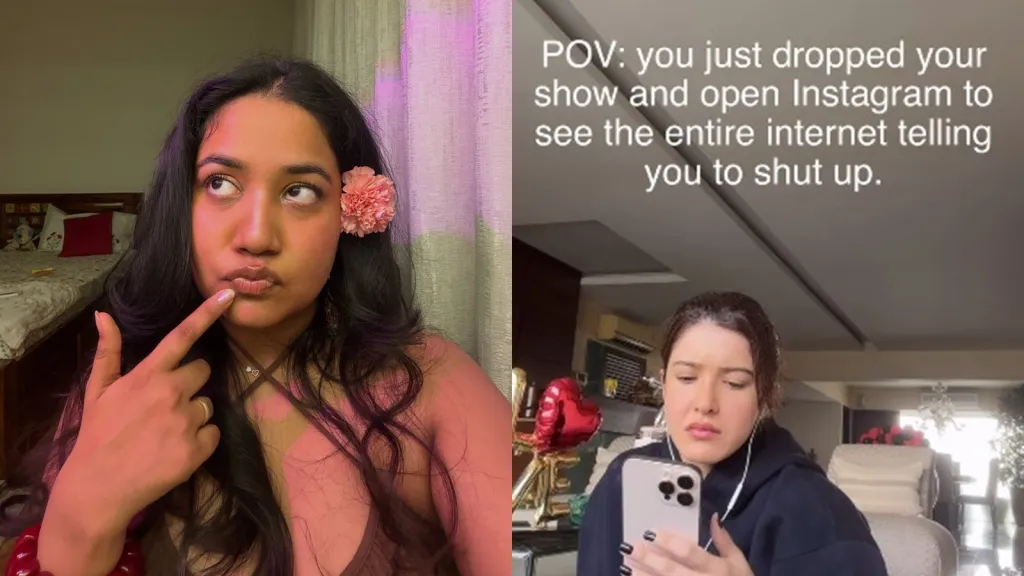
A short Instagram reel questioning why some people look down on those who appear to come from villages has reopened a wider conversation about class prejudice, urban privilege and the social hierarchies that shape everyday interactions in India. Created by Delhi-based content creator Divyanshi Chauhan, the video became widely discussed after crossing 10 million views, with its use of the name Shanaya becoming a talking point of its own.
Chauhan has now explained that the name was chosen spontaneously and was not intended as a reference to a particular person. Her central argument was about the tendency to associate urban lifestyles with social superiority while treating rural backgrounds as something embarrassing. She also addressed criticism over using a woman’s name, arguing that women can participate in caste-based discrimination and class prejudice just as men can.
What began as a humorous Social Media commentary has consequently developed into a broader discussion about who gets to define respectability, how privilege operates and why conversations about gender cannot be separated from caste and class.
How Divyanshi Chauhan’s Shanaya reel went viral
Chauhan uploaded the Instagram reel on April 19. In the video, she addressed an imaginary person named Shanaya, questioning the assumption that people who appear to have rural roots should be treated as less sophisticated than those associated with metropolitan lifestyles.
One of the most widely circulated lines was: “Everybody is from the village, Shanaya. Do you think your ancestors were born in Bandra, next to Boojee Cafe? Eating avocado toast?”
She followed the remark with a direct appeal against looking down on people because they reached cities at different points in time. Her argument was that migration and urbanisation do not erase a person’s origins, and that living in a city should not become a reason to claim superiority over someone from a village.
The reference to Bandra, a well-known Mumbai neighbourhood, and avocado toast gave the video its satirical edge. Together, they represented a particular image of urban privilege: fashionable neighbourhoods, lifestyle consumption and the cultural signals sometimes associated with wealth and social status.
Within a couple of days, the reel had attracted more than 10 million views, according to the source report. Many viewers supported its criticism of casual classism, particularly the habit of judging people by their appearance, accent, clothing or perceived rural background.
The video resurfaced in November, when more social media users began sharing and adapting its central idea. Its renewed circulation introduced the original message to another wave of viewers and brought fresh attention to the name used in the reel.
Why Chauhan used the name Shanaya
The name became one of the most discussed aspects of the video, with some viewers interpreting it as a reference to a real person. Chauhan clarified in the comments that there was no specific Shanaya being targeted.
“There isn’t a ‘Shanaya’ – this is obviously a commentary on social hierarchy. I don’t even live in Mumbai,” she wrote in a clarification shared under the post.
In an interview with The Indian Express, Chauhan explained that she had not spent much time deciding which name to use. It was simply the first name that came to mind while making the video.
She also said she was pleased to see actor Shanaya Kapoor make a video in response to the trend and revealed that Kapoor had reached out to her. Chauhan described the interaction positively, saying that Kapoor was very sweet.
The clarification is important because the reel’s message was never intended to be about an individual celebrity or a particular woman. The name functioned as part of a fictional conversation through which Chauhan wanted to question a broader attitude towards people perceived as coming from rural backgrounds.
That distinction also highlights how quickly social media discussions can shift away from their original subject. A video intended to challenge social prejudice can become a debate about a name, a celebrity or the creator’s choice of language. In this case, the attention surrounding Shanaya risked overshadowing the class hierarchy Chauhan wanted viewers to examine.
The original context: Debate around rural identity and class prejudice
Chauhan said she made the reel in April, when online conversations were taking place around content creator Pujarini Pradhan. Pradhan had faced criticism from some social media users who accused her of pretending to be poor.
Chauhan told The Indian Express that her video was not aimed at one particular creator or gender. Instead, it was a response to what she considered an unreasonable attitude towards people whose appearance or lifestyle was perceived as rural or less affluent.
Her argument was straightforward: a person’s background should not become a reason for humiliation. People move between villages and cities for education, employment, family circumstances and other reasons. Their economic position and lifestyle can change over time, but those changes do not make one background inherently better than another.
The distinction between rural and urban identity is often treated as more than a geographical difference. In everyday social interactions, it can become a way of judging someone’s education, sophistication, economic status or cultural awareness. A city address may be treated as a marker of achievement, while a village association can be unfairly presented as evidence of limited opportunity or social standing.
Chauhan’s use of humour was designed to expose the absurdity of that hierarchy. By asking whether anyone’s ancestors were born in a fashionable Mumbai neighbourhood, she challenged the idea that urban lifestyles are natural or inherited markers of superiority.
Urban privilege and the overlooked stigma attached to rural backgrounds
India’s urban and rural communities are connected through migration, family relationships, work and cultural exchange. Yet social attitudes can create an artificial divide between the two, particularly when city life is associated with modernity and village life is reduced to stereotypes.
One problem with this way of thinking is that it treats urbanisation as a measure of personal worth. Someone who has grown up in a major city may be assumed to be more polished or socially advanced, while a person from a smaller town or village may be judged before their abilities or achievements are considered.
Such assumptions can appear in ordinary situations. A person’s accent may become a source of jokes. Traditional clothing may be treated as unfashionable. Familiarity with particular restaurants, brands or social spaces may be mistaken for intelligence or cultural knowledge.
These judgements are not always expressed through direct insults. They can also operate through jokes, dismissive comments and subtle expectations about how a person should speak, dress or behave to be accepted in an urban environment.
The distinction between class prejudice and rural prejudice is not always clear-cut. Economic status can influence how people are perceived, while rural identity can become shorthand for assumptions about income, education or access to opportunities. This is why Chauhan’s commentary resonates beyond the specific wording of the reel.
Her argument does not suggest that every urban person looks down on rural communities or that rural and urban experiences are identical. Rather, it questions the assumption that one should automatically command more respect than the other.
‘Women can be casteist too’: Chauhan addresses the gender debate
The conversation around the reel took another turn when viewers questioned why Chauhan had chosen a woman’s name rather than a man’s. Some criticism suggested that using a female name was unfair or that a male character would have been a more appropriate target for the joke.
Chauhan rejected the idea that women should be excluded from criticism of social prejudice simply because they experience discrimination themselves.
“But the truth is that women can be casteist as well. It’s important to call them out as much as men,” she told The Indian Express.
Her point challenges a tendency to treat women as a single, uniformly disadvantaged group. Gender discrimination is real, but it does not mean every woman holds the same social position or is incapable of exercising prejudice against others.
A woman can experience sexism while also benefiting from class privilege or participating in caste-based discrimination. These experiences can coexist. Recognising one form of inequality does not require overlooking another.
Chauhan also argued that placing women beyond criticism can become another form of dehumanisation. Treating women as if they are naturally free from prejudice may appear protective, but it can prevent honest discussions about their actions and social influence.
Her position is not that women and men experience discrimination in identical ways. It is that accountability should not depend entirely on gender. If a person expresses casteist or classist attitudes, those attitudes deserve examination regardless of whether the person is male or female.
Understanding intersectionality: Why gender, caste and class cannot be separated
One of the more significant aspects of Chauhan’s response is her reference to intersectionality. The concept helps explain how different forms of inequality can overlap and shape a person’s experience of society.
Gender, caste and class do not operate as completely separate categories. A person’s opportunities, social treatment and access to resources can be influenced by several factors at the same time. Looking at only one category may therefore provide an incomplete picture of their position.
For example, two women may share experiences of gender discrimination but have very different access to education, financial security, social networks and institutional support. Their experiences of public spaces and professional environments may also differ because of their caste and economic backgrounds.
Similarly, someone can face class-based judgement while holding social advantages in another area. Inequality is not always a simple division between people who experience discrimination and those who do not. Social identities can place individuals in different positions depending on the context.
Chauhan acknowledged that internalised misogyny can influence how people respond to a woman’s name in a joke or criticism. She said she was open to recognising that reaction as part of the discussion.
This is an important distinction in debates about representation. It is possible to question whether a particular choice reinforces a stereotype while also examining the assumptions behind that criticism. The two conversations do not necessarily cancel each other out.
In the context of her reel, the question is not simply whether a male or female name would have worked better. It is also whether people are comfortable acknowledging that women, like men, can hold and reproduce discriminatory beliefs.
Why the viral discussion matters beyond Instagram
Social media has made it easier for everyday attitudes about class, caste, gender and identity to become subjects of public discussion. A short video can reach millions of people, prompting reactions from audiences who may have very different experiences of the issue being discussed.
That reach can be useful, but virality does not automatically produce understanding. Short-form content often relies on humour, sharp language and recognisable cultural references. These elements make a message easy to share, but they can also encourage viewers to focus on one line or one name rather than the larger argument.
The response to Chauhan’s video demonstrates both possibilities. Its popularity brought attention to casual classism and the tendency to judge people by their perceived rural origins. At the same time, the discussion about Shanaya and the choice of a woman’s name opened a separate debate about gender and accountability.
Chauhan said she was glad the reel had generated conversations, even when some responses were critical. She believes discussions about class consciousness and intersectionality deserve greater visibility.
That willingness to engage with criticism is significant because social conversations rarely produce a single agreed interpretation. Some viewers may connect with the reel’s criticism of urban superiority, while others may question its language or the way it frames the issue. A productive discussion can examine both without losing sight of the underlying prejudice.
What the reel ultimately says about social hierarchy
At its centre, Chauhan’s video challenges the idea that a person’s value can be measured through proximity to a city, a particular lifestyle or a perceived level of sophistication. Its humour works because it turns an everyday assumption into an exaggerated question: who decided that urban life was the original standard against which everyone else should be judged?
The broader issue is not whether people should be proud of living in cities or whether rural communities should be romanticised. Both urban and rural environments have different opportunities, challenges and ways of life. The problem begins when those differences are converted into a hierarchy of human worth.
The same principle applies to the discussion about gender. Women should be able to speak about discrimination without being portrayed as incapable of prejudice themselves. Acknowledging that possibility does not weaken conversations about sexism. It makes those conversations more honest by recognising that power and privilege can exist in different forms.
Chauhan’s reel may have started as a brief piece of social commentary, but its continuing circulation has brought several connected questions into focus: why rural backgrounds are sometimes treated as inferior, how class prejudice becomes normalised, and why Gender Equality must also make room for accountability.
Ultimately, the most useful part of the viral moment is not the popularity of the name Shanaya or the number of views the video received. It is the discussion it has encouraged about the assumptions people carry into everyday interactions. Challenging those assumptions requires more than a viral reel, but the conversation is a meaningful place to begin.
For breaking news and live news updates, like us on Facebook or follow us on Twitter and Instagram. Read more on Latest Lifestyle on thefoxdaily.com.






COMMENTS 0