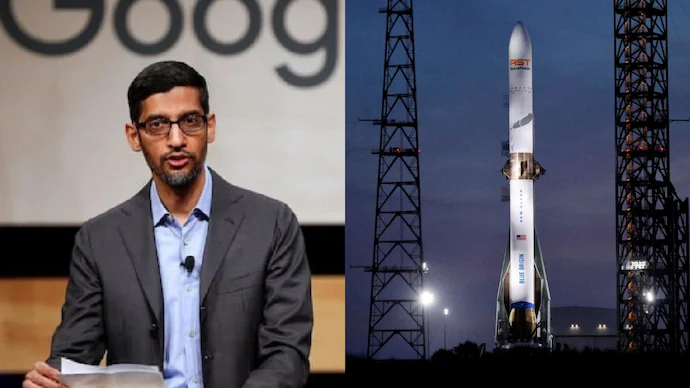
Google is taking another major step towards moving Artificial Intelligence computing beyond Earth by partnering with Jeff Bezos’ aerospace company, Blue Origin, to launch its next-generation computing satellites into orbit. The planned mission, scheduled for the first quarter of 2029, will use Blue Origin’s New Glenn rocket to carry several satellites equipped with Google’s custom Tensor Processing Units (TPUs) into space.
The agreement expands Google’s ambitious Project Suncatcher programme, which aims to establish a network of interconnected, solar-powered satellites capable of running AI workloads in orbit. The project explores whether space-based computing could eventually provide an alternative way to expand AI infrastructure as demand for processing power, electricity, land and cooling capacity continues to increase.
The partnership also brings two major technology and aerospace players together in an emerging area of competition: building computing infrastructure beyond the planet. While Google is developing the AI hardware and satellite network, Blue Origin will provide the launch capability needed to deploy the system.
Google Selects Blue Origin’s New Glenn for Dedicated Project Suncatcher Launch
Under the agreement, Blue Origin’s New Glenn heavy-lift rocket will transport multiple Google computing satellites into sun-synchronous orbit. The launch is scheduled for the first quarter of 2029 and will represent the first dedicated launch for Project Suncatcher.
Each satellite will carry Google’s Tensor Processing Units, specialised processors designed to accelerate machine-learning and artificial intelligence workloads. The computing capacity planned for each satellite is roughly comparable to a rack of servers found in a conventional data centre.
Placing the satellites in sun-synchronous orbit is central to the project’s design. This orbital arrangement is intended to provide relatively consistent exposure to sunlight, allowing the satellites to generate electricity through solar panels and reduce their dependence on conventional energy sources.
The companies have not disclosed the financial terms of their agreement. They have also not announced a final deployment schedule for a full orbital computing network.
The 2029 mission follows an earlier Project Suncatcher milestone in October, when Google launched its first prototype satellite aboard a SpaceX Falcon 9 rocket. That spacecraft travelled as part of a rideshare mission carrying approximately 130 payloads, rather than through a dedicated launch arranged specifically for Google’s project.
The distinction matters because the upcoming Blue Origin mission is expected to provide a more focused deployment opportunity for Google’s experimental infrastructure. It will allow the company to advance from an initial technology demonstration towards testing a larger group of interconnected computing satellites.
What Is Google’s Project Suncatcher?
Project Suncatcher is Google’s long-term research programme to determine whether AI computing infrastructure can operate effectively in space. Instead of constructing increasingly large data centres on Earth, the company is investigating whether satellites equipped with powerful processors and solar panels could perform some computing tasks in orbit.
The broader vision involves connecting multiple satellites so they can work together on machine-learning workloads. In such a system, individual spacecraft would contribute computing resources while communicating with other satellites and transmitting information between space and ground-based systems.
Google’s approach is built around two important technologies: its custom AI processors and solar-powered satellite platforms. TPUs would handle the computational work, while solar panels would provide electricity to operate the hardware.
Travis Beals, senior director of Project Suncatcher at Google, described the programme as a long-term effort to scale AI infrastructure in space by using the abundant solar energy available in orbit.
The concept is still experimental. Google’s immediate objective is not to replace its existing data centres but to establish whether the technical and economic requirements of orbital computing can be met. A functioning network would require reliable power generation, thermal management, radiation protection, high-speed communication and coordinated operations across multiple spacecraft.
Google Has Already Run an AI Model on Its Satellite
Google has moved beyond theoretical research with its first Project Suncatcher prototype. Following the satellite’s launch in October, the company conducted an experiment to test whether an AI model could process a request while operating in orbit.
In the demonstration, Google sent a prompt from Earth to its Gemma 4 model running on the satellite. The model processed the request and returned an AI-generated haiku to the ground.
The experiment demonstrated an important capability: a satellite carrying Google’s TPU hardware could execute an AI model in space and communicate its generated output back to Earth.
However, the test should not be confused with the operation of a full-scale orbital data centre. Generating a short response from a model is considerably different from supporting the continuous, complex workloads handled by large commercial AI services.
The prototype is also being used to examine whether Google’s computing hardware can survive the demanding conditions of space. These include intense launch vibrations, radiation exposure and extreme temperature changes.
These tests are essential because AI processors are designed to operate under carefully controlled conditions. Moving them into orbit introduces environmental challenges that conventional terrestrial data centres do not face in the same way.
Why Google Wants to Move AI Computing Into Space
The growing demand for artificial intelligence has created pressure on the infrastructure required to train and operate increasingly powerful models. Modern AI systems depend on large numbers of specialised processors, high-capacity networking equipment and substantial electricity supplies.
Data centres also require land, buildings, power distribution systems and cooling infrastructure. As companies expand their AI operations, securing enough electricity and suitable locations has become an increasingly important part of technology investment decisions.
Google’s orbital computing concept attempts to address some of these constraints by shifting part of the infrastructure into space.
Solar Energy Could Provide a Continuous Power Source
One of the main attractions of space-based computing is access to sunlight. Satellites operating in appropriately selected orbits can receive more consistent solar exposure than solar installations on the ground, which are affected by night-time conditions and local weather.
Google hopes to use this advantage to power computing hardware without depending on the electricity grids that supply terrestrial data centres. In theory, a network of solar-powered satellites could generate substantial energy for AI workloads.
However, solar availability alone does not make orbital computing inexpensive. Satellites need solar panels, power-management systems, batteries or other energy-storage arrangements where required, and reliable electrical connections to their computing equipment.
Less Dependence on Land and Ground-Based Cooling
Large data centres require significant physical space and infrastructure. Their expansion can create pressure on local electricity networks, land availability and water or other cooling resources, depending on the facility’s design.
Moving some computing capacity into orbit could reduce the need to build equivalent infrastructure on the ground. It may also offer an alternative to conventional cooling arrangements, although space introduces its own thermal-management problems.
For Google, the potential benefit is not simply moving servers away from Earth. It is determining whether the combination of solar power, specialised processors and satellite networking can support AI computing at a competitive scale.
Space-Based Data Centres Face a Major Cooling Problem
Despite the potential advantages, operating powerful AI processors in orbit presents a difficult engineering challenge. One of the biggest problems is removing heat generated by computing hardware.
On Earth, data centres use air circulation, liquid-cooling systems, heat exchangers and other technologies to prevent processors from overheating. Space does not offer the same cooling environment because there is no surrounding atmosphere through which heat can be carried away by conventional airflow.
Satellites must instead manage heat through specialised thermal systems that transfer energy towards radiators and panels, which release it into space as infrared radiation.
This becomes particularly important when multiple high-performance processors operate together. AI workloads can generate substantial heat, and a satellite must be able to remove that energy without allowing temperatures to damage sensitive components.
The cooling system also adds weight, complexity and cost. Engineers must design it to function reliably in a compact spacecraft while accounting for changing sunlight exposure and the thermal conditions of orbit.
Radiation Could Damage Google’s AI Chips in Orbit
Radiation is another major obstacle for Project Suncatcher. Unlike equipment inside terrestrial data centres, satellites are exposed to energetic particles and radiation that can interfere with electronic components.
One possible consequence is a phenomenon known as a bit flip. Digital systems represent information using binary values, generally expressed as zeros and ones. Radiation can sometimes change the state of a memory bit, potentially corrupting stored information or affecting calculations.
For AI computing, such errors can create reliability problems. A processor that performs correctly on Earth may behave differently when exposed to the radiation environment of space.
Google’s prototype testing is therefore intended to determine whether its TPUs can continue operating reliably under these conditions. The company will need to establish how much protection the hardware requires and whether errors can be detected and corrected without disrupting computing operations.
Launch conditions present another challenge. Satellites must survive intense vibrations and mechanical forces during their journey into orbit before they can begin operating. The computing hardware, electrical connections and thermal systems all need to remain functional after deployment.
Google Is Not Alone: SpaceX and Indian Companies Are Exploring Orbital AI
Google’s partnership with Blue Origin reflects growing interest across the technology and aerospace industries in moving some computing infrastructure into orbit. The possibility of using space-based solar power for AI has attracted attention from companies seeking alternatives to the resource requirements of conventional data centres.
SpaceX chief executive Elon Musk has been among the most prominent supporters of the concept. He has argued that terrestrial electricity generation may struggle to keep pace with the growing energy requirements of artificial intelligence.
Musk has suggested that orbital data centres could eventually provide a way to expand computing capacity without placing additional pressure on communities and the environment through ground-based energy infrastructure.
His position is closely connected to SpaceX’s launch capabilities and its broader ambitions in space infrastructure. Lower launch costs and the ability to deploy large numbers of satellites could become important factors if orbital computing develops beyond experimental demonstrations.
India is also entering the field. Space Technology company Pixxel and artificial intelligence startup Sarvam AI are working together on the development of space-based data centres. Their collaboration indicates that interest in orbital computing is not limited to the largest American technology companies.
However, these initiatives remain part of an emerging technology landscape. The commercial viability of large-scale orbital computing has not yet been established, and different companies may pursue different hardware, satellite and communication architectures.
Why Some Technology Leaders Question the Economics of Space Data Centres
Not everyone is convinced that moving AI data centres into orbit will be economically practical. While sunlight may be abundant, the cost of building, launching, maintaining and eventually replacing orbital infrastructure could outweigh some of the benefits.
SoftBank chief executive Masayoshi Son has questioned whether lower electricity costs would compensate for the expense of operating computing hardware in space. His concern is that the overall cost of AI infrastructure depends on much more than the price of electricity or the availability of solar energy.
Launching satellites requires expensive rockets, while spacecraft also need specialised components, radiation protection, thermal systems and communication equipment. Any failure in orbit could be difficult and costly to repair compared with replacing equipment inside a ground-based data centre.
The launch cost is only one part of the calculation. A single satellite cannot provide the same scale or flexibility as a large interconnected network. Building such a network would require repeated launches, coordination between spacecraft and significant long-term investment.
For context, a SpaceX Falcon 9 launch costs approximately $74 million, although actual mission prices vary according to the launch arrangement and requirements. The cost of deploying a large orbital computing network would depend on the number and design of satellites, launch frequency, operating lifespan and the infrastructure needed to connect them.
There is also a question of computing performance. AI systems often require rapid communication between processors and data centres. Space-based networks would need to deliver sufficiently fast and reliable connections to support workloads that may depend on frequent data exchanges.
What the Blue Origin Partnership Means for the Future of AI Infrastructure
The agreement gives Google access to Blue Origin’s New Glenn rocket for a dedicated Project Suncatcher mission, adding another major launch provider to the programme after its initial SpaceX rideshare deployment.
For Blue Origin, the partnership represents an opportunity to support an advanced technology project that could become an important category of demand for heavy-lift launch services. For Google, it provides a route to test more of its orbital computing architecture and move towards a larger satellite deployment.
Still, the 2029 mission will not mean that Google is ready to replace conventional data centres with satellites. The company first needs to demonstrate that multiple spacecraft can operate together, exchange information reliably and sustain demanding AI workloads over extended periods.
The economics must also work. Solar power could reduce dependence on terrestrial electricity, but launch costs, satellite manufacturing, maintenance, cooling and communications will determine whether orbital data centres can compete with facilities on Earth.
Project Suncatcher is therefore best understood as a long-term experiment into a possible new form of computing infrastructure. Google’s early satellite test has shown that an AI model can run in orbit and return a response. The next challenge is proving that the technology can scale beyond a demonstration.
If the approach succeeds, space could eventually become an additional location for specialised AI computing, supported by solar energy and networks of interconnected satellites. If the technical and financial barriers prove too difficult, terrestrial data centres are likely to remain the foundation of large-scale AI infrastructure for the foreseeable future.
For breaking news and live news updates, like us on Facebook or follow us on Twitter and Instagram. Read more on Latest Technology on thefoxdaily.com.






COMMENTS 0