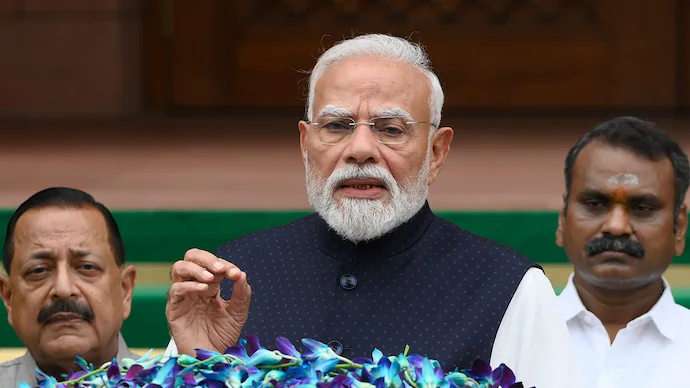
Seven state assembly elections scheduled for 2027 will provide a major test of Prime Minister Narendra Modi’s political position and the strength of the opposition ahead of the 2029 Lok Sabha elections. Covering 940 assembly constituencies and 132 parliamentary seats, the contests will put the BJP‘s hold over key states, the ambitions of Uttar Pradesh Chief Minister Yogi Adityanath and the future of opposition leaders under scrutiny.
The elections will also test whether the opposition can turn its gains in individual contests into a broader political challenge to the BJP. For the Congress, Samajwadi Party (SP) chief Akhilesh Yadav and Aam Aadmi Party (AAP), the results will offer an opportunity to demonstrate their organisational strength and ability to retain or expand their political bases.
Recent Legislative Council Results Reveal Political Fault Lines
The political calculations for 2027 have already begun against the backdrop of recent legislative council elections. On October 29, the BJP lost both Varanasi seats in Uttar Pradesh’s legislative council elections to the Samajwadi Party, despite nine ministers and seven MLAs campaigning in Prime Minister Narendra Modi’s Lok Sabha constituency.
In Maharashtra’s Nagpur, where the Rashtriya Swayamsevak Sangh (RSS) headquarters is located, Congress candidate Abhijeet Wanjari retained the graduates’ constituency by 3,271 votes.
However, the overall result across 28 teachers’ and graduates’ constituencies in four states did not indicate a decisive political shift. The BJP won 13 seats independently, while the National Democratic Alliance (NDA) secured 16, down from 18. The Congress won just one seat, in Nagpur, and lost all four constituencies in Karnataka, where it is in power.
The results exposed weaknesses on both sides. They did not establish a broader anti-BJP wave, but neither did they demonstrate a major opposition revival. The outcomes instead offered an early indication of the political challenges facing parties before the larger assembly elections.
Seven States, 940 Assembly Seats and 132 Lok Sabha Constituencies
The seven states scheduled to vote in 2027 are Uttar Pradesh, Punjab, Uttarakhand, Goa, Manipur, Gujarat and Himachal Pradesh. Uttar Pradesh, Punjab, Uttarakhand, Goa and Manipur are expected to vote in February-March, while Gujarat and Himachal Pradesh will hold elections towards the end of the year.
The BJP currently governs five of these seven states, while the Congress is in power in Himachal Pradesh and the AAP governs Punjab.
The assembly arithmetic gives the NDA a substantial existing base. The BJP holds 557 of the 940 assembly seats, while its allies have another 47. With the support of 12 Independents, the alliance has a combined strength of 616 legislators.
The Congress has 98 seats, while the AAP holds 101, nearly all of them in Punjab. The AAP left the INDIA opposition bloc in July 2025, making the political relationship between the two parties another factor in the wider opposition landscape.
Uttar Pradesh and Gujarat together account for 585 assembly constituencies and 106 Lok Sabha seats. Their results will be particularly important for the BJP as it seeks to consolidate its position after the 2024 general election, when it won 240 Lok Sabha seats and became dependent on allies such as the Telugu Desam Party (TDP) and Janata Dal (United) to maintain the NDA government‘s majority.
Why the 2027 Results Matter for Narendra Modi
The seven assembly elections will not directly determine the survival of the Union government or elect the next prime minister. However, they will provide an important measure of the BJP’s political position ahead of the 2029 general election.
The BJP and its allies have recorded victories in several state elections since the 2024 Lok Sabha results, including a sweeping victory in Bihar and electoral gains in other major states, according to the political assessment in the supplied report.
For Modi, retaining the party’s core states would help demonstrate that the BJP has maintained its electoral support despite the setbacks of 2024. Losses in major states, particularly Uttar Pradesh, would raise questions about the party’s organisational strength and its ability to sustain its national political position.
The elections will also influence the political standing of regional leaders and the opposition parties seeking to challenge the BJP. Their importance therefore extends beyond individual state governments to the alliances, leadership equations and electoral strategies that could shape the 2029 contest.
Uttar Pradesh: Yogi Adityanath’s Leadership and Akhilesh Yadav’s Test
Uttar Pradesh is likely to be the most closely watched of the seven states because of its 403 assembly seats and 80 Lok Sabha constituencies. The state also carries significant political importance for both the BJP and the opposition.
In the 2022 assembly elections, the BJP won 255 seats, while the Samajwadi Party secured 111. The Congress was reduced to just two constituencies. Yogi Adityanath returned as chief minister, becoming the first Uttar Pradesh chief minister in 37 years to win another term after completing a full five-year tenure.
The NDA’s strength in the assembly has subsequently increased to 292 MLAs, following the movement of the Rashtriya Lok Dal (RLD) and Suheldev Bharatiya Samaj Party (SBSP) from the SP camp. Four SP rebels have also cross-voted in favour of the alliance.
What a Third Consecutive Victory Could Mean for Yogi Adityanath
A third consecutive assembly victory would carry considerable political significance for Adityanath. It would make him the first Uttar Pradesh chief minister since Independence to lead his party to three successive assembly election victories.
Such a result would also strengthen his position within the BJP and could influence discussions about the party’s leadership beyond the current Modi-Shah era.
Adityanath’s political approach combines Hindutva, assertive policing and welfare delivery. An electoral victory would provide an opportunity for the BJP to claim renewed public support for this model of governance.
However, a defeat or a significantly reduced majority would raise questions about the BJP’s ability to maintain its caste-based support coalition and the chief minister’s political standing within the party.
Akhilesh Yadav’s PDA Strategy and the INDIA Bloc Partnership
For Samajwadi Party chief Akhilesh Yadav, the Uttar Pradesh election will be an important test of whether the social coalition that helped his party in the 2024 Lok Sabha elections can be sustained in an assembly contest.
His PDA strategy, built around Pichhda (backward), Dalit and Alpsankhyak (minority) communities, helped the SP win 37 Lok Sabha seats in Uttar Pradesh in 2024, four more than the BJP. Its ally, the Congress, won another six.
With several opposition parties facing setbacks in different states, Akhilesh has become one of the INDIA bloc’s important regional political figures. The results in Uttar Pradesh will test his ability to retain that position.
His partnership with Rahul Gandhi and the Congress will also face scrutiny. Seat-sharing discussions have already exposed differences over the number of constituencies each party should contest. The Congress has reportedly sought around 170 seats, while SP leaders have discussed offering between 60 and 70.
Akhilesh began his campaign from Raebareli, Rahul Gandhi’s Lok Sabha constituency, in September. He has maintained that seats should go to whichever party is best positioned to win them.
The two parties face different organisational challenges. The Congress has a national presence but limited assembly-level organisation in Uttar Pradesh, while the SP has a stronger state-level structure. Their ability to transfer votes between supporters will be important to the alliance’s performance.
The presence of former SP allies now aligned with the NDA, including the RLD and SBSP, adds another dimension. The Bahujan Samaj Party (BSP) could also influence close contests by drawing Dalit votes, making constituency-level calculations particularly important.
Punjab: AAP’s Political Future and Congress’s Opportunity
Punjab is the only state among the seven where the BJP is not a principal contender for power. The main political contest is expected to involve the ruling AAP, the Congress and other regional parties.
The AAP won 92 of Punjab’s 117 assembly seats in 2022, establishing a strong governing base outside Delhi. After losing power in the national capital, retaining Punjab has become central to the party’s continued political relevance.
Chief Minister Bhagwant Mann’s government faces questions involving drug abuse, employment, public debt, law and order, agrarian distress and religious controversies. At the same time, the AAP’s performance in recent bypolls and municipal elections has indicated that its organisational network remains active.
According to the supplied figures, the party has won six of seven assembly bypolls held since 2022 and now holds 95 seats. The Congress, meanwhile, has declined from 18 seats to 16.
Congress, Akali Dal and the Possibility of a BJP-Akali Alliance
The Congress sees an opportunity to challenge the AAP in Punjab, particularly after winning seven of the state’s 13 Lok Sabha constituencies in 2024. However, internal leadership disagreements remain a challenge for the party.
The Shiromani Akali Dal (SAD) has also seen its political position weaken, while Amritpal Singh’s new Panthic formation could further divide the state’s Sikh political landscape.
Talk of a possible BJP-Akali Dal alliance adds another variable to the election calculations. Whether the two parties reunite could influence how anti-AAP votes are distributed among opposition parties.
A Congress victory would provide the party with an opportunity to rebuild its political presence in northern India. Another AAP term, on the other hand, would demonstrate that the party can retain a major state government even after losing power in Delhi.
Uttarakhand: BJP’s Record and the Congress Challenge
Uttarakhand will provide another test of the BJP’s ability to retain power in a state where it broke a long-standing electoral pattern in 2022.
The BJP won 47 of the state’s 70 assembly seats in that election, returning to power despite Chief Minister Pushkar Singh Dhami losing his own Khatima constituency. The result ended the state’s tradition of alternating governments between the BJP and Congress.
The Congress has since increased its assembly strength from 19 to 20. It won the Badrinath constituency after its MLA defected to the BJP and also secured victory in Manglaur.
Employment opportunities, migration from hill regions, environmental pressures and the Uniform Civil Code are expected to feature prominently in the campaign.
A change of government would demonstrate that the BJP’s organisational strength has not eliminated local dissatisfaction. Retaining power would further consolidate its position in another northern state and create additional challenges for the Congress as it attempts to rebuild its electoral base.
Goa: Congress Organisation and the BJP’s Long Stay in Power
Goa presents a different political challenge for the opposition. The BJP has governed the state since 2012, while the Congress has struggled to maintain its legislative strength despite competing in successive elections.
In 2022, the BJP won 20 of the state’s 40 assembly seats. Subsequently, eight of the Congress’s 11 MLAs joined the BJP, leaving the Congress with only three legislators.
The developments highlighted the difference between winning seats during an election and retaining elected representatives afterwards.
Tourism-led development, land use and employment are among the issues that could feature in the campaign against the government led by Chief Minister Pramod Sawant.
However, the opposition landscape is fragmented. The AAP, Goa Forward Party and regional parties are also part of the political contest, making coordination among opposition groups an important consideration.
Manipur: Election Takes Place Against the Backdrop of Ethnic Violence
Manipur faces a different set of challenges from the other states scheduled to vote in 2027. The election will take place against the backdrop of prolonged ethnic violence, displacement and continuing disagreements over security and political arrangements.
More than 250 people have died and tens of thousands have been displaced since ethnic violence erupted in May 2023. The BJP won 32 of Manipur’s 60 assembly seats in 2022, but the Congress secured both Lok Sabha constituencies in the state in the 2024 general election.
The political situation has changed considerably since the violence began. N. Biren Singh left the chief minister’s post, followed by nearly a year of President’s Rule. Yumnam Khemchand Singh became chief minister in February 2026, with Kuki-Zo and Naga deputy chief ministers also appointed as part of efforts to reset the political administration.
Security, Autonomy and Reconciliation Remain Central Issues
Manipur’s valley and hill constituencies remain divided over security, territory and autonomy. Kuki-Zo groups continue to demand a separate administration, while trust between communities remains fragile.
For the BJP, the election will test whether changes in political leadership and government arrangements have helped address the crisis. An electoral victory alone would not resolve the underlying disagreements between communities.
The Congress faces the challenge of turning dissatisfaction with the handling of the conflict into a credible political alternative. Its ability to select candidates and build alliances that can appeal to communities with sharply different political concerns will be an important factor.
The outcome will also be viewed in the context of the Centre’s handling of the violence and its efforts to restore stability in the state.
Gujarat: Modi and Amit Shah’s Home State Faces Another Election
Gujarat, the home state of Prime Minister Narendra Modi and Union Home Minister Amit Shah, has been governed by the BJP since 1995. The state has remained a major part of the party’s electoral base for decades.
In 2022, the BJP won a record 156 of the 182 assembly seats. Its position subsequently expanded through defections, while the party also swept all 15 municipal corporations in April, according to the supplied report.
The Congress faces the challenge of rebuilding its organisation and defending its remaining political support. The AAP is also seeking to establish itself as a stronger challenger in the state.
Employment, farmers’ concerns and local grievances could provide opportunities for the opposition to question the government’s performance. However, the BJP’s long period in power and established organisational network will remain important factors in the contest.
Himachal Pradesh: Congress Faces an Incumbency Test
Himachal Pradesh offers the Congress an opportunity to demonstrate that it can retain power in a state where the BJP has traditionally been a major competitor.
The Congress won 40 of the 68 assembly seats in 2022, allowing Sukhvinder Singh Sukhu to become chief minister. The party subsequently survived a rebellion and a series of political challenges involving cross-voting in the February 2024 Rajya Sabha election.
Six Congress MLAs were disqualified after cross-voting. However, the party won six of the nine subsequent assembly bypolls, restoring the legislative balance to 40 seats for the Congress and 28 for the BJP.
Fiscal pressures will be among the issues facing the Sukhu government. The state has also experienced a long pattern of alternating governments, with no incumbent government being re-elected since 1985.
Retaining power would give the Congress an opportunity to demonstrate that it can defend an existing state government while facing electoral challenges elsewhere. A defeat would further reduce its governing footprint.
Youth Discontent and the Rise of the Cockroach Janta Party
Beyond the established political parties, youth mobilisation has emerged as another issue in the wider political landscape. The Cockroach Janta Party (CJP) has developed as a vehicle for protests over examination irregularities, unemployment and institutional accountability.
The movement gained attention amid the NEET-UG controversy and protests at Delhi’s Jantar Mantar. The supplied report also links the broader pressure over these issues to the resignation of Union Education Minister Dharmendra Pradhan in July.
The CJP is not a registered electoral party and has also joined protests over the Special Intensive Revision (SIR) of voter rolls.
Its political significance will depend on whether dissatisfaction among students and job aspirants influences voter turnout and electoral choices. The issue also raises questions about how established political parties respond to concerns involving recruitment examinations, employment opportunities and institutional accountability.
How the 2027 Elections Could Shape the Presidential Poll
The 2027 assembly elections will have importance beyond the formation of state governments. Newly elected MLAs will also participate in the presidential election scheduled for July 2027.
Each MLA’s vote carries a value determined by the state’s population and assembly strength. Uttar Pradesh has the highest value per legislator, with each MLA’s vote carrying a value of 208.
With 403 assembly seats, Uttar Pradesh therefore holds considerable weight in the presidential electoral college. The election results will also influence the political arithmetic for future Rajya Sabha elections.
This constitutional dimension makes the assembly contest important for national political parties, particularly those seeking to strengthen their position in the institutions that shape India’s political system.
What the Seven State Elections Mean for the 2029 General Election
The 2027 elections will not decide who becomes prime minister in 2029, but they will provide a clearer picture of the political strengths and weaknesses of the BJP and its challengers.
For the BJP, the central questions concern its ability to retain major state governments, maintain its social coalition and manage leadership expectations beyond the current national leadership. Uttar Pradesh and Gujarat will be particularly important because of their size and political significance.
For the opposition, the challenge is to turn electoral gains into a more coordinated political strategy. Akhilesh Yadav’s performance in Uttar Pradesh, the Congress’s ability to defend Himachal Pradesh and rebuild its presence in other states, and the AAP’s prospects in Punjab will all influence the wider opposition landscape.
Manipur will test the political response to a prolonged security and reconciliation crisis, while Uttarakhand and Goa will provide additional measures of the BJP’s ability to retain power and the opposition’s organisational strength.
The elections will also reveal whether youth-led concerns over employment, examinations and institutional accountability can translate into sustained electoral participation.
Ultimately, the seven state contests will offer an important assessment of India’s political landscape before the 2029 Lok Sabha elections. The results will shape the strength of national and regional parties, their leadership calculations and the alliances they may seek to build for the next general election.
For breaking news and live news updates, like us on Facebook or follow us on Twitter and Instagram. Read more on Latest India on thefoxdaily.com.






COMMENTS 0