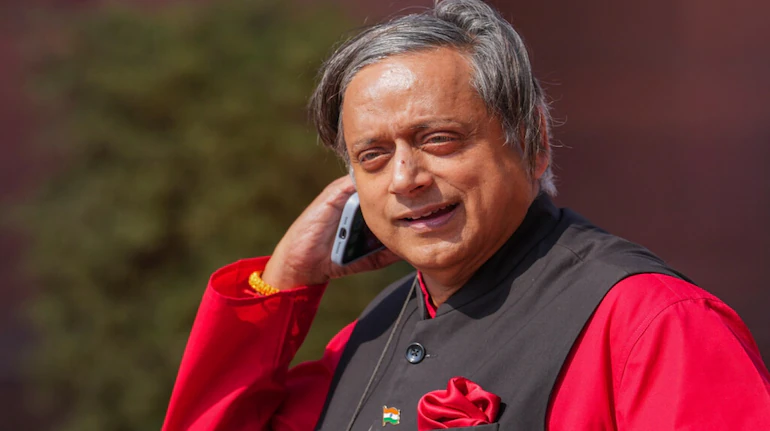
Congress MP Shashi Tharoor has backed Prime Minister Narendra Modi‘s criticism of Indian companies over their failure to translate government tax concessions into higher investment, job creation and better salaries. However, while agreeing with the Prime Minister’s concerns about corporate performance and employment, the Thiruvananthapuram MP also launched a sharp attack on the Modi government, alleging that corruption has worsened and the ease of doing business remains far from reality.
Speaking to news agency ANI on Monday, November 23, 2026, Tharoor said Modi’s argument about companies not fulfilling their responsibility after receiving tax benefits reflected a genuine economic concern. He pointed to difficulties faced by young graduates in securing employment, including reports of IIT graduates struggling to obtain campus placements.
Tharoor’s remarks came after Modi questioned corporate leaders about whether tax reductions and other government concessions had resulted in more jobs and higher salaries. The Prime Minister had urged India Inc to demonstrate that the benefits offered by the government were translating into tangible improvements for workers and the wider Economy.
While Tharoor agreed with the substance of Modi’s criticism, he argued that the government also needed to examine its own policies and regulatory environment. He called for simpler regulations and better business conditions before delivering a pointed political remark referring to Modi’s earlier slogan, “Na khaunga, na khane dunga”.
Tharoor Says Modi’s Criticism of Corporates Reflects Economic Reality
Tharoor said the Prime Minister’s criticism was justified because the government had reduced corporate taxes with the expectation that businesses would use the additional financial flexibility to expand operations, invest in new projects, create employment and improve employee compensation.
According to the Congress MP, companies had not necessarily delivered on those expectations. He acknowledged that corporates might have their own explanations for investment and hiring decisions, but maintained that the government’s argument deserved attention.
“I think what the Prime Minister said is a reality. The corporates may have their own defence of it, but his argument, as I understand it, is that the government has lowered taxes to encourage companies to invest more, create more jobs, and raise salaries, and the companies have not kept their share of the bargain,” Tharoor told ANI.
His comments were notable because they aligned with a criticism coming from the Prime Minister despite the Congress leader’s broader opposition to the government’s economic policies. Rather than dismissing Modi’s remarks as political messaging, Tharoor accepted that the gap between corporate tax benefits and employment outcomes was a legitimate issue.
The debate centres on what companies do with the financial resources made available through tax reductions. Lower corporate taxes can improve profitability and leave businesses with more money for expansion, investment or other uses. However, whether those savings translate into additional hiring and higher wages depends on demand, business confidence, investment opportunities and companies’ own decisions.
Tharoor’s position was that the government had offered incentives partly to encourage companies to contribute more directly to economic growth, and that the results needed to be assessed against those expectations.
IIT Graduates Struggling to Find Jobs Raises Employment Concerns
One of the strongest points in Tharoor’s response was his reference to the employment difficulties reportedly facing graduates of the Indian Institutes of Technology. He argued that the struggle to secure placements among highly qualified students illustrated the seriousness of the jobs challenge, particularly for young people entering the workforce.
“The public tells us that it’s very difficult to get jobs that for the first time, for example, an IIT graduate couldn’t get placement. I mean, this kind of thing was not heard in the past, so it suggests that the environment for employment, particularly of college graduates, is rather grim,” he said.
The IIT system has long been associated with technical education, competitive admissions and strong recruitment prospects. Campus placements at these institutions are closely watched because they offer an indication of hiring demand in sectors such as technology, engineering, consulting and finance.
However, the reference to an IIT graduate being unable to secure a placement should not be interpreted as evidence that all IIT students are facing unemployment. Placement outcomes vary between institutes, academic departments, graduating batches and economic conditions. Tharoor used the example to highlight what he described as a wider deterioration in employment opportunities for educated young people.
The concern extends beyond engineering graduates. India’s expanding pool of college-educated job seekers has increased the importance of creating employment that matches their qualifications and expectations. When graduate hiring slows, students can face longer job searches, greater competition and pressure to accept positions that may not match their training.
For businesses, hiring decisions are influenced by several factors, including consumer demand, access to capital, global economic conditions and expectations about future growth. Companies may increase profits without expanding their workforce at the same rate, particularly when they invest in automation or improve productivity through technology.
Tharoor’s remarks therefore brought attention to a central question in India’s economic debate: whether growth in corporate earnings and tax relief is producing enough quality employment for the country’s educated workforce.
Congress MP Says Government Must Improve Ease of Doing Business
Although Tharoor agreed with Modi’s criticism of companies, he argued that the government could not place the entire responsibility for weak investment and hiring outcomes on the corporate sector.
He said the government needed to simplify regulations and address difficulties faced by businesses operating in India. In his view, improving the ease of doing business remained an important unfinished task.
Tharoor suggested that the disagreement between the government and companies over investment and employment should be examined rather than treated as a one-sided problem. If businesses believe government policies are making expansion difficult, he argued, those concerns also deserve attention.
“The economy requires attention, and if the Prime Minister is pointing fingers at the companies and the companies want to point fingers at government policies, that’s something we can watch,” he said.
He added that the government could certainly do more to simplify regulations and improve the business environment. The criticism reflects a longstanding concern among businesses that complicated compliance requirements, administrative procedures and regulatory uncertainty can increase the cost and difficulty of operating enterprises.
Ease of doing business is not determined by tax rates alone. Companies also consider the time required to obtain approvals, the predictability of regulations, the efficiency of public services and the consistency with which rules are implemented.
For smaller businesses, regulatory complexity can be particularly challenging because they may not have dedicated legal, financial or compliance teams. Larger companies can also face difficulties when rules differ across sectors or jurisdictions.
Tharoor’s argument was that the government should examine these obstacles if it expects companies to invest more, expand operations and create additional jobs.
Tharoor Alleges Corruption Has Worsened Under Modi Government
The Congress MP then shifted from economic policy to corruption, making one of his sharpest allegations against the Modi government. He claimed that businessmen he speaks to have expressed concern that corruption has become worse rather than improving.
“And I’m sorry to say that corruption, according to every businessman I speak to, is much worse than it’s ever been,” Tharoor said.
The remark directly challenged the government’s emphasis on cleaner administration and its public messaging around tackling corruption. However, Tharoor presented the statement as his assessment based on conversations with businesspeople, rather than citing a specific survey or official measurement.
His criticism also connected corruption to the wider business environment. For companies, concerns about unofficial payments, administrative discretion and inconsistent enforcement can affect the cost of doing business and confidence in investment decisions.
Corruption allegations are politically contested, and Tharoor’s statement does not by itself establish the extent or direction of corruption across the economy. It does, however, underline the opposition’s argument that the government’s claims about improving business conditions should be judged against the experiences reported by entrepreneurs and investors.
The issue also complicates the debate over corporate responsibility. If companies are expected to invest more and create jobs after receiving tax concessions, the government must also provide a predictable regulatory environment in which businesses can operate without unnecessary obstacles.
‘Na Khaunga, Na Khane Dunga’: Tharoor’s ‘Beef’ Remark
Tharoor ended his comments with a pointed reference to one of Modi’s best-known political slogans, “Na khaunga, na khane dunga”, which is commonly understood as a promise not to engage in corruption or allow others to do so.
Turning the slogan into a political jibe, the Congress MP said: “And now we realise he only meant beef.”
The remark introduced a reference to the politically sensitive issue of beef consumption and its place in India’s public debate. It also shifted the tone of the interview from economic criticism to a direct attack on the Prime Minister’s political messaging.
Tharoor’s comment was a sarcastic political allegation, not a factual finding about the Prime Minister’s conduct. Its significance lies in the way it challenged the consistency of the slogan by linking it to controversies surrounding beef and the government’s broader political positions.
The remark is likely to attract attention because it came immediately after Tharoor had agreed with Modi on the need to question corporate performance. His response combined an acknowledgement of the Prime Minister’s economic argument with criticism of the government’s record on business conditions and corruption.
Why Modi Had Questioned Corporate India
Tharoor’s comments followed Modi’s address to representatives of Corporate India at the Federation of Indian Chambers of Commerce and Industry’s annual general meeting the previous week.
During the interaction, the Prime Minister questioned whether companies had increased investment, created more employment opportunities and raised salaries after receiving tax reductions and other government benefits.
The remarks placed corporate performance at the centre of a wider discussion about whether tax relief was producing the economic outcomes policymakers had expected.
One of the major measures Modi’s government introduced was the 2019 reduction in the headline corporate tax rate for domestic companies from 30% to 22%, subject to specified conditions. The reform was intended to improve India’s competitiveness and encourage investment by leaving businesses with a larger share of their profits.
The government has also introduced income-tax relief, including changes that reduced the tax burden for eligible individual taxpayers. Modi’s broader message was that such measures should contribute to stronger economic activity rather than simply improving corporate or household finances.
However, tax reductions do not automatically guarantee new factories, additional hiring or higher salaries. Companies make investment decisions based on expected demand, financing costs, infrastructure, regulatory conditions and their assessment of future profitability.
That is why the debate over corporate tax relief involves more than measuring the amount of tax collected. It also requires examining whether the policy has encouraged additional investment and employment that might not otherwise have occurred.
A Rare Point of Agreement Amid Political Differences
Tharoor’s response created an unusual moment in the political debate because he supported the central concern raised by Modi while using the same discussion to criticise the government’s economic and administrative record.
His comments suggest that the question of whether corporate tax benefits have translated into better employment outcomes is not limited to the ruling party’s political narrative. The issue also matters to opposition leaders concerned about graduate unemployment, wages and the quality of economic growth.
At the same time, Tharoor’s criticism highlights the competing responsibilities involved. Companies are expected to invest, expand and create jobs, while the government is expected to provide stable policies, efficient administration and a business environment that supports growth.
The central question is whether both sides are delivering on those expectations. Corporate profitability alone cannot demonstrate that employment conditions are improving, just as tax concessions alone cannot guarantee that companies will expand their workforce.
For India’s young graduates, the debate has immediate significance. Access to quality employment remains one of the most important measures of whether economic growth is improving opportunities for ordinary households. Tharoor’s reference to IIT placement difficulties brought that concern into focus, while his criticism of corruption and regulatory complexity broadened the discussion to the conditions businesses face.
His remarks ultimately brought together two contrasting messages: Modi was right, in Tharoor’s view, to question whether companies had delivered on the benefits they received, but the government must also answer questions about jobs, regulation and corruption. The Congress MP’s final reference to beef ensured that his response would be remembered not only for its economic agreement with the Prime Minister but also for its pointed political attack.
For breaking news and live news updates, like us on Facebook or follow us on Twitter and Instagram. Read more on Latest India on thefoxdaily.com.






COMMENTS 0