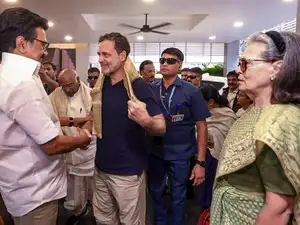
Congress’s attempt to persuade Dravida Munnetra Kazhagam (DMK) chief and Tamil Nadu Chief Minister M.K. Stalin to oppose the Centre’s revised Delimitation Bills has failed, exposing differences within the opposition INDIA Bloc over one of the most consequential proposed changes to India’s electoral system. Despite a meeting involving senior Congress leaders, Stalin has maintained that the DMK will support the legislation, arguing that the revised framework addresses Tamil Nadu’s concerns about parliamentary representation.
The disagreement creates a challenge for Congress as it seeks to build a united opposition against the constitutional amendments. The DMK’s position is particularly significant because the party has been among the strongest voices warning that delimitation could weaken the political influence of southern states. Its decision to back the revised Bills suggests that regional parties may assess the legislation differently depending on the safeguards they believe have been secured for their states.
The political dispute also comes amid a deterioration in relations between Congress and the DMK following their split in Tamil Nadu. With the two parties now differing over the proposed legislation, the opposition faces the difficult task of coordinating its parliamentary strategy while managing competing regional and national political priorities.
Congress-DMK Fallout Complicates Opposition Strategy
Congress’s outreach to Stalin was intended to prevent a division within the INDIA bloc over the delimitation legislation. Senior Congress leaders, including Rahul Gandhi, party president Mallikarjun Kharge and Sonia Gandhi, met the DMK chief in Chennai to explain why they believed the proposed changes could have serious consequences for Tamil Nadu and the wider federal structure.
Congress leaders reportedly urged Stalin to reject the Bills, arguing that the proposed delimitation framework could threaten the political representation of states that have successfully controlled population growth. Their concern is that a future redistribution of Lok Sabha seats could increase the relative influence of states with larger populations while reducing the share held by several southern states.
However, the meeting did not produce the outcome Congress wanted. Stalin remained firm on the DMK’s position, saying that the revised legislation offered safeguards that Tamil Nadu could not afford to lose.
The disagreement has exposed the difficulty of maintaining a common position among opposition parties when a national legislative proposal carries different consequences for individual states. Congress is approaching the issue from the perspective of a coordinated national opposition, while the DMK has emphasised what it considers the immediate interests of Tamil Nadu.
The split in Tamil Nadu has further complicated the relationship. Political differences between the two parties have weakened the basis for cooperation in the state, making it more difficult for Congress to persuade the DMK to follow its position on a major national issue.
DMK Says Revised Bill Addresses Tamil Nadu’s Concerns
Stalin has defended the DMK’s decision by arguing that rejecting the revised delimitation legislation could leave Tamil Nadu without adequate protection during the next constituency-reorganisation exercise.
His position is based on the party’s assessment that the revised framework offers safeguards for the state’s parliamentary representation. Stalin has said that the DMK used its strength in Parliament to secure protections for Tamil Nadu for the next 25 years.
The Chief Minister has also argued that the opposition parties which met him did not present an alternative proposal capable of addressing the state’s concerns while ensuring that women’s reservation could be implemented.
For the DMK, the decision is therefore being presented as a practical political choice rather than an endorsement of every aspect of the Centre’s delimitation policy. The party’s argument is that opposing the Bills without a workable alternative could expose Tamil Nadu to greater uncertainty over its future representation.
However, the precise impact of the revised framework will depend on the constitutional provisions ultimately passed by Parliament and the subsequent delimitation process. The DMK’s claim that it has secured long-term safeguards reflects its interpretation of the proposed arrangement; the final distribution of seats will depend on how the legislation is implemented.
Why Southern States Are Concerned About Delimitation
Delimitation is the process of redrawing electoral constituency boundaries and determining the allocation of seats in legislative bodies. In India, the exercise has major political implications because changes to the number and distribution of parliamentary constituencies can influence the relative representation of states in the Lok Sabha.
Southern states have raised concerns that a population-based redistribution could reduce their relative share of parliamentary seats. Tamil Nadu, Kerala, Karnataka, Andhra Pradesh and Telangana have pointed to their efforts to control population growth and argued that they should not lose political influence as a consequence.
The concern is rooted in the difference between population growth across regions. If parliamentary representation is recalculated primarily according to population, states with faster population growth could gain a larger share of seats compared with states where population growth has been slower.
For southern political parties, the issue is not simply the number of additional seats each state receives. They also want assurances that their proportionate influence in national decision-making will not decline after the delimitation exercise.
The Centre’s revised proposal is intended to address some of these concerns through a framework linked to an expansion of existing seat allocations. The government has presented the legislation as a way to increase representation while enabling the implementation of women’s reservation.
Delimitation Bills Linked to Expansion of Lok Sabha and Women’s Reservation
The revised legislation is connected to the government’s plan to expand the Lok Sabha and implement 33 per cent reservation for women in elected legislatures. The proposed framework could increase the maximum strength of the Lok Sabha to 850 members, creating additional seats while changing the structure of parliamentary representation.
The Constitution (106th Amendment) Act, 2023, commonly known as the Women’s Reservation Act, provides for one-third reservation for women in the Lok Sabha, state legislative assemblies and the Delhi Legislative Assembly. Its implementation is linked to a future Census and the subsequent delimitation exercise.
The Centre has argued that the revised constitutional framework is necessary to make the women’s quota operational in the 2029 general election. The proposal also provides for an increase in seats reserved for Scheduled Castes and Scheduled Tribes alongside the broader expansion, with the women’s quota applying within those reserved constituencies.
While the government has presented the Bills as a measure to expand representation, opposition parties have questioned the process and its possible impact on the balance of power among states. The disagreement has made delimitation a wider constitutional debate involving federalism, electoral fairness and the representation of women and historically disadvantaged communities.
Congress Faces a Tougher Parliamentary Battle
The DMK’s decision to support the revised Bills complicates Congress’s efforts to mobilise opposition parties against the legislation. A united opposition could have strengthened the challenge to the government’s proposed constitutional changes, particularly because such amendments require a special majority in Parliament.
Under Article 368 of the Constitution, a constitutional amendment must be passed in each House by a majority of its total membership and by at least two-thirds of members present and voting. This means the government needs more than a routine parliamentary majority to secure passage.
Support from parties outside the ruling National Democratic Alliance (NDA) could therefore be important to the government’s parliamentary calculations. The DMK’s backing may weaken the opposition’s ability to present a common position, although it does not automatically determine the final voting outcome.
Congress will now have to navigate differences among its allies while continuing to challenge the proposed framework. Other regional parties may also assess the revised Bills according to their own states’ interests, rather than adopting a uniform opposition position.
The divide also raises questions about the future coordination of the INDIA bloc. The alliance was formed to bring opposition parties together against the BJP, but its members have different political priorities, regional calculations and electoral interests. Delimitation has brought those differences into sharper focus.
What Stalin’s Position Means for INDIA Bloc Unity
Stalin’s refusal to change the DMK’s position demonstrates that cooperation within the INDIA bloc does not necessarily translate into agreement on every major legislative issue. Regional parties may remain part of the opposition alliance while taking independent positions when they believe their state’s interests require a different approach.
For Congress, the challenge is to maintain coordination without expecting every ally to adopt its position on constitutional and electoral reforms. For the DMK, the immediate priority is to defend the political representation of Tamil Nadu, even if its approach differs from that of other opposition leaders.
The disagreement does not by itself mean that the INDIA bloc has broken apart. However, it exposes the limits of its ability to maintain a unified parliamentary strategy when its members disagree over the consequences of a proposed law.
Delimitation Debate Could Reshape Opposition Politics
The revised delimitation Bills have turned a debate over electoral boundaries into a test of political coordination among parties that oppose the Centre. The Congress leadership’s unsuccessful attempt to persuade Stalin highlights how difficult it can be to reconcile national opposition strategy with the priorities of regional parties.
The DMK’s support also shows that the revised proposal has changed the political calculations surrounding delimitation. A party that previously raised strong concerns about the possible consequences for southern states is now arguing that the updated framework provides safeguards worth preserving.
The final parliamentary outcome will depend on the positions taken by parties and MPs when the legislation is put to a vote. Beyond that immediate contest, the debate will shape discussions about how India balances population, state representation and women’s reservation in its electoral system.
For Congress, the immediate task is to build a broader parliamentary position despite the DMK’s disagreement. For Stalin, the priority remains securing what his party considers adequate protection for Tamil Nadu. Their differing approaches have exposed a significant fault line within the INDIA bloc at a critical moment in the delimitation debate.
For breaking news and live news updates, like us on Facebook or follow us on Twitter and Instagram. Read more on Latest India on thefoxdaily.com.






COMMENTS 0