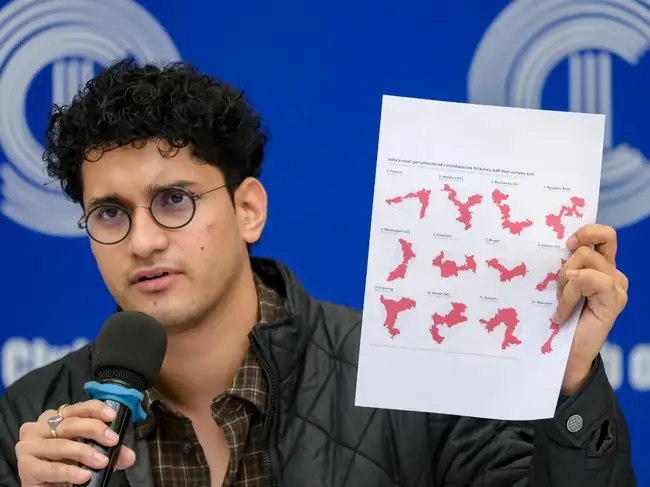
The Cockroach Janta Party (CJP) has strongly opposed the proposed Delimitation Bill, warning that the legislation could reshape India’s electoral representation in ways that favour the ruling Bharatiya Janata Party (BJP) and weaken the influence of voters. At a press conference, the group argued that the proposed changes raise serious questions about political representation, democratic accountability and the use of public money.
CJP also called for the immediate implementation of 50 per cent reservation for women in the Lok Sabha, saying that electoral reforms should address the underrepresentation of women rather than focus primarily on expanding the size of Parliament. The group further questioned proposals to increase the strength of the Lok Sabha and the Council of Ministers, arguing that a larger political establishment could add to the financial burden on taxpayers.
Why CJP Says the Delimitation Bill Could Weaken Democracy
CJP co-convenor Saurav Das warned that the proposed delimitation exercise could give the BJP a lasting electoral advantage if constituency boundaries are redrawn without sufficient safeguards. He questioned the proposed powers of the Delimitation Commission, particularly the possibility that decisions on constituency boundaries could face limited judicial scrutiny.
Das argued that delimitation should not be examined in isolation. He linked the proposed legislation to two other major political developments: the Special Intensive Revision (SIR) of electoral rolls and the government’s proposal for simultaneous elections, commonly referred to as One Nation, One Election.
His warning was that the combined effect of these measures could weaken the ability of voters to change governments through elections.
“Once all three are in place, Special Intensive Revision of voter rolls, the Delimitation Bill, and One Nation, One Election, Indian Democracy will be finished,” Das warned.
The statement reflects CJP’s political assessment of the proposed changes. The party has not established that the legislation would necessarily produce the electoral outcome it fears. Its central demand is for stronger safeguards, transparency and independent scrutiny before any major redrawing of constituencies takes place.
CJP Alleges BJP Could Benefit From Gerrymandering
One of CJP’s principal objections is the possibility of gerrymandering, a practice in which electoral boundaries are drawn in ways that can advantage a particular political party or group.
Constituency boundaries influence how voters are grouped into parliamentary seats. Even when the overall number of votes cast for different parties remains unchanged, the way voters are distributed across constituencies can affect the number of seats those parties win.
CJP alleged that electoral rolls, polling-booth results and historical voting patterns could potentially be used to redraw constituencies in ways that benefit the ruling BJP. The group argued that concentrating opposition voters in some constituencies or dividing them across several others could influence electoral outcomes without changing the total number of votes received by political parties.
Das also questioned whether a Delimitation Commission operating under the proposed framework would have sufficient independence. He raised concerns about the scope for challenging its decisions in court, arguing that meaningful judicial scrutiny is an important safeguard against arbitrary boundary changes.
These remain allegations and concerns raised by CJP, rather than established findings about how the proposed commission would conduct its work. The extent of the commission’s powers, the procedures it follows and the safeguards available to affected parties will be central to evaluating the proposal.
Why CJP Wants Women’s Reservation Implemented Immediately
CJP also challenged the government’s approach to Women’s Reservation, arguing that the issue should not be tied to a fresh delimitation exercise. The group said it supports 50 per cent reservation for women in proportion to their population and wants the quota implemented immediately in the existing 543-member Lok Sabha.
The demand differs from the 33 per cent reservation provided for under the Constitution (106th Amendment) Act, 2023, popularly known as the Women’s Reservation Act. That legislation provides for one-third reservation for women in the Lok Sabha, state legislative assemblies and the Delhi Assembly, with implementation linked to a future Census and subsequent delimitation exercise.
CJP argued that the government could take steps to improve women’s representation within the existing parliamentary structure instead of using the issue to justify changes to constituency boundaries.
The group questioned why women’s reservation could not be implemented in the current Lok Sabha if improving women’s participation in politics was the government’s immediate objective.
The debate therefore involves two connected but distinct questions: how to increase women’s representation in elected institutions and how to determine the number and boundaries of constituencies. CJP’s position is that the first objective should not become a justification for proceeding with the second without adequate democratic safeguards.
CJP Questions Expansion of Lok Sabha to 850 Seats
The proposed expansion of the Lok Sabha is another major point of criticism. The current House has 543 elected seats, while the proposed constitutional framework could raise its maximum strength to 850 members, including up to 815 representatives from states and 35 from Union Territories.
The government has presented the expansion as a way to increase parliamentary representation while facilitating the implementation of women’s reservation. The proposal also envisages a 50 per cent increase in the number of seats allocated to states and Union Territories under the revised framework.
CJP questioned whether simply increasing the number of MPs would improve Parliament’s ability to address the country’s most pressing problems. Das pointed to the gap between India’s young population and the age profile of its elected representatives.
He cited figures suggesting that nearly 60 per cent of India’s population is below 35, while only around 5 per cent of MPs belong to that age group. He also put the average age of MPs at approximately 56.
Das questioned the rationale for increasing the Lok Sabha’s strength from 543 to 850 if the existing Parliament was not adequately addressing the concerns of young people.
“If you cannot address the issues of the youth with 543 MPs, what guarantee is there that you will address them with 850?”
CJP argued that Parliament should give greater attention to unemployment, examination paper leaks, education, air pollution and healthcare. Its criticism is that expanding the legislature should not be treated as a substitute for improving the quality of representation and addressing issues affecting citizens.
Party Also Raises Concerns Over Taxpayer Expenditure
CJP founder Abhijeet Dipke separately criticised the proposed expansion of the Lok Sabha and the Union Council of Ministers, arguing that a larger political establishment could increase public expenditure.
Dipke claimed that the government currently spends approximately Rs 620 crore annually on its Council of Ministers, which he said has 68 members. Based on his calculation, the average annual expenditure works out to around Rs 9.1 crore per minister.
He argued that the proposed changes could increase the maximum permissible strength of the Council of Ministers from 81 to 122, creating room for 41 additional ministers. On that basis, he estimated that the potential additional annual expenditure could reach Rs 374 crore.
These figures are estimates presented by Dipke, not confirmed projections of future government spending. Actual expenditure would depend on the number of ministers appointed, their entitlements and the administrative arrangements made by the government.
Nevertheless, the criticism adds a financial dimension to CJP’s opposition. The group argues that expanding Parliament and the ministerial establishment should be assessed not only in terms of representation but also in terms of the cost to taxpayers and the benefits delivered to the public.
CJP Appeals to Opposition Parties to Reject the Bill
CJP has urged political parties and MPs to oppose the proposed delimitation legislation when Parliament takes it up. Das particularly appealed to opposition parties from southern India, where concerns over the long-term distribution of parliamentary representation have become an important part of the delimitation debate.
The group warned that opposition parties supporting the legislation, or choosing to abstain from the vote, could face criticism for enabling changes that CJP believes may weaken electoral competition.
It also questioned political leaders who have supported the proposal on the grounds that every state would receive additional parliamentary seats. According to CJP, an increase in the number of seats does not automatically guarantee fair representation if constituency boundaries are drawn without adequate safeguards.
The appeal comes amid wider political disagreement over the proposed constitutional amendment and related delimitation legislation. The government has defended the proposed expansion as part of its plan to increase representation and facilitate women’s reservation, while opposition parties have raised concerns about the process, state representation and the timing of implementation.
Delimitation Debate Moves Towards a Crucial Parliamentary Test
The Centre is preparing to bring the proposed legislation before Parliament during the special sitting scheduled to begin on November 30. The proposals are expected to trigger debate over the future size of the Lok Sabha, the distribution of seats among states, women’s representation and the powers of the Delimitation Commission.
For CJP, the issue goes beyond the number of MPs or the boundaries of individual constituencies. Its objection is rooted in the concern that changes to electoral institutions could affect how effectively voters can hold governments accountable.
The government’s stated objective is to expand representation and provide a framework for implementing women’s reservation. CJP, meanwhile, wants the women’s quota implemented in the existing Lok Sabha and is demanding stronger protections against partisan constituency redrawing.
The central questions for Parliament will be whether the proposed framework provides sufficient transparency, how the independence and accountability of the delimitation process will be protected, and whether the expansion can address concerns about representation across India’s states and communities.
As the special parliamentary sitting approaches, the disagreement is likely to become a major test of political consensus over electoral reform. The outcome will matter not only for the composition of the next Lok Sabha but also for the rules that shape India’s parliamentary representation in the years ahead.
For breaking news and live news updates, like us on Facebook or follow us on Twitter and Instagram. Read more on Latest India on thefoxdaily.com.





COMMENTS 0