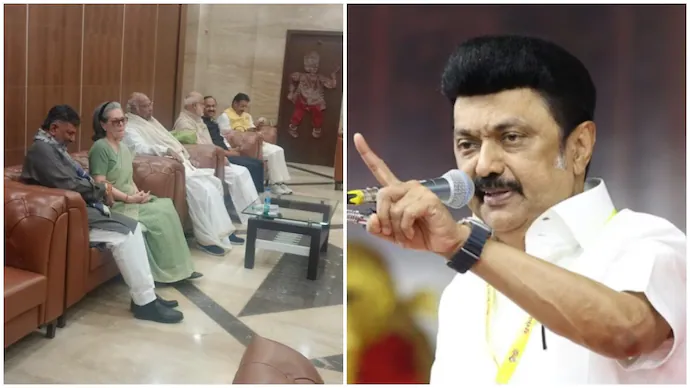
The Dravida Munnetra Kazhagam (DMK) has reiterated its demand for “fair delimitation” after Tamil Nadu Chief Minister MK Stalin met Congress leaders Sonia Gandhi, Rahul Gandhi and Mallikarjun Kharge to discuss the proposed changes to India’s electoral constituencies. Despite the discussions, the DMK has shown no indication that it is prepared to dilute its position, arguing that Tamil Nadu’s existing share of representation in the Lok Sabha must be protected.
Stalin told the Congress leadership that the party’s position was based on concerns about the possible consequences of rejecting the proposed delimitation framework. According to his explanation, defeating the Bill could put Tamil Nadu’s current share of parliamentary seats at risk. The DMK is therefore seeking an arrangement that allows constituencies to expand while ensuring the state does not lose its relative representation.
The meeting brought together senior Congress leaders and three Chief Ministers, but it did not produce an announced agreement that changed the DMK’s position. Instead, Stalin said the Congress leaders had heard and accepted the party’s concerns, while discussions also covered other aspects of the issue.
DMK Reaffirms Its Fair Delimitation Position
The meeting followed a resolution adopted at a DMK MPs’ meeting a day earlier. Stalin said he had conveyed that resolution to the Congress leadership and explained the political and constitutional concerns behind the party’s position.
In a statement shared through the DMK’s IT Wing, the party made its position explicit: “The DMK remains just as firm in its stance of #FairDelimitation.”
The statement indicates that the discussions with Sonia Gandhi, Rahul Gandhi and Mallikarjun Kharge did not lead to a change in the party’s stated demand. While Stalin said the Congress leaders had accepted the DMK’s position, the meeting did not result in any publicly announced compromise or joint formula for the proposed exercise.
At the centre of the disagreement is how India’s parliamentary constituencies should be reorganised and whether states that have experienced slower population growth could lose a portion of their relative representation under a future delimitation exercise.
The DMK argues that Tamil Nadu should not be disadvantaged because of its demographic trajectory. Its demand for fair delimitation is therefore focused on protecting the state’s existing share while allowing the overall number of parliamentary seats to increase.
Why Stalin Says Defeating the Bill Could Put Tamil Nadu’s Share at Risk
One of the most significant points Stalin raised during the meeting was the possibility that Tamil Nadu could lose its existing share of parliamentary representation if the proposed Bill failed.
“Our stand is, if this bill is defeated, we might even lose the share Tamil Nadu holds,” Stalin said while explaining the party’s position to Congress leaders.
The remark reflects the DMK’s concern that the outcome of the current legislative debate could affect the state’s future representation. The party is presenting its position as an effort to secure a framework that protects Tamil Nadu rather than simply oppose an increase in the number of elected representatives.
However, the consequences of the Bill being defeated would depend on the constitutional and legislative arrangements that follow. Stalin’s warning represents the DMK’s assessment of the political risk; it does not, by itself, establish that Tamil Nadu would automatically lose seats if the proposal failed.
The distinction matters because delimitation involves decisions about the legal basis for determining constituency boundaries, the allocation of seats among states and the timing of any future changes. The precise impact on Tamil Nadu would depend on the final framework adopted by Parliament.
Why the DMK Is Insisting on Fair Delimitation
The DMK’s position has developed against the backdrop of concerns that a population-based redistribution of Lok Sabha seats could reduce Tamil Nadu’s relative influence in Parliament. The state currently has 39 Lok Sabha constituencies out of a total of 543 elected seats, giving it approximately 7.18% of the House.
The party has argued that states which made progress in population stabilisation should not face a reduction in their parliamentary representation as a consequence of that progress. Tamil Nadu’s concern is that a delimitation exercise based primarily on newer population figures could increase the number of seats for states with faster population growth while reducing the relative share of states such as Tamil Nadu.
An infographic circulated by the DMK outlined how the party’s assessment of the issue had changed. It said earlier projections suggested that Tamil Nadu’s representation could fall from 39 seats to approximately 31 or 32 if delimitation resulted in a redistribution based on population.
Under that scenario, the state’s share of Lok Sabha representation could decline to between 5.71% and 5.89%, according to the party’s calculations. The DMK presented these estimates as a reason for opposing an arrangement that could reduce Tamil Nadu’s existing parliamentary influence.
However, the party’s current argument is not simply against increasing the number of seats. It is seeking an expansion formula that protects the state’s existing proportion of representation while allowing the Lok Sabha to become larger.
DMK’s Alternative: Increase Seats Without Reducing Tamil Nadu’s Share
The DMK’s revised position centres on a proposal under which Tamil Nadu’s existing representation would be protected even as the total strength of the Lok Sabha increases.
According to the party’s infographic, Tamil Nadu could receive 59 Lok Sabha seats under a proposed expansion, compared with its current 39. The party has argued that this would allow the state to increase its number of elected representatives without losing its relative share in Parliament.
The figures are significant because 59 seats in an expanded Lok Sabha of approximately 816 members would give Tamil Nadu a share of around 7.23%. The precise percentage depends on the final strength of the House and the provisions adopted in the legislation. The government’s proposed uniform expansion has also been described as keeping Tamil Nadu’s share close to its existing 7.18% level.
The DMK’s demand goes beyond the number of seats allocated to Tamil Nadu. It also wants the existing proportion of parliamentary representation among states, based on the 1971 Census framework, to remain protected for another 25 years.
Under the proposed arrangement discussed by the party, the protection would continue until 2051. This would give states greater certainty that their relative share of parliamentary representation would not be reduced during the extended period, even as constituency numbers increase.
The distinction between increasing the number of seats and changing the distribution of seats is central to the debate. The DMK is arguing for the former while seeking safeguards against the latter.
Why the 1971 Census Remains Central to the Debate
The controversy over delimitation is closely connected to the decision to freeze the allocation of Lok Sabha seats among states based on the 1971 Census. The arrangement was introduced to address concerns that states which successfully reduced population growth could be disadvantaged if parliamentary representation were repeatedly redistributed according to newer population figures.
Constitutional amendments subsequently extended the freeze, with the current arrangement linked to the first Census conducted after 2026. This has made the next delimitation exercise particularly consequential for states with different population growth patterns.
States in southern India, including Tamil Nadu, have raised concerns that a straightforward population-based redistribution could shift parliamentary representation towards states with larger or faster-growing populations. The debate therefore involves not only constituency boundaries but also the balance of representation within India’s federal system.
The DMK’s demand to retain the existing interstate proportions for another 25 years is intended to address this concern. It would allow the number of seats to increase while preserving the relative distribution among states for the specified period.
Supporters of this approach argue that it would recognise the importance of population stabilisation and prevent states from losing parliamentary influence because of demographic differences. The broader debate, however, also involves questions about population-based representation and how the constitutional framework should balance competing principles.
What the Revised Delimitation Proposal Could Mean for Tamil Nadu
The revised proposal discussed by the government envisages a 50% increase in the number of Lok Sabha seats allocated to each state and Union Territory. Unlike a redistribution based solely on population differences, this formula is intended to increase representation while retaining the existing relative distribution among states.
For Tamil Nadu, the proposed increase from 39 to 59 seats would mean 20 additional constituencies. The party has presented this as a way to expand representation without reducing the state’s share of the House.
The proposed protection of interstate seat proportions until 2051 is another important part of the arrangement. If incorporated and implemented as described, it would provide a longer period of stability in the distribution of parliamentary seats among states.
However, the final implications will depend on the legislation passed by Parliament and the rules governing the delimitation exercise. The allocation of seats, the drawing of constituency boundaries and the treatment of reserved constituencies will all matter when the framework is implemented.
Congress Meeting Highlights Differences Within the Opposition
The meeting between Stalin and senior Congress leaders underlines the challenge of maintaining a common position among Opposition parties on the delimitation issue. The Congress leadership has sought discussions with regional parties because the legislation raises questions about state representation, federal balance and the future structure of Parliament.
The DMK’s position has become a particularly important point of discussion because it is a significant regional party with a substantial parliamentary presence. Its insistence on protecting Tamil Nadu’s share has shaped the terms of the debate, even as Congress and other Opposition parties have raised broader objections to the government’s approach.
The discussions also reflect a difference between opposing delimitation in principle and negotiating the conditions under which it should take place. The DMK has argued that its priority is to secure safeguards for Tamil Nadu, while other parties may consider the wider constitutional and political consequences of the proposed framework.
Stalin’s explanation that the Congress leaders accepted the DMK’s position does not establish that the two parties have reached agreement on every aspect of the legislation. Nor does it mean that Congress has endorsed the DMK’s approach to the proposed Bill.
Why the DMK’s Stand Matters for the Delimitation Debate
The DMK’s position has implications beyond Tamil Nadu because the delimitation exercise could affect the distribution of parliamentary representation across the country. Any decision about how seats are allocated will influence the relative political weight of states in the Lok Sabha.
For states concerned about losing their share, the DMK’s proposed safeguards offer one possible approach: expand the House while retaining the existing proportions among states for a defined period. Whether that formula addresses all concerns about representation remains a matter of political and constitutional debate.
The issue also demonstrates why delimitation cannot be treated as a purely administrative exercise. Redrawing constituency boundaries and changing the strength of legislatures can influence the balance between states, the representation of communities and the functioning of Parliament.
For Tamil Nadu, the immediate concern is that its current 7.18% share should not be reduced. The DMK’s demand for a further 25-year protection of interstate representation is intended to provide a longer-term guarantee, rather than leave the state’s position uncertain after the next delimitation exercise.
DMK Keeps Its Focus on Tamil Nadu’s Parliamentary Share
The meeting with Sonia Gandhi, Rahul Gandhi and Mallikarjun Kharge has not changed the DMK’s stated insistence on fair delimitation. Stalin has made clear that the party’s decisions on the issue will be guided by Tamil Nadu’s interests, particularly the protection of its existing share of parliamentary representation.
The party’s position is also more specific than a blanket rejection of additional Lok Sabha seats. It is seeking an arrangement under which Tamil Nadu’s representation could rise from 39 to 59 seats while its relative share remains protected, alongside a continuation of the existing interstate proportions until 2051.
The political disagreement now centres on whether the proposed safeguards are sufficient and whether other Opposition parties will accept the DMK’s approach. As Parliament takes up the revised legislative framework, the debate is likely to focus on the relationship between population, federal representation and the constitutional principles governing delimitation.
For Stalin, the central message remains that an increase in the size of Parliament must not come at the cost of Tamil Nadu’s political representation. The DMK’s insistence on fair delimitation reflects its effort to secure that protection as India prepares for its next major electoral restructuring.
For breaking news and live news updates, like us on Facebook or follow us on Twitter and Instagram. Read more on Latest India on thefoxdaily.com.






COMMENTS 0