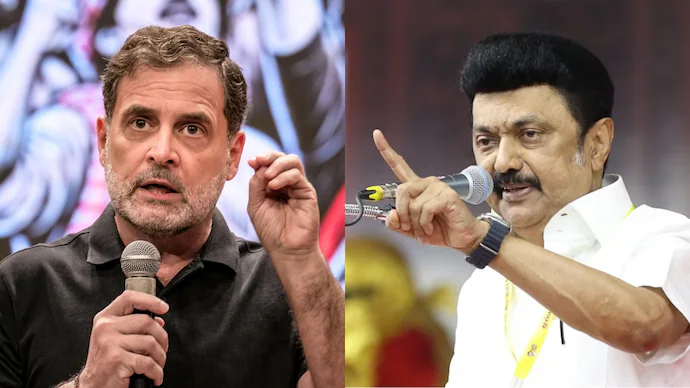
Congress leader Rahul Gandhi appeared caught off guard on Sunday when asked about Tamil Nadu Chief Minister and DMK president M.K. Stalin’s decision to support the Centre’s proposed Delimitation Bill. Speaking to reporters in Chennai, the Leader of the Opposition in the Lok Sabha said he was “not aware” of what the DMK had said or done, even though a delegation of senior INDIA bloc leaders had met Stalin to persuade him to oppose the legislation.
The meeting included Rahul Gandhi, Congress president Mallikarjun Kharge and Sonia Gandhi, who sought to convince the DMK chief that the proposed delimitation exercise could threaten Tamil Nadu’s political representation and have wider consequences for the country’s federal structure. Stalin, however, maintained that his party had no alternative but to support the Bill, arguing that rejecting it could leave Tamil Nadu and other southern states without adequate safeguards.
The exchange exposed a significant disagreement within the opposition INDIA bloc over how to approach the proposed constitutional amendment. While Congress leaders have raised concerns about the possible consequences of delimitation, Stalin has defended the legislation as the available route to protect Tamil Nadu’s representation in Parliament.
Rahul Gandhi Says He Is Unaware of DMK’s Latest Position
Responding to questions about Stalin’s position after the meeting, Rahul Gandhi said he could not comment on what the DMK had decided. He instead reiterated the concerns he had conveyed to the Tamil Nadu Chief Minister during their discussion.
“We are not aware of what the DMK has said or done. I am telling you what we discussed and what we mentioned to Brother Stalin. We mentioned to Brother Stalin that this is a threat to Tamil culture, to the Tamil language, to the Tamil people, to the Indian Union, and to India. And Brother Stalin, like all patriotic people, must stand against this threat.”
Rahul’s remarks indicated that Congress remained opposed to the proposed legislation and had urged Stalin to take a similar position. His response also suggested that the Congress leadership had not secured a change in the DMK’s publicly stated approach during the meeting.
The timing of the exchange made it particularly significant. The senior opposition leaders had travelled to meet Stalin specifically to discuss the delimitation issue, but the DMK chief continued to defend support for the Bill after the discussions.
Stalin Says Defeating the Bill Could Leave Tamil Nadu Without Safeguards
Stalin defended the DMK’s position by arguing that defeating the proposed legislation would not necessarily protect Tamil Nadu from the risks associated with delimitation. Instead, he said, rejection could leave the state without even the minimum safeguards that the party believes are necessary to protect its parliamentary representation.
“Our stand is that if the delimitation Bill is defeated, we will lose even the minimum safeguard available for Tamil Nadu.”
The Tamil Nadu Chief Minister also said there was no alternative proposal available to replace the Centre’s legislation. According to Stalin, the parties that met him had not presented another workable plan that could address the state’s concerns while ensuring the implementation of women’s reservation.
“There is no option but to support the Delimitation Bill. There is no other alternative proposal either. The parties that met me also do not have an alternative plan.”
Stalin summed up the DMK’s position with the statement, “For us, Tamil Nadu is first.” His remarks underline the party’s argument that its decision is based on protecting the state’s interests, even if that means taking a position different from other INDIA bloc constituents.
Why the DMK Is Supporting the Delimitation Bill
The DMK’s support is rooted in concerns about the future distribution of Lok Sabha seats among states. Southern states have repeatedly questioned whether a delimitation exercise based on population could reduce their relative influence in Parliament compared with states that have experienced faster population growth.
Tamil Nadu and other southern states have argued that they should not face a political disadvantage for implementing population-control measures. Their concern is that a population-based redistribution could alter the balance of representation between regions and weaken the voice of states that have achieved slower population growth.
Stalin has maintained that the proposed legislation offers safeguards that could protect Tamil Nadu’s share of parliamentary representation. He argued that the DMK had used its parliamentary strength to secure protections for the state for the next 25 years.
However, the precise effect of the proposed framework will depend on the final constitutional provisions and the delimitation process. The DMK’s claim that the legislation safeguards Tamil Nadu’s representation reflects the party’s interpretation of the proposal and should be distinguished from the final outcome of any future constituency exercise.
What Is the Delimitation Bill and Why Has It Triggered a Political Dispute?
Delimitation refers to the process of redrawing electoral constituency boundaries and determining the allocation of seats in legislative bodies. In India, the exercise has major implications because it can influence how states and communities are represented in the Lok Sabha and state Assemblies.
The Centre’s proposed legislation is linked to expanding the strength of the Lok Sabha and implementing 33 per cent reservation for women. The broader framework could raise the maximum strength of the lower House to 850 members, while also changing the way parliamentary and Assembly constituencies are structured.
The proposal has triggered disagreement over how the expanded seats will be distributed. Southern states are concerned about preserving their relative representation, while the government has presented the expansion as a way to increase parliamentary capacity and make women’s reservation operational.
The debate also involves the reservation of seats for Scheduled Castes and Scheduled Tribes. The government has indicated that these reserved seats would increase alongside the broader expansion and that the women’s quota would apply within reserved constituencies.
For opposition parties, the central question is whether the proposed framework provides sufficient protection against changes that could affect the political influence of individual states. The disagreement has become particularly sharp because delimitation can shape parliamentary representation for years after the exercise is completed.
Congress and DMK Take Different Positions Within INDIA Bloc
The meeting in Chennai highlighted the difficulty of maintaining a common position among INDIA bloc parties on an issue that affects states differently. Congress leaders have warned that the proposed delimitation framework could have consequences for Tamil Nadu’s political influence, while Stalin has argued that supporting the Bill is necessary to secure safeguards.
The difference is significant because the DMK is one of the major opposition parties in Tamil Nadu and an important constituent of the INDIA bloc. Its decision to support the legislation creates a divide within an alliance that has sought to coordinate its response to the Centre on major national issues.
For Congress, persuading the DMK to oppose the Bill would have strengthened the opposition’s effort to challenge the proposal in Parliament. Stalin’s refusal to withdraw support, however, means the parties must now navigate a disagreement over strategy without necessarily ending their broader political cooperation.
The episode also demonstrates that opposition unity on constitutional and electoral reforms may be difficult to sustain when regional parties believe their states face distinct risks. The DMK’s argument is that its responsibility to protect Tamil Nadu’s interests must take priority when deciding how to vote on the legislation.
Can the Delimitation Bill Pass Without a United Opposition?
The DMK’s stated support could become relevant to the government’s efforts to secure the special majority required for a constitutional amendment. Under Article 368, a Constitution Amendment Bill must receive the support of a majority of the total membership of each House and at least two-thirds of members present and voting.
This requirement makes support from parties outside the ruling National Democratic Alliance (NDA) important to the government’s parliamentary calculations. Even if opposition parties disagree with the Centre’s proposal, their individual positions may differ depending on their assessment of the consequences for their respective states.
The DMK’s position could therefore complicate attempts by Congress and other opposition parties to present a unified front against the legislation. At the same time, support from one opposition party does not establish that the Bill has secured the numbers required for passage. The final outcome will depend on the confirmed positions of MPs and the voting arithmetic in both Houses.
What Happens Next in the Delimitation Debate?
Stalin’s meeting with the INDIA bloc delegation has not produced a change in the DMK’s publicly stated position. Congress leaders have reiterated their concerns, while the Tamil Nadu Chief Minister has defended the decision to support the proposed legislation as a way to protect the state’s political representation.
The disagreement is likely to remain central to the parliamentary debate as parties consider the implications of expanding the Lok Sabha, redrawing constituency boundaries and implementing women’s reservation. The positions taken by regional parties could influence both the legislative arithmetic and the wider discussion about federal representation.
For the DMK, the immediate priority is to secure what Stalin describes as safeguards for Tamil Nadu. For Congress, the concern is that the proposed framework could create long-term risks for the state and the wider Indian Union.
Rahul Gandhi’s response that he was “not aware” of the DMK’s position captured the uncertainty surrounding the meeting’s outcome. Despite the intervention by senior INDIA bloc leaders, Stalin has made clear that his party intends to stand by its assessment of what is in Tamil Nadu’s interest.
For breaking news and live news updates, like us on Facebook or follow us on Twitter and Instagram. Read more on Latest India on thefoxdaily.com.






COMMENTS 0