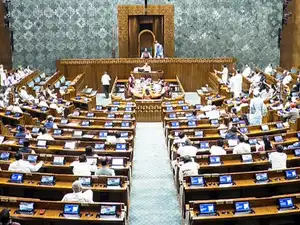
The BJP-led National Democratic Alliance (NDA) government is moving closer to securing the two-thirds majority required to pass the proposed delimitation-linked Constitution Amendment Bill, with the Dravida Munnetra Kazhagam (DMK) and YSR Congress Party (YSRCP) emerging as potential supporters. Backing from the Nationalist Congress Party (NCP) faction led by Sharadchandra Pawar could further strengthen the government’s position, taking its projected support to 353 MPs.
That would leave the government six votes short of the reported target of 359, making support from additional opposition lawmakers or parties crucial as the legislation approaches a parliamentary vote. The proposed amendment is linked to expanding the Lok Sabha and implementing 33 per cent reservation for women in elected legislatures.
The developing numbers indicate that the government’s effort to build support is extending beyond its NDA partners. However, projected backing does not guarantee that MPs will vote in favour of the Bill when it is formally taken up in the House.
DMK and YSRCP Support Strengthens Government’s Numbers
The reported support of the DMK and YSRCP has become an important factor in the government’s attempt to secure the special majority needed for the constitutional amendment. Their backing could help the BJP-led alliance move closer to the required threshold despite opposition from several parties over the proposed delimitation framework.
The DMK’s position is particularly significant because the party has repeatedly raised concerns about how delimitation could affect the representation of southern states. Tamil Nadu Chief Minister M.K. Stalin has called for a fair delimitation process and argued that states which have controlled population growth should not be disadvantaged in the distribution of parliamentary seats.
The reported support for the Bill suggests that the DMK’s position on the legislation may involve considerations beyond its broader concerns about representation. The precise terms of its support and any conditions attached to it remain important to understanding the party’s final parliamentary position.
The YSRCP’s backing adds another source of support outside the ruling alliance. Its position could help the government narrow the gap between its projected numbers and the special majority required for passage.
Sharad Pawar-Led NCP Support Could Take Tally to 353
The NCP faction led by Sharadchandra Pawar could play a decisive role in the government’s numbers. According to the reported calculation, support from this faction could take the projected tally to 353 MPs.
Even at that level, the government would remain six votes short of the reported 359-vote requirement. This means the Centre would still need to secure additional backing from other parties or individual MPs before it could be confident of passing the amendment.
The political significance of the NCP (Sharadchandra Pawar) position extends beyond its numerical strength. Support from an opposition-aligned party would demonstrate that the government can attract backing across political lines on a major constitutional proposal.
However, the projected tally should not be treated as a confirmed voting list. Party decisions, individual MP positions, attendance and the final voting strength of the House will determine the actual outcome.
Why the Bill Needs a Two-Thirds Majority
Unlike ordinary legislation, a constitutional amendment requires a special majority under Article 368 of the Constitution. It must secure the support of a majority of the total membership of each House of Parliament and at least two-thirds of members present and voting.
For the Lok Sabha, this means the government cannot rely only on having more MPs in favour than against among those attending the vote. It must also satisfy the constitutional requirement based on the House’s total membership.
The reported target of 359 reflects the parliamentary arithmetic being used in the current political calculations. The final number required will depend on the House’s applicable membership and voting circumstances, while the separate majority-of-total-membership condition must also be met.
There is another important constitutional requirement: a Constitution Amendment Bill must be passed separately by both the Lok Sabha and the Rajya Sabha. Securing the necessary support in the lower House would therefore be a major step, but it would not by itself complete the legislative process.
Delimitation Bill Linked to Women’s Reservation
The proposed legislation is closely connected to the government’s plan to implement 33 per cent reservation for women in the Lok Sabha and state legislative assemblies. The Constitution (106th Amendment) Act, 2023, commonly known as the Women’s Reservation Act, provides for one-third reservation for women in these elected bodies.
However, implementation of the quota is linked to a future Census and a subsequent delimitation exercise. The government has argued that a fresh constitutional framework is necessary to expand legislative representation and make the women’s quota operational in the 2029 general election.
The proposed delimitation exercise is also expected to increase the maximum strength of the Lok Sabha to 850 members. The expansion would involve changes to the allocation and boundaries of parliamentary constituencies, making the process politically significant for states and parties across the country.
The government has maintained that increasing the number of seats would create room for women’s reservation while expanding overall representation. Opposition parties, however, have questioned the proposed mechanism and its possible impact on the relative political influence of different states.
Seat Distribution Remains a Major Point of Disagreement
One of the most contentious aspects of the delimitation debate is how parliamentary representation will be distributed after the proposed expansion. Southern states have expressed concerns that their relative share of Lok Sabha seats could be affected by changes based on population figures.
States such as Tamil Nadu, Kerala, Karnataka, Andhra Pradesh and Telangana have argued that the delimitation framework should recognise their efforts to control population growth. Their concern is that a population-based redistribution could reduce their relative influence in Parliament compared with states that have experienced faster population growth.
The government has sought to address some of these concerns through a proposed expansion framework that would increase existing seat allocations rather than simply redistribute seats according to population. Whether the arrangement provides sufficient protection to states will remain a central issue during parliamentary debate.
The number of reserved seats for Scheduled Castes and Scheduled Tribes is another important part of the discussion. The government has indicated that these reserved seats would also increase alongside the proposed expansion, while the women’s quota would apply within reserved constituencies.
Opposition Parties Remain Divided Over the Proposal
The government’s effort to secure support has unfolded against a divided political response. Several opposition parties have raised concerns about the timing of delimitation, the absence of a fresh Census-based exercise and the possible consequences for federal representation.
Some parties have demanded guarantees that no state will lose its relative share of parliamentary representation because of population-control policies. Others have questioned whether women’s reservation should be implemented through the existing constitutional framework rather than being linked to a wider redrawing of constituency boundaries.
The reported support of the DMK and YSRCP, along with the possibility of backing from the Sharadchandra Pawar-led NCP faction, shows that political positions on the Bill may not fall strictly along ruling-alliance and opposition lines.
At the same time, support from individual parties does not necessarily mean agreement with every aspect of the proposed delimitation framework. Parties may back the implementation of women’s reservation while maintaining reservations about constituency redistribution, state representation or the commission’s powers.
What the Government Needs to Cross the Majority Mark
With the projected support figure potentially reaching 353, the government would need at least six additional votes to reach the reported threshold of 359. The remaining gap makes the position of smaller parties, independent MPs and individual lawmakers especially important.
The government will also need to ensure that its projected supporters remain present and vote in favour when the Bill is taken up. Any abstentions, absences or changes in party positions could affect the final arithmetic.
The constitutional amendment will then have to clear the Rajya Sabha through the prescribed special-majority process. Only after completing the parliamentary stages and receiving presidential assent can the proposed constitutional changes become law.
A Crucial Test for the Delimitation-Linked Amendment
The latest parliamentary calculations suggest that the government is closer to the required numbers than it may have been at the beginning of its effort to build support. The reported backing of the DMK and YSRCP, together with possible support from the NCP (Sharadchandra Pawar), could bring the projected tally to 353 MPs.
But the government is not yet at the reported 359-vote mark. The next phase of negotiations will determine whether it can secure the remaining support and convert political assurances into votes on the floor of the Lok Sabha.
Beyond the immediate parliamentary arithmetic, the Bill carries implications for women’s representation, the size of Parliament and the distribution of political power among states. Its passage would begin a wider process of determining how India’s electoral map is structured for the next phase of parliamentary representation.
For now, the government’s position remains within reach of the required majority, but the final outcome will depend on the confirmed stance of its potential supporters and the constitutional voting requirements in both Houses.
For breaking news and live news updates, like us on Facebook or follow us on Twitter and Instagram. Read more on Latest India on thefoxdaily.com.





COMMENTS 0