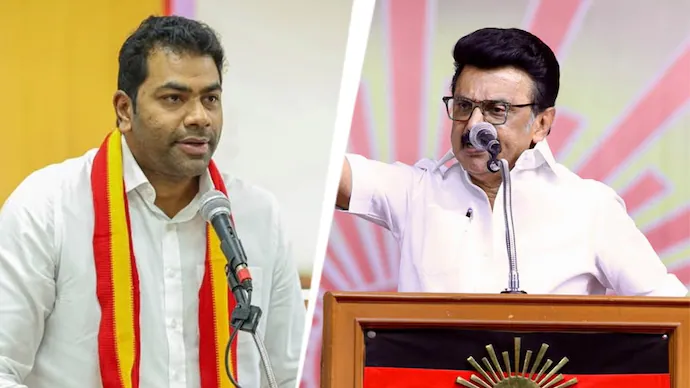
Tamil Nadu’s political confrontation over the Centre’s revised delimitation Bill intensified on Sunday after Tamilaga Vettri Kazhagam (TVK) leader and state minister Aadhav Arjuna accused Dravida Munnetra Kazhagam (DMK) president M.K. Stalin of betraying the ideological legacy of Periyar E.V. Ramasamy by backing the proposed legislation. Invoking the Dravidian social reformer, Arjuna said Periyar would have strongly confronted the DMK leadership if he had been alive to witness its decision.
The remarks came after Stalin refused to reconsider the DMK’s support for the revised Bill, even following an appeal from senior INDIA bloc leaders who met him in Chennai. The dispute has brought competing political arguments into focus: the DMK says the revised framework protects Tamil Nadu’s share of parliamentary representation, while TVK leaders argue that the proposed 50 per cent seat expansion does not fully address the state’s concerns.
Arjuna Invokes Periyar to Question Stalin’s Decision
Addressing the controversy, Arjuna questioned how the DMK could support the revised delimitation proposal after repeatedly presenting Periyar, former Chief Minister C.N. Annadurai and B.R. Ambedkar as its ideological inspirations.
He said the party’s decision had placed Stalin at odds with the principles associated with the Dravidian movement and accused the DMK leadership of abandoning its earlier position on protecting Tamil Nadu’s political representation.
“They called themselves ideological leaders. Do you know who our ideological leaders are? Thanthai Periyar, our Anna, and Revolutionary Ambedkar. In the end, today MK Stalin has come and sidelined Periyar.”
Arjuna then delivered his sharpest personal attack on the DMK chief, invoking Periyar’s name to underline the seriousness of his criticism.
“If he alone had been alive, he would have cut you all down on to Cenotaph Road for taking this decision.”
The remark was a political attack rather than a statement about any actual historical incident. Arjuna used the reference to portray Stalin’s support for the Bill as a departure from the ideological tradition the DMK claims to represent.
He also questioned the presence of Deputy Chief Minister Udhayanidhi Stalin during the Tamil Nadu Assembly proceedings in which a resolution opposing delimitation was passed on August 12. Arjuna argued that DMK legislators had publicly supported the state’s position at the time but were now backing a revised proposal from the Centre.
TVK Accuses DMK of Reversing Its Earlier Position
Arjuna recalled the DMK’s history of opposing changes to parliamentary representation that it believed could weaken Tamil Nadu’s political influence. He specifically referred to former Chief Minister M. Karunanidhi and his party’s earlier resistance to delimitation.
According to Arjuna, Karunanidhi had opposed the proposed exercise in 2001, when the DMK was part of an alliance with the BJP, and supported constitutional safeguards that retained the existing allocation of 543 Lok Sabha seats while extending the freeze on readjustment.
He contrasted that history with Stalin’s current decision, accusing the DMK president of abandoning the position associated with his father and the party’s earlier leadership.
“Today, those traitors the Dravida Munnetra Kazhagam (DMK) was a movement created by Anna after shedding blood and walking for 18 years for Tamil Nadu. One can even mention Kalaignar; Kalaignar stood for social justice.”
Arjuna also referred to the August 12 Assembly resolution, arguing that the DMK had already taken a collective position against the earlier delimitation proposal.
“Having raised your hands saying you stand for Tamil Nadu’s rights, you are now in betrayal this is the biggest betrayal by the DMK.”
His criticism extended to Udhayanidhi Stalin, whom he mocked with the phrase “toilet revolutionary”. The personal remarks added to the confrontational tone of the dispute, shifting the debate beyond the technical details of seat allocation to questions about the DMK’s political identity and consistency.
Why Stalin Says the Revised Bill Protects Tamil Nadu
Stalin has defended the DMK’s decision by arguing that the revised legislation incorporates the party’s central demands. The DMK’s earlier opposition was based on fears that a population-based delimitation exercise could reduce Tamil Nadu’s share of representation in the Lok Sabha.
The revised proposal provides for a uniform 50 per cent increase in the number of seats allocated to states and Union Territories, while retaining their existing relative shares for the proposed period. The DMK says this framework addresses its concerns and protects Tamil Nadu’s political representation for the next 25 years.
Stalin reiterated this position after meeting a delegation of senior INDIA bloc leaders in Chennai on Sunday. The delegation included Congress president Mallikarjun Kharge, Sonia Gandhi, Rahul Gandhi and Mamata Banerjee, among other opposition leaders. They sought to persuade him to oppose the legislation, but he maintained that the revised proposal offered safeguards that Tamil Nadu could lose if the Bill were defeated.
“There is no option but to support the proposed Delimitation Bill. There is no other alternative proposal either. The parties that met me also do not have an alternative plan.”
Stalin’s argument is that rejecting the revised legislation without a workable alternative could leave southern states more exposed during the next delimitation exercise. The DMK maintains that its support is based on the safeguards it says have been incorporated into the new framework, rather than an abandonment of its opposition to any redistribution that reduces Tamil Nadu’s relative representation.
That distinction is central to the political disagreement. The DMK describes the revised proposal as an outcome of its campaign for fair delimitation, while TVK argues that the formula does not provide sufficient protection for the state’s long-term political interests. :chatgpt-content-reference{index=”0″}
Arun Raj Questions the 50 Per Cent Seat Expansion Formula
TVK leader Arun Raj separately challenged the DMK’s claim that the revised formula would adequately safeguard Tamil Nadu. He focused on the proposed 50 per cent increase in parliamentary seats, arguing that an identical percentage increase across states would not eliminate the difference in their numerical representation.
To explain his position, Raj compared the existing Lok Sabha representation of Tamil Nadu and Puducherry with that of Uttar Pradesh.
“Right now, Tamil Nadu and Puducherry together have 40 seats; 50 per cent of that would be 60. Right now, UP already has 80 MPs; 50 per cent of that would be 120.”
Under the calculation he presented, the combined representation of Tamil Nadu and Puducherry would rise from 40 to 60 seats, while Uttar Pradesh’s strength would increase from 80 to 120. The numerical difference would therefore expand from 40 seats to 60.
Raj acknowledged that applying the same percentage increase to every state might appear mathematically uniform. However, he argued that this would not amount to complete protection for Tamil Nadu because states with larger existing allocations would continue to have a greater numerical advantage.
“Whether it will be a complete safeguard for us definitely not.”
His argument raises an important distinction in the delimitation debate: maintaining the same percentage share of representation is not identical to keeping the absolute difference in the number of seats unchanged. A uniform percentage increase preserves the existing ratio between two states’ seat allocations, even though the numerical gap becomes larger.
For example, increasing 40 seats by 50 per cent produces 60, while increasing 80 seats by the same percentage produces 120. The difference rises from 40 to 60, but the ratio remains two to one. Whether that arrangement provides adequate protection is a political and constitutional question at the centre of the dispute.
MPLADS Funding Becomes Part of TVK’s Argument
Raj also brought the Members of Parliament Local Area Development Scheme (MPLADS) into the debate, using the annual allocation of Rs 5 crore per MP to illustrate the financial implications of expanding parliamentary representation.
He argued that an additional 20 MPs would represent an increase of Rs 100 crore annually under the scheme, or Rs 500 crore over five years.
“Then 20 extra MPs come in. Because of that, Rs 100 crore per year, Rs 500 crore over five years in just this one state, our Tamil Nadu is going to lose.”
The calculation reflects the additional MPLADS allocation associated with 20 MPs at Rs 5 crore each per year. However, it should be understood as an argument about the distribution and scale of public development funding, not evidence that the money would automatically be transferred away from Tamil Nadu. Additional MPs would also represent additional constituencies and receive allocations for development works under the scheme.
Raj’s broader concern was that a larger parliamentary allocation for states with more existing seats could preserve their numerical advantage in both representation and associated constituency-level funding. He described the proposed arrangement as a disadvantage for Tamil Nadu, although the actual financial impact would depend on the final seat distribution and implementation of the scheme.
TVK’s ‘Sanghi’ Jibe Adds to the Political Confrontation
The criticism of Stalin has also moved beyond speeches and press statements. A day before Arjuna’s remarks, the TVK information technology wing shared a morphed image depicting the DMK chief in the uniform of the Rashtriya Swayamsevak Sangh (RSS).
The post labelled Stalin “Savarkar 2.0”, using the image to mock what TVK portrayed as a contradiction between the DMK’s traditional opposition to the RSS and its decision to support the Centre’s revised delimitation proposal.
Another animated post depicted Stalin and Udhayanidhi taking an oath as RSS members, accompanied by the caption, “The moment they turned completely Sanghi!”
The term “Sanghi” is frequently used in Tamil Nadu’s political discourse to criticise or associate political opponents with the RSS and its ideological positions. TVK used the label to question the DMK’s political consistency, rather than to establish any actual association between the DMK leadership and the organisation.
The social media campaign reflects how the delimitation dispute has become a wider contest over political identity. For TVK, the DMK’s support for the Bill provides an opportunity to challenge its claims of defending Dravidian ideology and state rights.
TVK Questions Dissolution of Centre-State Relations Committee
Arun Raj also questioned the decision to dissolve a high-level committee established during Stalin’s tenure to examine relations between the Union government and state governments.
The committee was headed by retired Supreme Court judge Justice Kurian Joseph and was tasked with examining issues concerning Centre-state relations and suggesting ways to improve the federal framework.
Raj questioned why the committee’s work was discontinued after the change in government. He referred to the decision to assign related work to the Law Commission as part of his criticism of the administration’s approach to federalism.
“After we came into power, deciding that the Law Commission itself would do the work that committee was doing, it was dissolved.”
The criticism connects the delimitation controversy with a broader political debate about the relationship between the Union and state governments. TVK is arguing that the DMK’s support for the revised Bill is difficult to reconcile with its earlier emphasis on state autonomy and federal safeguards.
Delimitation Debate Becomes a Test of Tamil Nadu’s Political Priorities
The confrontation between TVK and the DMK highlights two competing interpretations of the revised delimitation proposal. Stalin argues that the government has incorporated safeguards sought by the DMK and that supporting the legislation is necessary to protect Tamil Nadu’s representation. TVK leaders contend that a uniform expansion of seats does not resolve every concern about the state’s political influence and have accused the DMK of reversing its earlier position.
The dispute is also unfolding as Parliament prepares to consider the revised legislation. The proposed changes are linked to the expansion of the Lok Sabha and the implementation of the 33 per cent reservation for women under the Constitution (106th Amendment) Act, 2023.
For Tamil Nadu, the central question is how the next delimitation exercise will affect its share of parliamentary representation and its influence in national decision-making. For the DMK, the revised formula is being presented as a negotiated safeguard. For TVK, it remains insufficient and represents a departure from the state’s earlier political position.
Arjuna’s invocation of Periyar has given the disagreement an ideological dimension, while Raj’s numerical and financial arguments have focused attention on the practical consequences of seat expansion. The final assessment will depend on the legislation’s provisions, its passage through Parliament and how the proposed framework is implemented.
What is already clear is that delimitation has become more than a debate over constituency boundaries. It is now a major political contest in Tamil Nadu over representation, federalism, social justice and the legacy of the Dravidian movement.
For breaking news and live news updates, like us on Facebook or follow us on Twitter and Instagram. Read more on Latest India on thefoxdaily.com.





COMMENTS 0