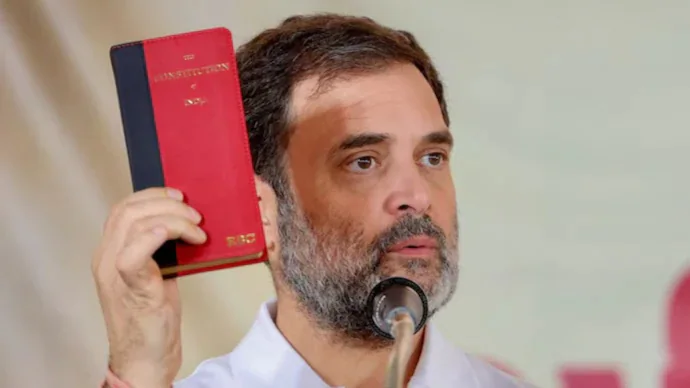
Congress leader Rahul Gandhi on Thursday described the Indian Constitution as the soul of the nation and its greatest weapon against injustice, renewing his pledge to defend the country’s democratic framework and protect the rights of every citizen. His message came on November 26, which India observes as Constitution Day to commemorate the adoption of the Constitution by the Constituent Assembly in 1949.
In a post on X, Gandhi, the Leader of Opposition in the Lok Sabha, said the Constitution was much more than a legal document. He described it as a safeguard for individual dignity, a source of strength for citizens’ voices and the foundation of justice, liberty, equality and fraternity.
Gandhi also pledged that he and his party would defend the Constitution under all circumstances and continue fighting for the rights of Indians. His message was accompanied by a broader Congress campaign on Constitution Day, with party units organising Samvidhan Raksha Marches across the country against what they describe as vote theft and irregularities in electoral rolls.
Congress president Mallikarjun Kharge also used the occasion to reaffirm his commitment to constitutional principles and democracy. Quoting Dr B R Ambedkar, he highlighted the relationship between political and social democracy and called on citizens to protect the Constitution’s foundational ideals.
Rahul Gandhi Calls Constitution a Shield for Every Citizen
In his Constitution Day message, Gandhi said the Constitution should be understood as the foundation of India’s democratic system rather than simply a book of laws. He emphasised its role in protecting individual dignity and ensuring that every citizen has a voice within the country’s political and social framework.
“India’s Constitution is not just a book; it is the soul of the nation. It is a shield for every citizen’s dignity, the strength of every voice, a guardian of justice, liberty, equality and fraternity,” Gandhi said in his post, as reported by the Press Trust of India.
He called the Constitution India’s “greatest weapon against injustice” and renewed his commitment to defending it regardless of circumstances.
“On Constitution Day, I renew my pledge; we will defend it under all circumstances and keep fighting for every Indian’s rights. Long live the Constitution, long live India!” he added.
The message reflects the Congress leadership’s continuing emphasis on constitutional rights, democratic institutions and electoral participation. The party has repeatedly raised concerns about electoral roll revisions and alleged irregularities in voting processes, making these issues central to its Constitution Day mobilisation.
Mallikarjun Kharge Invokes Ambedkar’s Idea of Social Democracy
Congress president Mallikarjun Kharge also extended Constitution Day greetings and said protecting the Constitution’s core ideals was a responsibility shared by the entire country.
In his message on X, Kharge quoted Dr B R Ambedkar, the chairman of the Constitution’s Drafting Committee, who had emphasised that political democracy could not survive without social democracy as its foundation.
“Political democracy cannot survive unless there is social democracy at its foundation,” Kharge quoted Ambedkar as saying.
The statement highlights an important distinction in India’s constitutional framework. Political democracy provides citizens with rights such as voting and representation, while social democracy concerns the broader conditions of equality, dignity and fraternity necessary for those rights to have meaning in everyday life.
Kharge said protecting justice, liberty, equality, fraternity, secularism and socialism remained a major national responsibility. He urged citizens to renew their commitment to the Constitution and democracy and preserve India’s unity, integrity and harmony.
He also paid tribute to several leaders associated with India’s freedom struggle and the making of modern India, including Mahatma Gandhi, Jawaharlal Nehru, Sardar Vallabhbhai Patel, Netaji Subhas Chandra Bose, Maulana Abul Kalam Azad, Dr Rajendra Prasad, Sarojini Naidu and Dr Ambedkar.
Kharge’s message connected the Constitution’s democratic principles with the contributions of the leaders who participated in India’s independence movement and the country’s political institution-building.
Congress Organises Nationwide Samvidhan Raksha Marches
The Congress marked Constitution Day with a nationwide programme of Samvidhan Raksha Marches, organised through its state units. The protests were directed against alleged “vote chori”, a term the party uses to describe what it claims are irregularities and manipulation in electoral rolls and the voting process.
Congress general secretary K C Venugopal had announced that every Pradesh Congress Committee would organise a march in its respective state on November 26. The programme was presented as a central part of the party’s campaign to safeguard the Constitution and raise awareness about electoral rights.
According to the announced programme, marches would begin near statues of Dr B R Ambedkar or Mahatma Gandhi. Participants would pay tribute to the leaders, read the Preamble of the Constitution and take an oath to protect its principles.
The Preamble identifies justice, liberty, equality and fraternity as foundational objectives of the Republic. The Congress said the marches were intended to bring these values into public discussion while drawing attention to its concerns about electoral processes.
Kharge was scheduled to participate in the party’s Constitution Day programme in Lucknow. The Congress also planned activities in several other states, with local leaders and party workers taking part in demonstrations and public gatherings.
The party’s mobilisation combined constitutional messaging with its political campaign against alleged voter-list irregularities. This distinction is important: the allegations are the Congress’s claims and have not been established as a nationwide finding by an independent authority.
What Is the Congress’ Vote Rakshak Campaign?
Alongside the marches, the Congress announced plans to intensify its Vote Rakshak campaign. Under the initiative, party workers are expected to visit polling booths and check electoral rolls for names they believe have been wrongly deleted.
The party says the campaign will help identify affected voters and assist them in pursuing the necessary procedures to restore their names to electoral lists. It has argued that access to the right to vote is closely connected to the protection of other constitutional rights.
Congress leaders have raised concerns about alleged fake and duplicate entries, the deletion of genuine voters and irregularities in electoral rolls in different parts of the country. Rahul Gandhi has previously highlighted cases involving Mahadevapura in Karnataka, Aland in the same state and Haryana.
The party has also criticised the Special Intensive Revision (SIR) of electoral rolls, arguing that the process could create difficulties for vulnerable groups if documentation requirements or verification procedures result in genuine voters being excluded.
These concerns have become part of a wider political dispute involving the Congress and the Election Commission of India. The Election Commission is responsible for preparing and maintaining electoral rolls and conducting elections under the constitutional framework.
Any claim of wrongful deletion or manipulation needs to be examined through the relevant electoral records, complaints and verification procedures. The Congress’s campaign represents its position on the issue, while specific allegations require examination by the appropriate authorities.
Why November 26 Is Celebrated as Constitution Day
India observes Constitution Day, also known as Samvidhan Diwas, on November 26 every year. The date marks the day in 1949 when the Constituent Assembly adopted the Constitution of India after an extensive process of debate, drafting and discussion.
The Constitution did not come into force immediately after its adoption. It became effective on January 26, 1950, a date now celebrated as Republic Day. The interval allowed the country to complete the transition from the constitutional arrangements inherited at independence to a sovereign democratic republic governed by its own Constitution.
The decision to formally observe November 26 as Constitution Day was announced by the government in 2015 to commemorate the 125th birth anniversary of Dr B R Ambedkar. The observance also aims to promote awareness of constitutional values and the responsibilities associated with citizenship.
Constitution Day is marked by activities in government institutions, educational establishments and public organisations. These include readings of the Preamble, discussions on constitutional principles and tributes to the members of the Constituent Assembly.
The occasion provides an opportunity to understand how the Constitution establishes the structure of government, distributes powers among institutions and guarantees fundamental rights to citizens.
Ambedkar’s Role in Shaping India’s Constitutional Framework
Dr B R Ambedkar occupies a central place in India’s constitutional history because of his leadership of the Drafting Committee. The committee was responsible for preparing the draft that formed the basis of the Constitution adopted by the Constituent Assembly.
Ambedkar’s contribution is closely associated with constitutional safeguards, equality before the law, individual liberty and protections for historically disadvantaged communities. His emphasis on social democracy also remains relevant to discussions about the relationship between political rights and social conditions.
The Constitution established a framework in which all citizens are entitled to equal protection of the law, subject to its provisions. It also provides safeguards against discrimination and recognises the importance of justice across social, economic and political life.
Kharge’s decision to quote Ambedkar on Constitution Day brought attention to the idea that elections and representative institutions alone cannot guarantee a functioning democracy. Democratic participation also depends on equality, social inclusion and respect for individual rights.
Constitutional Values at the Centre of India’s Political Debate
Gandhi and Kharge’s messages came at a time when constitutional institutions and electoral processes remain prominent subjects of political debate. The Congress has made the protection of the Constitution a central theme of its political campaign, particularly in relation to voter-list revisions and its allegations of electoral irregularities.
The party’s position is that protecting voting rights is essential to preserving democratic representation. It argues that citizens must be able to participate in elections without facing wrongful exclusion from electoral rolls.
At the same time, electoral roll verification is an established part of the election administration process. Authorities have a responsibility to maintain accurate voter lists, remove duplicate or ineligible entries and ensure that eligible citizens are not wrongly excluded. The effectiveness and fairness of these procedures depend on transparent rules, accessible correction mechanisms and proper grievance redressal.
The broader constitutional debate also involves the independence of institutions, the balance of power among the legislature, executive and judiciary, and the protection of fundamental rights. These questions are frequently raised by political parties, civil society groups and constitutional experts, although their interpretations of particular developments can differ.
Constitution Day therefore provides a platform not only for ceremonial tributes but also for public discussion about how constitutional principles are implemented in practice.
What Rahul Gandhi’s Constitution Day Message Signals
Gandhi’s statement that the Constitution is India’s soul and greatest weapon against injustice reinforces the Congress leadership’s effort to place constitutional protection at the centre of its political messaging. By linking the Constitution with dignity, equality, liberty and citizens’ rights, he framed the document as a living democratic guarantee rather than a historical achievement alone.
Kharge’s message added an emphasis on social democracy, national unity and the responsibility of citizens to preserve constitutional values. The nationwide marches and Vote Rakshak campaign connected these themes with the party’s specific concerns about electoral participation.
Whether the Congress’s allegations about electoral irregularities are substantiated in individual cases will depend on evidence and the findings of the relevant authorities. The wider significance of the debate lies in the importance of maintaining public confidence in electoral processes and ensuring that eligible citizens can exercise their voting rights.
As India marks Constitution Day, the messages from political leaders underline the continuing relevance of the principles adopted by the Constituent Assembly in 1949. The Constitution’s authority ultimately depends not only on the document itself but also on how institutions, political parties and citizens uphold its provisions in public life.
For breaking news and live news updates, like us on Facebook or follow us on Twitter and Instagram. Read more on Latest India on thefoxdaily.com.






COMMENTS 0