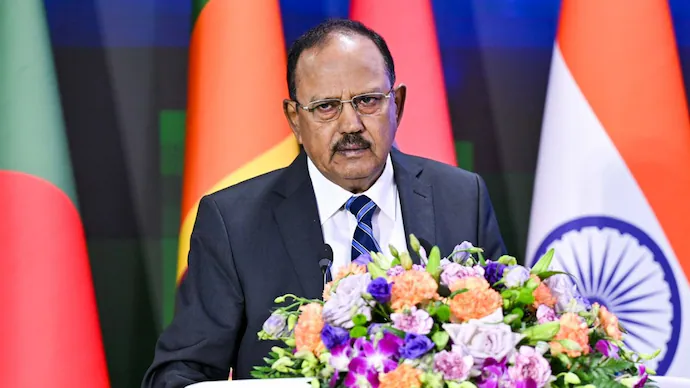
India has assured Indian Ocean countries of its full support in addressing emerging security challenges, with National Security Adviser (NSA) Ajit Doval calling for stronger cooperation among regional partners during the eighth Colombo Security Conclave (CSC) meeting in Malé, Maldives, on November 25, 2026.
Doval said India would provide necessary assistance to help member countries strengthen their collective capabilities against threats that increasingly cross national borders. His remarks come amid growing strategic competition in the Indian Ocean, where maritime security, international trade routes and the expanding presence of major powers have become central concerns for regional governments.
Although Doval did not directly name China, his emphasis on collective security comes as Beijing continues to deepen its economic, diplomatic and maritime engagement across South Asia and the wider Indian Ocean. The Maldives’ recent diplomatic outreach to Pakistan has also drawn attention to the changing security relationships among countries in the region.
Addressing representatives of the participating countries, Doval reaffirmed India’s commitment to the conclave and said New Delhi would work closely with regional partners to pursue common security objectives. The message underlined India’s effort to strengthen the CSC as a platform for practical cooperation rather than treating maritime security as an issue for individual countries alone.
Ajit Doval Assures Regional Partners of India’s Full Support
Speaking at the eighth Colombo Security Conclave meeting, Doval said India remained committed to working with member countries to improve their ability to respond to evolving security threats.
He stressed that the challenges facing Indian Ocean nations required a coordinated response and that India was prepared to contribute to the grouping’s shared objectives.
Doval said India, as one of the countries that initiated the idea of the Colombo Security Conclave, would provide its best efforts and all necessary help and assistance to regional partners. He also reiterated New Delhi’s commitment to strengthening the collective capabilities of the participating countries.
The assurance is significant because the Indian Ocean is not simply a geographical space connecting coastal and island nations. It is a major corridor for global commerce, energy transportation and strategic maritime movement. Disruptions to shipping, trafficking networks, piracy, terrorism and cyberattacks can affect several countries simultaneously.
For India, cooperation with neighbouring maritime states is closely connected to its broader regional security approach. Stronger partnerships can improve information-sharing, maritime surveillance, law-enforcement coordination and the ability to respond to emergencies.
Why the Indian Ocean Has Become More Important in Regional Security
The Indian Ocean connects major economies in Asia, Africa, the Middle East and Europe. Large volumes of international trade and energy supplies move through its shipping routes, making stability in the region important to countries far beyond its coastline.
Its strategic importance has also increased as major powers expand their economic and diplomatic relationships with coastal and island countries. Ports, maritime infrastructure, defence cooperation and commercial investments can all influence the security environment, particularly when they involve locations close to important sea lanes.
India has long regarded the Indian Ocean as central to its national security. The country’s extensive coastline, island territories and dependence on maritime trade mean that developments across the region can have direct consequences for its economic and strategic interests.
For smaller island countries, the security challenges can be equally significant. Limited maritime surveillance capacity, large exclusive economic zones and dependence on international shipping can make it difficult to monitor illegal activity across vast stretches of ocean.
Regional cooperation can help address these limitations. Countries can share information about suspicious vessels, coordinate patrols, improve maritime domain awareness and work together against criminal networks operating across borders.
Doval’s remarks reflect this broader approach: the Indian Ocean should remain a shared space where countries cooperate on common interests rather than become divided by strategic competition.
Colombo Security Conclave: Six Countries Working on Shared Threats
The Colombo Security Conclave is a regional security cooperation platform involving six member countries: India, Sri Lanka, the Maldives, Mauritius, Bangladesh and Seychelles. Its purpose is to improve coordination on security issues that affect the Indian Ocean region and require cooperation between governments.
The grouping focuses on five principal areas of cooperation:
- Maritime safety and security: Improving coordination to protect shipping routes, monitor maritime activity and address threats at sea.
- Counterterrorism and radicalisation: Strengthening cooperation to prevent terrorist activities, identify networks and counter radicalisation.
- Combating trafficking and organised crime: Addressing drug trafficking, illicit networks and other cross-border criminal activities.
- Cybersecurity and critical infrastructure protection: Improving the ability of member countries to respond to cyber threats against essential systems and infrastructure.
- Humanitarian assistance and disaster relief: Building the capacity to coordinate emergency responses during natural disasters and humanitarian crises.
These priorities reflect the range of risks facing countries around the Indian Ocean. Maritime crime, drug trafficking and terrorism can operate across multiple jurisdictions, making information-sharing and coordinated enforcement important. Cyberattacks and natural disasters also require preparedness that extends beyond national borders.
Bangladesh and Seychelles, previously participating as observers, were inducted as full members during the seventh NSA-level meeting in November 2025. Their membership expanded the grouping’s regional reach and strengthened its role as a platform for cooperation among Indian Ocean countries.
India’s Neighbourhood First Policy and MAHASAGAR Vision
Doval described the Colombo Security Conclave as an important connection between India’s Neighbourhood First policy and its MAHASAGAR vision. The term MAHASAGAR stands for Mutual and Holistic Advancement for Security and Growth Across Regions.
India’s Neighbourhood First policy places emphasis on maintaining close relationships with neighbouring countries through diplomatic engagement, economic cooperation, development assistance and security partnerships. The MAHASAGAR vision extends this approach to wider maritime and regional cooperation.
For India, these initiatives are closely linked. Security in the Indian Ocean depends partly on the stability and capabilities of neighbouring countries, particularly island states located near major international shipping routes.
Cooperation under the CSC can support these objectives through joint initiatives, training, information exchange and coordination between security agencies. It also provides a regular forum for national security officials to discuss emerging threats and identify areas where countries can work together.
Doval’s remarks about the Indian Ocean connecting rather than dividing countries reflect the importance India places on maintaining regional relationships despite differences in national interests and foreign-policy priorities.
Drug Trafficking and Transnational Crime Remain Major Concerns
Alongside maritime security and counterterrorism, Doval highlighted the need for stronger cooperation against drug trafficking. He referred to India’s engagement with Sri Lanka, the Maldives and other regional partners, indicating that existing efforts should be expanded.
Drug trafficking is a cross-border challenge because illegal supply networks can use maritime routes to move narcotics between countries. Island nations and coastal states may face particular difficulties in monitoring large maritime areas, especially when criminal networks use smaller vessels and complex transportation arrangements.
Cooperation can help authorities identify suspicious movements, exchange intelligence and coordinate investigations. It can also improve the ability of law-enforcement agencies to trace organised networks rather than focusing only on individual shipments or arrests.
The CSC’s broader focus on trafficking and transnational organised crime provides a framework for addressing these connected threats. Drug smuggling can overlap with other criminal activities, including money laundering and the movement of illicit goods, making cooperation between security and enforcement agencies important.
For India, stronger coordination with Sri Lanka and the Maldives is particularly relevant because of their geographical proximity and shared maritime environment. Cooperation among these countries can contribute to better monitoring of sea routes and more effective responses to criminal activity.
Muizzu’s Pakistan Visit Adds a New Dimension to Regional Diplomacy
Doval’s visit to the Maldives comes shortly after President Mohamed Muizzu’s state visit to Pakistan from October 20 to 22, 2026. During the visit, Muizzu held talks with Pakistan’s Prime Minister Shehbaz Sharif and other senior leaders, with discussions covering trade, investment, education, healthcare, tourism, defence and maritime security.
The two countries witnessed the exchange of 20 memorandums of understanding covering several areas of cooperation. Among them were agreements on defence cooperation and maritime security, alongside arrangements involving health, education, agriculture, fisheries, cybersecurity and other sectors.
The agreements attracted attention because of the Maldives’ strategic position in the Indian Ocean. The country sits near important maritime routes and occupies a location relevant to the security calculations of regional powers, including India.
However, the agreements also form part of the Maldives’ broader effort to develop international partnerships. The 20 memorandums cover a wide range of civilian and economic sectors, meaning the visit should not be viewed exclusively through a defence or security lens.
For India, the development reinforces the importance of maintaining regular engagement with Maldivian authorities. The Maldives is a close maritime neighbour, and cooperation between the two countries has implications for maritime surveillance, regional stability, disaster response and the security of sea routes.
Doval’s presence at the Colombo Security Conclave provided an opportunity to reaffirm India’s commitment to regional cooperation at a time when the Maldives is also expanding its diplomatic engagement with other countries.
Doval Meets Maldivian Defence Minister Hassan Rasheed
Before the main conclave discussions, Doval met Maldivian Defence and National Service Minister Hassan Rasheed on November 24 on the sidelines of the meeting.
The discussions focused on strengthening bilateral defence and security cooperation. Both sides exchanged views on matters of mutual interest and reiterated their commitment to further developing the longstanding security partnership between India and the Maldives.
The meeting was significant because bilateral cooperation remains an important part of India’s engagement with the island nation. Regional security platforms such as the CSC provide a wider framework, but practical cooperation between neighbouring countries often depends on direct communication between their defence and security institutions.
India and the Maldives have areas of shared interest that include maritime surveillance, the safety of shipping routes, emergency response and cooperation against transnational criminal activity. Their geographical proximity makes coordination particularly relevant when incidents at sea require a rapid response.
The meeting also demonstrated that India’s engagement with the Maldives continues through official security channels alongside the country’s wider diplomatic relationships.
What India’s Security Assurance Means for the Indian Ocean Region
Doval’s assurance of full support is a political and diplomatic commitment to regional cooperation. Its practical significance will depend on how India and other CSC members translate that commitment into specific initiatives, training programmes, information-sharing arrangements and operational coordination.
For smaller countries, India’s capabilities and experience can provide support in areas where national resources may be limited. Cooperation could include maritime surveillance, capacity-building, intelligence exchange, counterterrorism training and assistance during humanitarian emergencies.
For India, working with neighbouring countries can improve awareness of developments across the Indian Ocean and strengthen the regional relationships needed to protect shared maritime interests. It also gives member states a forum to discuss security concerns without relying exclusively on larger international groupings.
At the same time, the CSC’s effectiveness will depend on the willingness of its members to cooperate consistently. Countries may have different diplomatic relationships, economic priorities and approaches to external powers. A regional security platform must therefore accommodate these differences while keeping its focus on agreed areas of common interest.
The conclave does not mean that member countries have adopted identical foreign policies or formed a military alliance. Its stated purpose is cooperation on shared security challenges, including maritime safety, terrorism, trafficking, cyber threats and disaster response.
Can the Colombo Security Conclave Become a Stronger Regional Security Platform?
The eighth meeting comes at a time when Indian Ocean countries face an increasingly complex security environment. Competition among major powers, the importance of maritime trade routes, organised crime and technological threats are all placing greater demands on regional governments.
The CSC offers a mechanism through which participating countries can coordinate their responses while maintaining their individual national interests. Its six-member structure brings together countries with different geographical positions and security capabilities, creating opportunities for cooperation across a wide maritime area.
For the grouping to become more effective, declarations of commitment will need to be followed by measurable progress. Regular information exchange, practical training, stronger maritime monitoring and coordinated action against trafficking networks could help translate diplomatic assurances into operational results.
India’s pledge to provide necessary assistance gives the grouping a clear signal of New Delhi’s continued interest in regional security cooperation. Doval’s emphasis on the Indian Ocean as a space that connects countries also reflects India’s preference for partnerships that focus on shared maritime interests.
The Maldives’ simultaneous engagement with India, Pakistan and other partners illustrates the region’s changing diplomatic landscape. Rather than treating every new relationship as a direct security confrontation, regional governments will need to assess developments through their actual agreements, activities and implications for maritime stability.
As the Colombo Security Conclave moves forward, its central test will be whether its members can turn their shared priorities into sustained cooperation. India’s assurance of full support provides a political foundation, but the long-term value of the grouping will depend on practical action to make the Indian Ocean safer, more connected and more resilient.
For breaking news and live news updates, like us on Facebook or follow us on Twitter and Instagram. Read more on Latest India on thefoxdaily.com.






COMMENTS 0