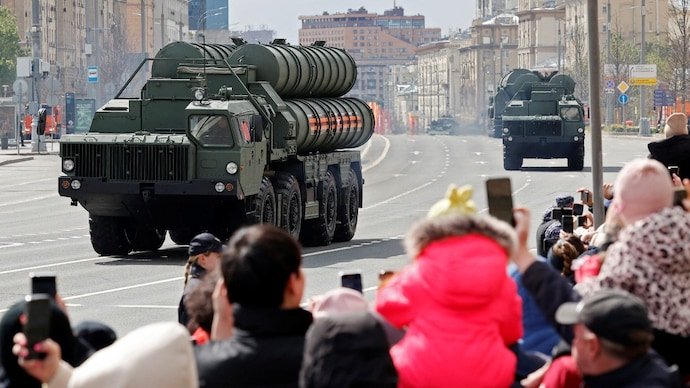
India‘s plan to expand its long-range air-Defence network has moved to the next stage after Russia submitted a detailed proposal for five additional S-400 Triumf squadrons for the Indian Air Force. The proposed project is estimated to cost more than ₹50,000 crore, and the Russian response is now being examined by the Defence Ministry.
The development follows India’s decision in March 2026 to clear the acquisition of five more S-400 systems. The move came after the system received significant attention for its reported performance during Operation Sindoor in May 2025, when India’s air-defence network was used during military hostilities with Pakistan.
If the new acquisition is ultimately approved and contracted, India’s planned S-400 inventory would rise to 10 squadrons. The expansion would give New Delhi greater flexibility to position long-range air-defence assets across its western and northern approaches while developing indigenous systems such as Project Kusha.
However, the Russian proposal does not mean that a final contract has been signed. The offer still has to pass through evaluation, negotiations and the remaining stages of India’s defence procurement process.
Russia submits proposal for five more S-400 squadrons
The latest development is significant because the procurement has moved from an Indian requirement to a concrete commercial response from Russia.
Defence sources said Russia’s response to India’s tender has been received and is currently under processing. The proposed five-squadron package is estimated to be worth more than ₹50,000 crore.
The Defence Acquisition Council, India’s top defence procurement body, had granted approval for the additional S-400 acquisition in March. The government subsequently moved ahead with the tender process.
The current stage is therefore best understood as a step toward a possible contract rather than a completed purchase.
Once the proposal is evaluated, India and Russia would need to settle issues including price, delivery schedules, configuration, support arrangements and the extent of domestic participation before a final agreement could be concluded.
Why India wants more S-400 systems
The central reason for expanding the S-400 fleet is the need for a larger and more resilient air-defence architecture.
India faces a demanding geographic situation, with major Security concerns on both its western and northern borders. Long-range air-defence systems can help protect important military Infrastructure and other high-value areas by providing an additional layer against aerial threats.
The S-400 is designed to detect and engage different types of aerial targets at varying ranges and altitudes. Its capabilities make it particularly relevant to a layered defence network in which long-range systems work alongside shorter- and medium-range weapons.
Five additional squadrons would not simply mean having more launchers. A larger fleet can provide greater geographic coverage, additional deployment options and more flexibility when individual systems require maintenance or repositioning.
That matters during a prolonged crisis, when an air-defence network must continue operating rather than depend on a small number of strategically placed assets.
Operation Sindoor changed the S-400 debate
The proposed acquisition gained momentum after Operation Sindoor, which brought India’s air-defence capabilities into sharper focus.
During the May 2025 confrontation, the S-400 became one of the most closely watched elements of India’s defensive architecture. Indian military officials subsequently highlighted the system’s role in countering Pakistani aerial threats.
Western Air Command chief Air Marshal Jeetendra Mishra has also said the S-400 achieved what he described as possibly the longest recorded surface-to-air missile kill, involving the destruction of a Pakistani surveillance aircraft at a reported range of 314 kilometres.
Such claims are important in understanding why the system has acquired greater prominence in India’s procurement planning. At the same time, individual battlefield claims should be distinguished from the broader assessment of an entire air-defence network, whose effectiveness depends on sensors, command systems, interceptors, operators and multiple layers of defence working together.
The lesson for India is therefore not simply that one weapon system performed well. It is that long-range detection and interception can create a wider defensive umbrella when integrated into a broader network.
India already has four of the original five S-400 squadrons
India’s current S-400 programme dates back to a 2018 agreement with Russia worth about $5.43 billion for five squadrons.
Four of those five squadrons have now been received, while the fifth and final unit is expected to be delivered by November 2026, according to defence sources.
The original purchase established the S-400 as a major component of India’s long-range air-defence capability. Additional systems would build on that existing infrastructure rather than introduce an entirely new platform.
If all five new squadrons are eventually contracted and delivered, India would have a planned fleet of 10 S-400 squadrons, effectively doubling the number covered by the original procurement programme.
That would give the Indian Air Force a substantially larger pool of long-range air-defence assets, although actual coverage would depend on where the systems are deployed and how they are integrated with other systems.
What the S-400 adds to a layered air-defence network
Modern Air Defence cannot rely on a single weapon. Different threats travel at different speeds, altitudes and trajectories, requiring multiple layers of detection and interception.
The S-400 provides India with a long-range component within that architecture. Other systems can address threats at shorter or intermediate distances, while fighter aircraft, electronic warfare capabilities and radar networks add further layers.
India is also developing its own long-range air-defence capability under Project Kusha.
The long-term objective is therefore broader than simply expanding Russian imports. India is attempting to build an increasingly integrated network in which imported systems provide immediate capability while domestic programmes gradually expand indigenous capacity.
The additional S-400s could consequently serve as a bridge while India’s home-grown long-range systems mature.
New deal could include Indian maintenance and production
One of the most significant aspects of the proposed procurement is the possibility of greater domestic participation.
Discussions are understood to include the establishment of a maintenance, repair and overhaul, or MRO, facility in India. Such infrastructure could reduce the dependence on overseas support for maintaining a large fleet over its operational lifetime.
The proposal is also reported to involve the possibility of joint production of two units in India by the private sector through a Technology-transfer arrangement, while three squadrons would be acquired directly from Russia.
These details are still part of the proposal and negotiations rather than a completed industrial agreement. Nevertheless, they highlight a broader issue in India’s defence procurement strategy: acquiring sophisticated equipment is only one part of building military capability.
Long-term availability depends on spare parts, maintenance, technical expertise, repair facilities and a reliable supply chain.
For a system intended to remain operational for many years, domestic support infrastructure could therefore be nearly as important as the initial purchase.
India also wants more S-400 missiles
The planned expansion is not limited to acquiring additional S-400 units.
India is separately pursuing additional interceptor missiles for the systems already in service. Reports have put the requirement at more than 280 missiles, aimed at replenishing stocks and creating a larger reserve after the expenditure of weapons during Operation Sindoor.
This distinction is important because the effectiveness of an air-defence system depends not only on how many launch platforms a country owns but also on how many ready-to-use interceptors are available.
A larger stockpile provides commanders with greater flexibility during sustained operations. It can also reduce the risk of exhausting critical interceptors during an extended period of repeated attacks.
The combination of new squadrons and additional missiles would therefore represent a broader effort to strengthen both the hardware and ammunition sides of India’s air-defence capability.
Why five more squadrons could change deployment options
The proposed acquisition could have an important operational benefit: flexibility.
India has to account for two major border theatres with very different geographical and strategic conditions. A larger S-400 fleet could allow the Air Force to distribute systems between western and northern sectors while retaining greater flexibility to reinforce particular areas when required.
It could also reduce the pressure on individual units during periods of heightened alert.
However, the number of squadrons alone does not determine the strength of an air-defence network. Radar coverage, communications, command-and-control infrastructure, interceptor availability, mobility and the ability to integrate different weapons are equally important.
The value of the additional S-400s will therefore depend on how effectively they are incorporated into India’s wider air-defence architecture.
Project Kusha and indigenous alternatives remain important
India’s continued interest in the S-400 does not remove the need for indigenous alternatives.
Project Kusha is intended to provide a domestic long-range air-defence capability and eventually reduce reliance on foreign systems for some requirements.
The two approaches can operate in parallel. Additional S-400s can provide a proven capability while Indian programmes are developed and brought into service.
That approach also reflects the practical difficulty of replacing an established high-end defence system overnight. Developing a sophisticated air-defence network requires years of work across radar technology, missile design, command systems, software, manufacturing and testing.
In that sense, the S-400 procurement is both an immediate capability decision and part of a longer transition toward a more diversified defence ecosystem.
Why the Russian offer matters beyond the price tag
The reported value of more than ₹50,000 crore makes the proposal a major defence procurement, but the financial figure is only one part of the story.
The agreement could influence India’s force structure, industrial partnerships and maintenance arrangements for years. A contract involving domestic production or technology transfer would also have implications for India’s effort to expand the role of private industry in defence manufacturing.
At the same time, any major acquisition from Russia has to be considered within India’s broader strategy of maintaining relationships with multiple defence partners while increasing domestic production.
The S-400 programme therefore sits at the intersection of operational requirements, industrial policy and strategic partnership.
What happens next in the S-400 deal
Russia’s submission is an important milestone, but several steps remain before India can take delivery of the proposed systems.
The Defence Ministry must evaluate the Russian response and negotiate the commercial and technical terms. The final acquisition would then have to move through the required approval process before a contract is signed.
Once an agreement is concluded, deliveries of the newly proposed systems are expected to begin around three years after signing, according to reports on the procurement.
This means the additional S-400 squadrons would strengthen India’s air-defence network over the medium term rather than provide an immediate expansion.
India’s air-defence strategy is becoming more layered
The decision to pursue five more S-400 squadrons reflects a broader shift in how India is approaching air defence.
The country is simultaneously expanding existing systems, purchasing additional interceptors, developing Project Kusha and examining greater domestic involvement in maintenance and production.
That layered approach is increasingly important as aerial threats become more diverse. Aircraft are no longer the only concern. Drones, cruise missiles, Ballistic Missiles and other advanced weapons can place different demands on detection and interception systems.
The strategic objective is therefore not simply to buy more missiles. It is to create a network capable of detecting threats early, deciding how to respond and deploying the appropriate interceptor at the right stage.
Russia’s proposal for five additional S-400 squadrons moves India another step toward that objective. But the ultimate impact will depend on the final contract, delivery timeline, domestic support arrangements and how effectively the Russian systems are integrated with India’s growing indigenous air-defence capabilities.
For breaking news and live news updates, like us on Facebook or follow us on Twitter and Instagram. Read more on Latest India on thefoxdaily.com.






COMMENTS 0