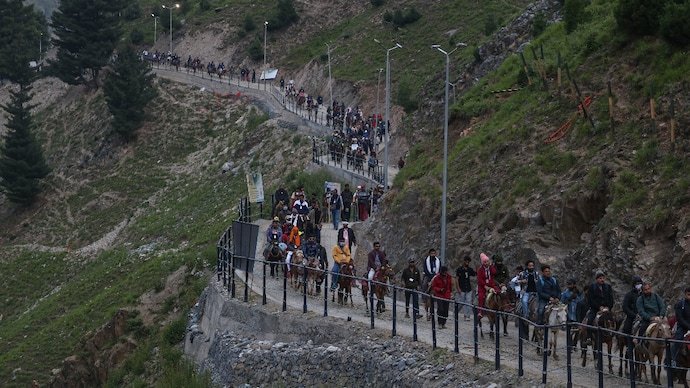
The 2026 Shri Amarnath Yatra has begun amid elaborate security arrangements, marking the start of one of India‘s most significant annual Hindu pilgrimages. Thousands of devotees departed from Jammu’s Bhagwati Nagar Base Camp in the first escorted convoy towards Kashmir, where the pilgrimage officially begins on July 3.
This year’s pilgrimage comes with unprecedented security coordination involving multiple agencies, enhanced surveillance technologies, improved Healthcare facilities, and streamlined traffic management to ensure the safe movement of lakhs of pilgrims expected over the next 57 days.
Beyond its immense religious significance, the Amarnath Yatra also represents one of India’s largest annual logistical operations, requiring months of planning across administration, security forces, disaster management agencies, and healthcare departments.
What Is the Amarnath Yatra?
The Amarnath Yatra is an annual Hindu pilgrimage to the holy Amarnath Cave Shrine, located at an altitude of approximately 3,880 metres in the Himalayas of Jammu and Kashmir.
The cave houses a naturally formed ice stalagmite, revered by devotees as a sacred Shivling representing Lord Shiva.
Every year, hundreds of thousands of pilgrims undertake the challenging journey through mountainous terrain to seek blessings at one of Hinduism’s most revered shrines.
When Does the 2026 Amarnath Yatra Take Place?
The 2026 pilgrimage will run for 57 days.
- Opening Date: July 3, 2026
- Closing Date: August 28, 2026
- Duration: 57 days
The pilgrimage coincides with the traditional religious calendar and concludes around the festival of Shravan Purnima, also observed as Raksha Bandhan.
First Batch Flagged Off from Jammu
Lieutenant Governor Manoj Sinha officially flagged off the first convoy from Bhagwati Nagar Base Camp in Jammu after performing traditional prayers.
The inaugural convoy comprised more than 5,000 pilgrims traveling under heavy security escort toward Kashmir.
Senior civil administration officials, police officers, religious representatives, and public leaders participated in the flag-off ceremony, which featured devotional chants celebrating Lord Shiva.
The departure marks the operational beginning of the pilgrimage after months of preparation by multiple government agencies.
Two Official Routes to the Holy Cave
Pilgrims can reach the Amarnath Cave through two officially designated routes.
1. Pahalgam Route
- Length: Approximately 48 kilometres
- District: Anantnag
- Traditional route
- Longer but comparatively gradual ascent
2. Baltal Route
- Length: Approximately 14 kilometres
- District: Ganderbal
- Shorter distance
- Steeper and physically more demanding
Both routes converge near the holy cave and officially opened simultaneously on July 3.
Religious Importance of the Amarnath Cave
The Amarnath Cave occupies a unique place in Hindu tradition.
According to religious beliefs, Lord Shiva chose this secluded cave to reveal the secret of immortality, known as the Amar Katha, to Goddess Parvati.
To ensure complete secrecy, mythology says Shiva left behind all companions and symbols before entering the cave, including:
- Nandi (his sacred bull)
- The Moon
- The snake Vasuki
- Lord Ganesha
- The five elements
The naturally formed ice Shivling, which waxes and wanes during the pilgrimage season, is considered a sacred manifestation of Lord Shiva.
Massive Security Operation in Place
Given the scale of the pilgrimage and the terrain involved, authorities have implemented one of the country’s most extensive seasonal security operations.
The multi-layered security framework includes:
- Road convoys under armed escort.
- Area domination patrols.
- Advanced surveillance systems.
- Drone monitoring in selected sectors.
- Quick Reaction Teams.
- Traffic regulation along the Jammu-Srinagar National Highway.
Security agencies continuously assess the situation throughout the pilgrimage period to facilitate the safe movement of pilgrims.
Traffic Management Along the National Highway
The Jammu-Srinagar National Highway serves as the primary transport corridor for the pilgrimage.
Authorities have introduced:
- Sector-wise traffic regulation.
- Daily movement advisories.
- Vehicle cut-off timings.
- Priority passage for pilgrimage convoys.
- Diversions where necessary.
These measures aim to minimize congestion while ensuring uninterrupted movement of emergency services and pilgrimage vehicles.
Record Number of Registrations
Officials have confirmed that more than 3.90 lakh devotees have already registered for the 2026 pilgrimage.
On-the-spot registration facilities have also been made available in Jammu to accommodate eligible pilgrims WHO were unable to complete advance registration.
The strong registration numbers demonstrate the continuing popularity and spiritual significance of the Amarnath Yatra despite its physically demanding nature.
Medical and Emergency Preparedness
High-altitude pilgrimages present unique medical challenges.
Authorities have established extensive healthcare infrastructure including:
- Medical camps.
- Emergency response units.
- Ambulance services.
- Specialist doctors.
- High-altitude medical support.
- Disaster response teams.
Health officials advise pilgrims to undergo medical examinations before undertaking the journey, particularly senior citizens and individuals with pre-existing health conditions.
Facilities Have Improved Over the Years
Many returning pilgrims and religious leaders have noted significant improvements in infrastructure over recent years.
Enhancements include:
- Better accommodation facilities.
- Improved sanitation.
- Enhanced communication systems.
- More organized registration procedures.
- Improved accessibility for elderly pilgrims.
- Additional support for differently-abled devotees.
Continuous upgrades have helped improve both safety and overall pilgrimage experience.
Economic Impact of the Amarnath Yatra
Beyond its religious significance, the annual pilgrimage plays an important role in the regional economy.
The Yatra generates seasonal employment for:
- Transport operators.
- Pony owners.
- Porters.
- Shopkeepers.
- Hotel operators.
- Local artisans.
tourism associated with the pilgrimage contributes substantially to economic activity in several districts of Jammu and Kashmir.
Overview of the 2026 Amarnath Yatra
| Category | Details |
|---|---|
| Pilgrimage Duration | 57 Days |
| Opening Date | July 3, 2026 |
| Closing Date | August 28, 2026 |
| Holy Shrine Altitude | Approximately 3,880 metres |
| Main Routes | Pahalgam (48 km) and Baltal (14 km) |
| Registered Pilgrims | More than 3.90 lakh |
| Starting Base Camp | Bhagwati Nagar, Jammu |
Essential Safety Advice for Pilgrims
Authorities recommend that pilgrims prepare carefully before undertaking the journey.
- Complete mandatory health certification.
- Carry valid registration documents.
- Wear suitable clothing for changing Weather.
- Stay hydrated throughout the trek.
- Avoid overexertion at high altitude.
- Follow official advisories and designated routes.
- Travel only with authorized convoys.
- Report any medical symptoms immediately.
Weather conditions in the Himalayas can change rapidly, making preparedness essential for a safe pilgrimage.
A Unique Perspective Beyond the Religious Journey
While the Amarnath Yatra is primarily a deeply spiritual pilgrimage, it also represents one of India’s most complex annual administrative exercises. Coordinating transportation, healthcare, communications, disaster management, environmental protection, and security for hundreds of thousands of pilgrims across challenging Himalayan terrain requires months of planning and cooperation among numerous government agencies.
The pilgrimage has also become a showcase of how Technology increasingly supports religious tourism, with digital registration, GPS-enabled monitoring, weather forecasting, surveillance systems, and real-time traffic management contributing to improved safety and efficiency.
The Amarnath Yatra is far more than a religious procession. It symbolizes faith, endurance, and community while demonstrating the remarkable coordination required to facilitate one of the world’s largest high-altitude pilgrimages safely each year. As participation continues to grow, balancing spiritual tradition with modern infrastructure and environmental sustainability will remain central to the pilgrimage’s future.
Future Outlook
With over 3.90 lakh registrations already recorded, the 2026 Amarnath Yatra is expected to witness another strong turnout throughout its 57-day duration. Authorities will continue monitoring weather conditions, traffic movement, and security developments to ensure the pilgrimage proceeds smoothly until its conclusion on August 28.
Looking ahead, continued investments in infrastructure, digital services, emergency response systems, and environmentally sustainable pilgrimage management are likely to further enhance the experience for devotees while preserving the ecological balance of the fragile Himalayan region. The Amarnath Yatra remains one of India’s most significant spiritual traditions, attracting devotees from across the country and around the world who undertake the sacred journey with unwavering faith and devotion.
For breaking news and live news updates, like us on Facebook or follow us on Twitter and Instagram. Read more on Latest India on thefoxdaily.com.




COMMENTS 0