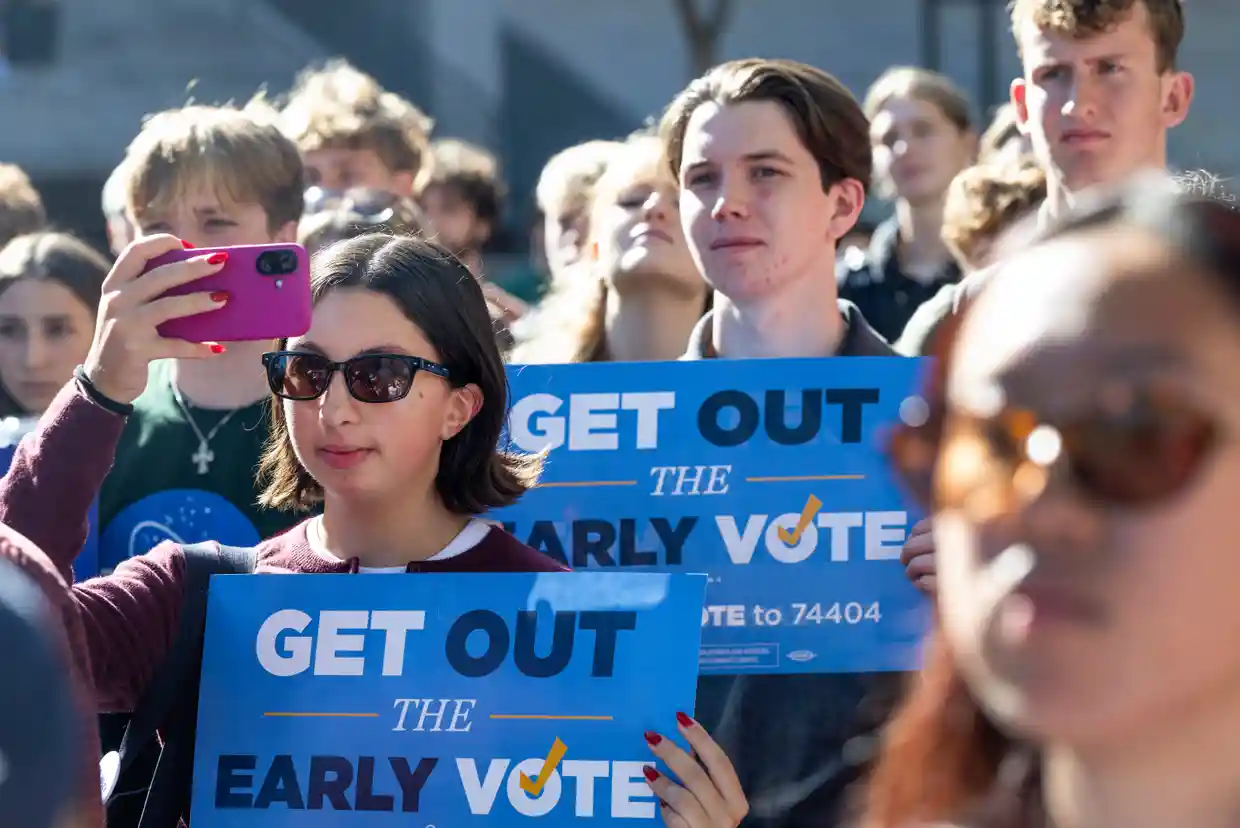
As the 2026 US midterm elections approach, young Americans are increasingly focused on issues they believe will shape the country’s political and economic future. From rising living costs and federal immigration policies to climate change, artificial intelligence and concerns about democracy, Gen Z voters say they want candidates to address problems affecting their everyday lives.
Although nearly 50 million Americans aged 18 to 29 are eligible to vote in the midterms, almost half remain either unregistered or civically disengaged, according to US Census Bureau data cited in the supplied report.
Gen Z readers across the country shared their priorities with The Guardian, highlighting a range of concerns ahead of Election Day. Their views reflect both economic pressures and wider political anxieties, including the actions of President Donald Trump’s administration, immigration enforcement and the future of civil rights.
Rising Prices, ICE and Trump’s Policies Among Gen Z’s Biggest Concerns
For Tyler, a 24-year-old working at a community church in Richfield, Minnesota, immigration enforcement, inflation and concerns about Trump’s use of military force are major factors shaping his vote.
“ICE, inflation and worries about [Donald] Trump’s military force have been … huge factor[s] in voting this year.”
Tyler said rising grocery prices had become particularly frustrating amid what he described as an unpopular and illegal war. He also expressed concern about what he sees as growing authoritarianism and the need for political accountability.
“Fascism is taking hold and I want there to be some semblance of accountability, and I want to make sure that we actually have a real opposition party that we’re not seeing at the moment, aside from some candidates.”
His concerns extend beyond the outcome of the election. Tyler also worries about possible attempts to undermine the results or challenge the electoral process, saying he fears “some trickery and subversion of results or another version of January 6”.
Healthcare and Affordability Shape Young Voters’ Priorities
For Charlie, a 22-year-old library worker in Ohio, healthcare access and the rising cost of living are central to deciding how to vote.
Charlie said opposition to universal healthcare reflected a disregard for people’s wellbeing. They also highlighted the growing wealth gap and argued that wealthier Americans should face higher taxes.
“People who have to work to survive are doing so poorly right now, all I want is to see life become affordable again,”
Charlie’s concerns reflect the importance of economic issues among young voters, particularly those who believe wages and living conditions have not kept pace with the cost of everyday necessities.
Long Working Hours and Distrust of Candidates Could Keep Some Young Americans From Voting
Economic pressure can also make voting difficult for young Americans who want to participate but struggle to find the time.
A 25-year-old maintenance worker in Connecticut said they wanted to vote but that participation depended on having enough time and energy after managing work and household expenses.
“I do want to vote, but that depends on how accessible it is. If I have the time and energy I go out and vote. I do work a lot. I have a lot of bills to pay (car, car insurance, rent, utilities, student loans, medical bills). It is hard to find time to do just about anything,”
The voter also expressed frustration with the candidates available, saying a lack of trust in both political parties made it difficult to decide whom to support.
They criticised what they viewed as a gap between campaign promises and political performance, while raising concerns that legislation could be influenced by corporate interests rather than the needs of working communities.
“I am concerned that any meaningfully good legislation will have bullcrap logrolled into it for things that our communities don’t want. I also worry that the almighty American dollar will blind every politician in the race and none of them will have actual integrity,”
AI, Gaza and Immigration Enforcement Concern Gen Z
Emily, a 28-year-old living in central Illinois, identified artificial intelligence, Israel’s war on Gaza and Immigration and Customs Enforcement (ICE) as major issues influencing the political environment.
She expressed concern about what she described as the normalisation of cruelty and the consequences of political messaging for American society and its international reputation.
“Our refusal to acknowledge the cruelty and absurdity of this administration has normalized it into our culture, if it wasn’t there already. Any attempt to criticize it is shot down with claims of hysteria or wokeness.”
Looking ahead to the elections, Emily said she wanted to see candidates willing to take clear positions and act on their promises rather than simply making statements on social media.
Climate Change and ICE Presence at Polling Locations Raise Concerns
Climate change and immigration enforcement are also shaping how some young voters view the midterms.
Matthew Doutt, a 26-year-old accountant in Knoxville, Tennessee, said he was concerned about the administration’s approach to climate policy and wanted political leaders to restore protections against climate change.
“This administration has done deep damages to the guardrails meant to defend against climate change, and we need someone – anyone – to get us back on track.”
Doutt also raised concerns about the possibility of federal immigration agents being present at polling locations. He pointed to Tennessee’s cooperation with ICE on local enforcement and said he feared such a presence could intimidate voters.
“I’m expecting to see ICE at polling locations to supposedly prevent against undocumented immigrants [from] voting but I expect it to be more about intimidating liberals,”
His comments reflect concerns among some young voters about the relationship between immigration enforcement and access to the electoral process.
First-Time Voter Focuses on Cost of Living and Minority Rights
For Niamh Catterall, an 18-year-old university student from Texas studying in Ireland, the 2026 midterms will be her first opportunity to vote. She plans to cast her ballot by mail.
Her main concerns include the war, living costs, protections for minorities and immigrants, and the separation of church and state.
Catterall said she hoped the election would encourage a greater focus on how candidates could improve people’s lives rather than relying entirely on party politics.
“I am hopeful of a break from party politics and a renewed focus on how a candidate can help a society or individual.”
She pointed to Texas candidates Gina Hinojosa and James Talarico, saying their platforms addressed issues such as healthcare and affordability at the state level.
LGBTQ+ Rights and Data Centre Expansion Enter the Election Debate
Nathan, a 21-year-old computer science student in Texas, highlighted LGBTQ+ rights and data centre expansion as important issues ahead of the midterms.
He also expressed excitement about the performance of Democratic candidate James Talarico and the possibility of political change in Texas, while acknowledging the challenges Democratic candidates face in traditionally conservative southern states.
“It really excites me to see how well Talarico is doing! The idea of a blue Texas is mind-blowing to me,”
Nathan also said he wished more people in his age group would participate in elections.
Young Voters Express Frustration With Both Political Parties
Not all Gen Z concerns are directed at one political party. Scott, a 29-year-old software engineer in Washington who had already voted, said he was disappointed with the leadership of both parties, while expressing particular concern about the Republican Party and Trump.
He described a growing sense of economic uncertainty among young Americans, saying his own career prospects had changed significantly over less than a decade.
“My career went from a sure thing to unknown in less than 10 years. I, and many others, especially my age, are not optimistic for the future … I’m emotionally raw, and very tired.”
Scott also criticised what he saw as a lack of a clear and unifying vision among Democrats, arguing that voters needed a concrete direction for the country’s future.
“My biggest concern is that Democrats won’t rally behind a unifying coherent vision for the future that we can get excited about.”
He said such a vision did not need to be perfect but should give Americans a shared sense of purpose and direction.
Election Integrity and Concerns About Democratic Underperformance
Connor Long, a 29-year-old remote sales representative in Orlando, Florida, said he was interested in how the midterm campaign was developing but remained cautious about the information emerging ahead of the vote.
He identified polling accuracy and election certification as two of his biggest concerns. Long also worried about possible political manoeuvres if Republicans retained control of Congress.
At the same time, he questioned whether Democrats would deliver meaningful changes if they gained control of the House and Senate. He acknowledged that a Democratic-controlled Congress would face political gridlock while Trump remained president.
“I am realistic about a Democratic Congress under Trump and the gridlock that will ensue, but I fear that if not enough is done, they will not be given the chance to make the major systemic changes most Americans are looking for.”
Why Gen Z Participation Matters in the 2026 US Midterms
The concerns shared by young Americans cover a wide range of issues, from household finances and healthcare to immigration, climate change, technology and election integrity.
While many of these priorities also matter to older voters, the experiences described by Gen Z readers highlight how economic pressures, uncertainty about future employment and distrust in political leadership are shaping younger Americans’ views.
Nearly 50 million Americans aged 18 to 29 are eligible to vote in the 2026 midterms, but the reported registration and civic engagement gap means a substantial number may not participate.
The election will therefore offer an important indication of how younger voters respond to the political and economic challenges facing the country. Their participation, however, will depend not only on the issues they care about but also on their ability and willingness to turn those concerns into votes.
For breaking news and live news updates, like us on Facebook or follow us on Twitter and Instagram. Read more on Latest World on thefoxdaily.com.






COMMENTS 0