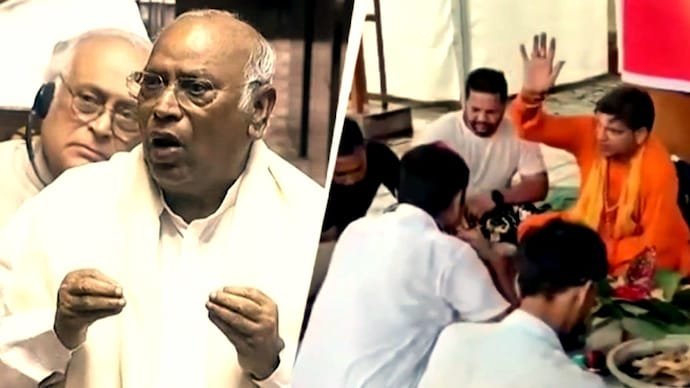
A political controversy over a ‘shuddhikaran’ ceremony at Haldwani’s Ram Lila Ground reached Parliament on Thursday after Congress president Mallikarjun Kharge raised the issue in the Rajya Sabha. Kharge alleged that a havan and purification ritual were conducted at the same venue where he had addressed a Congress rally two days earlier.
The incident has triggered sharp political reactions in Uttarakhand, with Congress leaders questioning the social message conveyed by the ceremony and the BJP denying any organisational connection with those who conducted it. Union Minister JP Nadda called the episode unfortunate and told Kharge that the BJP does not subscribe to such activities.
The controversy has become particularly sensitive because Kharge is a Dalit leader and because allegations have emerged that the ritual was linked to his presence at the venue. Organisers, however, have offered a different explanation, arguing that the ground has religious significance and that certain slogans allegedly raised during the Congress rally had offended members of the local community.
The dispute therefore involves several overlapping questions: whether the ceremony was intended as a response to Kharge’s presence, whether it had any connection with caste, whether the organisers had links to the BJP, and where the line should be drawn between religious practices and political events at a venue with religious associations.
What Mallikarjun Kharge said in the Rajya Sabha
Kharge raised the issue at the beginning of the Rajya Sabha proceedings on the final day of Parliament’s Monsoon session. He said that a havan and purification ceremony had been carried out at the stage from which he addressed a public meeting in Haldwani on August 8.
According to Kharge, a large crowd had attended the Congress rally and his speech focused on problems faced by people in the region. He stressed that he had not targeted any particular community or religion in his remarks.
Kharge questioned whether such a response was compatible with democratic values and India‘s constitutional framework. He also referred to his position as the Leader of the Opposition in the Rajya Sabha and said he had not wanted to politicise the matter.
The issue became particularly charged when Congress MPs began raising slogans in the House. The disruption reflected how quickly an incident in a state-level political dispute had become a national political confrontation.
Nadda distances BJP from the purification ceremony
As the uproar grew, Union Minister JP Nadda sought to separate the BJP from the ceremony.
Nadda described the incident as unfortunate and said the BJP did not subscribe to such activities. He also assured Kharge that the matter would be investigated and said the BJP’s national leadership would look into it.
His response was significant because Congress leaders had alleged that BJP workers were responsible for the ritual. Nadda specifically objected to Kharge repeatedly attributing the act to the BJP and emphasised that the party should not be held responsible without establishing who organised the event.
At the same time, Nadda acknowledged that Kharge’s sentiments had been hurt and said the incident was a matter of regret.
Kharge responded that his immediate demand was not simply for a political explanation. He called for a case to be registered and for those responsible to be arrested.
Why the ‘shuddhikaran’ ceremony has become controversial
The controversy centres on what happened at Haldwani’s Ram Lila Ground after the Congress rally.
A video circulated on social media showing a priest conducting a havan at the venue while Vedic mantras were being recited. Another video featured an organiser explaining why the ritual was held and arguing that the ground had religious significance.
The organisers’ explanation has become an important part of the political dispute. One member of the outfit involved, Girsh Chandra Pandey, reportedly said that certain slogans raised during Kharge’s rally sounded like Islamic slogans and had caused offence.
That account is sharply different from the Congress interpretation. Congress leaders have linked the purification ceremony to Kharge’s Dalit identity and described it as an example of caste prejudice.
As a result, the central dispute is not simply about whether a religious ceremony took place. It is about why the ceremony was conducted and what it was intended to signify.
Congress alleges caste discrimination
Uttarakhand Congress chief Ganesh Godiyal accused the Shri Ram Sena group of conducting the ritual and alleged that the organisation was associated with the BJP. The BJP has rejected the allegation.
Godiyal also alleged that the purification was carried out because Kharge belongs to the Dalit community. He accused the BJP of contributing to caste divisions in society.
Those allegations have elevated the dispute from a local disagreement over the use of a public venue to a much broader political argument about caste and social equality.
The caste dimension is especially sensitive because Kharge is only the second Dalit leader to have served as president of the Congress. Any suggestion that a public figure should be subjected to a purification ritual because of his caste can therefore carry a significance far beyond the immediate event.
However, the available accounts presented by the organisers dispute that interpretation. Their stated justification has focused instead on the religious character of the venue and alleged slogans at the Congress gathering.
Those competing explanations are now at the centre of the political controversy.
What the BJP says about the organisers
The BJP has denied having a connection with the group that conducted the ceremony.
This distinction is important because the Congress allegation that BJP-linked workers were behind the event would turn the episode into a direct confrontation between the two major political parties. The BJP’s response has been to reject that association while also acknowledging that the incident should be investigated.
Uttarakhand minister and BJP spokesperson Khajan Das offered another explanation for the anger surrounding the rally. He said certain slogans allegedly raised during Kharge’s event could have hurt the sentiments of members of the Sanatan community.
Das also stressed that the Ramlila Ground had religious significance. His argument was that the Nature of the venue and the slogans allegedly raised during the political gathering had contributed to resentment among some people.
This position does not establish that the purification ritual was justified, nor does it establish that the Congress rally had violated any rule. It represents the BJP side of a dispute in which the motives behind the ceremony remain politically contested.
Priyanka Gandhi demands an apology
The controversy also drew a strong reaction from Congress MP Priyanka Gandhi Vadra.
Priyanka demanded an apology from Prime Minister Narendra Modi and argued that the incident reflected a mindset associated with the BJP and the RSS. She said such an attitude should be repudiated.
Her reaction reflects the Congress strategy of treating the incident not as an isolated local dispute but as an example of a larger ideological conflict involving caste, religion and the interpretation of constitutional values.
The RJD also criticised the episode. Party spokesperson Priyanka Bharti accused the BJP of nurturing casteist elements and framed the controversy as a reaction against the political prominence of a Dalit leader.
The competing political responses demonstrate why the Haldwani incident has moved rapidly beyond Uttarakhand. For opposition parties, the ceremony provides an opportunity to question the BJP’s position on caste and social equality. For the BJP, the priority is to reject any suggestion that the party organised or endorsed the ritual.
The unanswered question: who organised the ceremony?
One of the most important unresolved issues is the precise organisational responsibility for the event.
Congress leaders have alleged that BJP-associated workers or a group linked to the BJP conducted the ceremony. The BJP has denied such a connection.
The name of the Shri Ram Sena has emerged in the political debate, with the Uttarakhand Congress alleging an association between the organisation and the BJP. That allegation has not been accepted by the BJP.
Establishing responsibility matters because the political implications are very different depending on whether the event was organised independently by a religious or right-wing group or was directly supported by party workers.
The call for an Investigation made by Nadda and Kharge’s demand for legal action therefore take on significance beyond the immediate political exchange. A formal investigation could potentially establish who organised the ritual, what their stated purpose was and whether any law was violated.
The role of the venue adds another layer
The Haldwani Ram Lila Ground is at the centre of the controversy because of competing claims about its character and use.
The organisers have described it as a place with religious significance and argued that it should be reserved for cultural rather than political activities. The Congress, meanwhile, used the venue for a public political rally addressed by its national president.
This raises a practical question that is separate from the allegations of caste discrimination: what are the rules governing political events at the venue?
If the ground is available for political gatherings, then the debate over its religious character may have one implication. If there are restrictions on political activity, the issue could instead involve the terms under which the venue was used.
Those questions should not be confused with the separate question of whether a purification ritual was appropriate after a political event. The two issues can coexist, but they require different factual assessments.
Why the caste angle has become the most sensitive part
India’s constitutional framework prohibits untouchability and guarantees equality before the law. That history makes any public controversy involving purification based on a person’s caste especially sensitive.
At the same time, it is important to distinguish between an allegation and an established fact. The Congress has alleged that Kharge’s caste was the reason for the ritual, while the organisers have offered a different explanation involving the venue and alleged slogans.
That distinction is essential because the political consequences are substantial. If a ceremony were explicitly organised to purify a place solely because a Dalit leader had spoken there, it would carry an obvious caste dimension. If it was instead conducted as a response to a dispute over the use of a religiously significant venue or alleged slogans, the circumstances would be different.
The controversy can therefore be understood properly only after the intention and responsibility behind the ceremony are established.
Why the issue reached Parliament
Parliament regularly becomes the venue for raising issues that have national political significance even when the underlying event occurs in a particular state.
Kharge’s decision to raise the Haldwani incident in the Rajya Sabha transformed a local controversy into a national political issue. It also placed the BJP leadership in the position of having to respond directly to an allegation involving one of India’s senior opposition leaders.
The fact that Nadda responded immediately also prevented the issue from remaining solely a Congress allegation. His statement established the BJP’s public position: the party does not support such activities and the incident should be investigated.
The exchange also explains why the controversy generated such a strong reaction in the House. The issue combined political rivalry, caste, religion, constitutional values and accusations against the ruling party.
What happens next in Uttarakhand
The immediate focus is likely to remain on establishing who conducted the purification ceremony and why.
If authorities investigate the incident, the findings could determine whether the Congress allegation of caste-based targeting has factual support, whether the organisers acted independently of political parties and whether any rules or laws were breached.
The political debate, however, is likely to continue regardless of the outcome of an investigation. Congress leaders have already framed the episode as a question of caste discrimination and constitutional values, while the BJP has rejected responsibility and pointed to the alleged religious sensitivities surrounding the venue.
The controversy also comes at a time when Uttarakhand remains an important political battleground, making disputes involving major national parties particularly combustible.
The larger issue beyond the political confrontation
The Haldwani controversy illustrates how quickly a local religious or cultural event can become a national political flashpoint when it involves a prominent political leader.
It also demonstrates the importance of separating three different questions: what happened, who organised it and why it happened.
The first question concerns the ceremony itself, which is supported by videos showing a havan and chanting at the venue. The second concerns organisational responsibility, which remains disputed between Congress allegations and the BJP’s denial. The third concerns motivation, with Congress alleging caste discrimination and organisers pointing to the venue and alleged slogans.
Those questions should be answered through evidence rather than political assumptions.
For Parliament, however, the incident has already become a larger debate about democracy and social equality. Kharge’s complaint was framed around the treatment of a Dalit leader and the constitutional principle of equality, while the BJP’s response was to reject the alleged party connection and promise an investigation.
Until the facts behind the ceremony are conclusively established, the political claims will continue to compete. What is already clear is that the Haldwani incident has moved well beyond the boundaries of a single venue. It has become a national argument over caste, religious identity, political conduct and the responsibilities of India’s major parties.
For breaking news and live news updates, like us on Facebook or follow us on Twitter and Instagram. Read more on Latest India on thefoxdaily.com.



COMMENTS 0