For decades, the comparison between India and china followed a familiar pattern: China grew faster, industrialised earlier and built a much larger economy, while India expanded more gradually with a greater dependence on services and domestic demand. That pattern has changed.
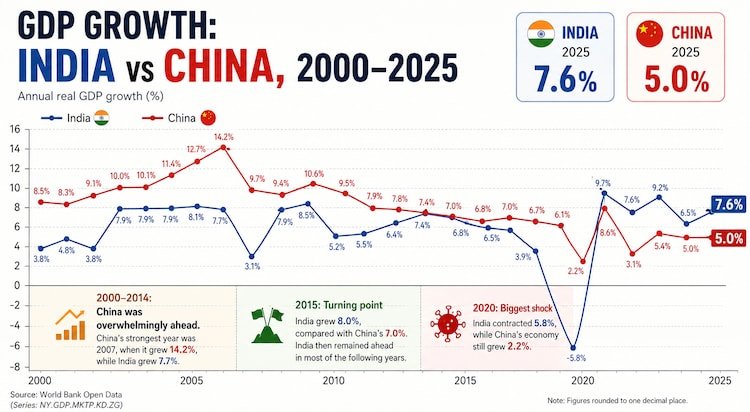
India has increasingly outpaced China in annual GDP growth, particularly since the middle of the 2010s and more clearly after the Covid-19 pandemic. The supplied data puts India’s FY2025-26 growth estimate at 7.7%, compared with around 5% for China. World Bank figures cited in the source put India’s 2025 growth at 7.6%, against China’s 5%.
Those numbers are significant, but they need to be interpreted carefully. India has won the race for GDP growth rate, not the race for economic size. China still has a vastly larger economy, substantially higher per-capita income and a Manufacturing base built over several decades.
That distinction explains why India’s current performance is best described as a major economic success rather than an outright victory over China.
India-China GDP growth: What has changed?
The most important part of the story is not one year’s growth figure. It is the direction of travel.
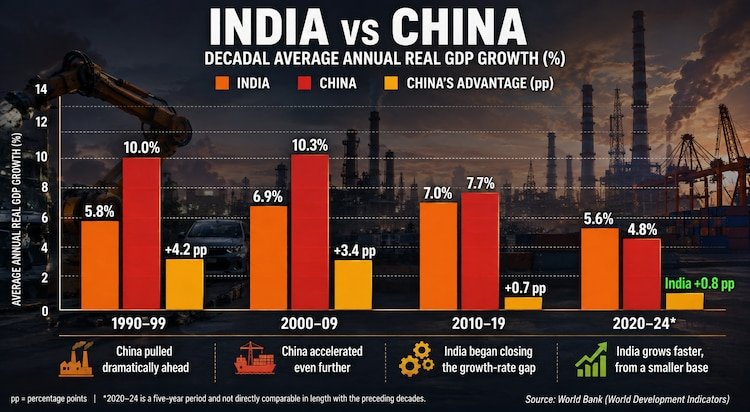
India and China were relatively close economically several decades ago. According to the figures provided, China’s economy was growing at about 7.9% in 1980, while India’s growth was around 6.7%. The gap widened substantially during the following decades as China sustained rapid expansion through industrialisation, investment and exports.
During the 1980s, 1990s and 2000s, China repeatedly posted stronger growth than India. China’s economic transformation accelerated as it became deeply integrated into global manufacturing and trade networks.
India’s growth trajectory was different. The economy became more market-oriented after the 1991 liberalisation reforms, but its expansion remained more dependent on services, domestic demand and consumption rather than the export-heavy manufacturing model that drove China’s rise.
The relationship began changing during the 2010s. India increasingly matched or exceeded China’s slowing growth rate, and the difference became particularly visible after the pandemic.
Since 2021, according to the supplied comparison, India has repeatedly grown faster than China. That makes the current decade unusual: the country that spent decades trying to close the growth gap is now operating with a sustained growth-rate advantage.
Why India’s faster GDP growth matters
A higher growth rate matters because Economic Growth compounds. If a country can consistently expand faster than another economy over many years, the difference eventually becomes much larger than the gap in any single year.
That is why India’s current performance deserves attention even though China remains considerably richer and larger.
The important question has shifted from whether India can occasionally grow faster than China to whether it can maintain that advantage for long enough to narrow the enormous economic gap accumulated over the past three decades.
The outlook cited in the source is favourable. The International Monetary Fund’s July 2026 World Economic Outlook Update projects Indian growth of 6.7% for FY2026-27, keeping India among the fastest-growing major economies. The World Bank’s projections similarly point to India maintaining a stronger growth trajectory than China through much of the decade.
However, forecasts are not guarantees. Maintaining high growth requires investment, productivity improvements, infrastructure development, job creation and a favourable Business environment. The more years India can sustain relatively high growth, the more meaningful the present advantage becomes.
India is growing faster, but China is still much bigger
This is the most important caveat in any India-China GDP comparison.
A percentage growth rate measures how quickly an economy is expanding relative to its existing size. It does not tell us how much economic output is being added in absolute terms.
Consider a simplified example. If a $4 trillion economy grows by 7%, it adds about $280 billion in output. A $19 trillion economy growing by 5% adds about $950 billion. The smaller economy is growing faster, but the larger economy can still add far more output.
That is broadly the situation India and China face today.
The source puts China’s nominal GDP in 2025 at around $19.5 trillion, compared with roughly $3.96 trillion for India. On those figures, China’s economy is almost five times larger in nominal terms.
Using purchasing power parity, or PPP, narrows the difference. The supplied figures put China’s PPP economy at around $41 trillion and India’s at approximately $17.7 trillion. China therefore remains substantially ahead even after adjusting for differences in domestic purchasing power.
This is why saying that India has “beaten” China economically would be misleading. India has gained the advantage in growth speed, but not in economic scale.
GDP growth rate versus GDP size: Why the distinction matters
GDP growth and GDP size answer two different questions.
GDP size tells us how much an economy produces. GDP growth tells us how quickly that output is increasing.
For India, the current advantage is strategically important because sustained faster growth can gradually reduce the distance between the two economies. But that process takes time.
China’s decades of rapid expansion created a huge economic base. The country built extensive industrial capacity, transport infrastructure, export networks and manufacturing supply chains. Those advantages do not disappear simply because annual growth has slowed.
India therefore faces a different challenge from the one China faced during its fastest expansion. China had to build economic scale at extraordinary speed. India now has to use faster growth to transform its existing economy while closing a substantial gap with its larger neighbour.
India and China started from a much closer position
The scale of today’s difference becomes more striking when viewed historically.
The supplied data indicates that the two economies were remarkably close in nominal size in 1987. In PPP terms, China was only somewhat ahead of India in 1990, while India’s per-capita income was also relatively competitive at that time.
The divergence that followed was enormous.
China’s economic model combined large-scale investment, manufacturing, infrastructure development and export growth. It became a central manufacturing hub for the global economy, integrating domestic companies with international supply chains.
India followed a different path. Services became an important source of growth, particularly in information technology and business services, while household consumption and domestic demand remained central to economic activity.
The result is two economies that started from broadly comparable positions but developed very different strengths.
India’s biggest advantage: domestic consumption
One of India’s strongest economic assets is the size of its domestic market.
The supplied figures indicate that household consumption represented nearly 61% of India’s GDP in 2024, compared with around 40% in China. The source also estimates that roughly 70% of India’s economy is linked to consumption.
This makes India’s growth model different from China’s historically investment- and export-heavy approach.
A large consumer market can provide resilience because economic activity does not depend entirely on overseas demand. Rising household incomes can increase spending on housing, transport, financial services, electronics, travel, Healthcare and other goods and services.
But consumption alone cannot guarantee a transformation on the scale achieved by China.
The crucial issue is whether India’s growing consumer market can be connected to stronger domestic production. If more demand is met through imports, the economic benefits will be different from a situation in which rising consumption is accompanied by expanding factories, supply chains, exports and productive employment.
Why China’s GDP growth has slowed
China’s slowdown is not simply the result of one weak economic year. The country is dealing with several structural pressures at the same time.
The property sector, once an important contributor to growth, has undergone a prolonged adjustment. Efforts to reduce excessive leverage among property developers contributed to financial stress in the sector, while weaker property values affected household wealth and confidence.
Consumer behaviour has also changed. Greater uncertainty and demographic pressures have encouraged caution and higher savings, making it harder for household spending to become the dominant engine of recovery.
China’s demographic outlook presents another long-term challenge. An ageing population can reduce the growth of the working-age labour force and increase pressure on public and household finances.
At the same time, China is attempting to shift its economic model toward higher-value manufacturing. electric vehicles, batteries, solar equipment, electronics and other advanced industries have become important areas of investment.
That strategy has created new strengths but also new tensions. If industrial production grows faster than domestic demand, Chinese manufacturers become more dependent on overseas markets. That creates friction with economies concerned about Chinese industrial overcapacity and trade imbalances.
China therefore remains an industrial powerhouse, but its path to continued rapid growth is becoming more complicated.
India’s manufacturing opportunity is real, but not automatic
China’s changing growth model creates an opportunity for India as multinational companies reconsider the structure of global supply chains.
India offers a combination of a large domestic market, a substantial workforce and an expanding consumer base. Companies looking to diversify manufacturing outside China can therefore view India as both a production location and a major market.
But attracting factories is not enough.
India needs manufacturing investment to generate wider economic benefits through local suppliers, exports, technology transfer, infrastructure and productive jobs. If multinational companies mainly use India as a consumer market while sourcing a significant share of products elsewhere, the effect on industrial transformation will be more limited.
This is where India’s experience could differ from China’s.
China’s rise was closely tied to manufacturing exports and integration into global production networks. India has developed a powerful services sector, but building deeper manufacturing capabilities remains an important part of its long-term growth challenge.
India’s per-capita income gap with China remains large
Another reason the current growth-rate advantage should not be confused with an economic victory is the difference in living standards measured through GDP per capita.
The supplied 2025 figures put China’s nominal GDP per capita at around $13,806, compared with approximately $2,818 for India.
On a PPP basis, the source gives China’s figure at around $31,000 and India’s at roughly $13,000.
These numbers highlight the scale of India’s remaining development challenge. Faster national GDP growth is valuable, but its ultimate significance for citizens depends on whether it translates into higher incomes, better employment opportunities, improved productivity and stronger public and private investment.
A country can have an impressive headline growth rate while still having millions of people whose individual incomes remain far below those in a richer economy.
What India needs to turn growth into long-term economic power
The next stage of India’s economic story will depend less on winning individual annual growth comparisons and more on the quality of that growth.
Several outcomes will matter particularly.
- Productivity: Faster growth needs to come from rising productivity rather than simply expanding consumption.
- Manufacturing: India needs deeper industrial supply chains and greater participation in global manufacturing.
- Jobs: Economic expansion must generate productive employment at a scale capable of absorbing India’s workforce.
- Investment: Infrastructure and private-sector investment will be important for sustaining expansion.
- Exports: Stronger participation in international trade can help India diversify beyond domestic consumption.
- Incomes: Ultimately, national GDP growth matters most when it raises household living standards.
These are not separate objectives. They reinforce each other. Productive investment can create factories and infrastructure; factories can create jobs; jobs can raise incomes; higher incomes can support consumption; and greater productivity can make Indian companies more competitive internationally.
Why India’s current lead is still a significant achievement
The caveats should not obscure how unusual the present situation is.
For much of the period since the 1980s, China was the faster-growing of the two economies. It repeatedly achieved growth rates that India could not match, including numerous years of double-digit expansion.
The supplied comparison notes that between 1961 and 2024, China recorded annual growth of 10% or more in 22 years, while India did not reach 10% in any year during that period.
That historical imbalance has now reversed in a meaningful way. India is operating with a higher growth rate while China is dealing with the challenges of a mature, much larger economy.
For India, this provides an important opportunity. Sustaining faster growth for another decade could significantly change the relative economic balance, even if China remains larger throughout much of that period.
The real India-China economic race is only beginning
The easiest way to describe the current situation is simple: India is running faster, but China is still much farther ahead.
That is not a contradiction. It is the central fact behind the GDP comparison.
India’s growth-rate advantage is meaningful because economic differences compound over time. But the enormous gap created by China’s earlier decades of rapid expansion cannot be eliminated in a few years.
The challenge for India is therefore to turn speed into scale. That means ensuring that high GDP growth produces stronger manufacturing, rising productivity, better jobs, higher incomes and greater economic complexity.
China’s own experience offers a useful lesson. Rapid growth can transform a country when it is supported by investment, productivity gains, industrialisation and integration into global markets. But once an economy becomes much larger and more mature, maintaining very high growth becomes increasingly difficult.
India is now at a different stage of that journey. It has the advantage of a large domestic market, a strong services sector and substantial room for development. It also has the opportunity to attract investment as global supply chains evolve.
India has the momentum, but the verdict is still out
India’s faster GDP growth compared with China is unquestionably an important economic milestone. After decades in which China was the faster-growing giant, India has established a sustained advantage in growth rates across much of the current decade.
But calling it an economic victory would go too far.
China’s economy remains several times larger in nominal terms, its per-capita income remains substantially higher and its manufacturing capabilities are far deeper. India’s faster growth is therefore best understood as an opportunity rather than a finished result.
The decisive test will be what India does with that opportunity.
If faster growth can be sustained and translated into productivity, industrial capacity, exports, employment and higher living standards, the current growth-rate advantage could become the foundation for a much larger economic transformation.
If growth remains heavily dependent on consumption without comparable gains in productive capacity, the gap with China will narrow much more slowly.
For now, India has something it did not consistently have for decades: the momentum in the growth race. The bigger economic race, however, is still underway.
For breaking news and live news updates, like us on Facebook or follow us on Twitter and Instagram. Read more on Latest India on thefoxdaily.com.






COMMENTS 0