India’s economy began the 2026-27 financial year on a stronger footing than economists had anticipated, with real GDP growing 7.8% year-on-year in the April-June quarter. The latest reading exceeded the roughly 7.1% expansion economists had expected and came despite elevated energy prices, geopolitical tensions and continuing uncertainty over global trade.
The June-quarter performance is significant because expectations had pointed to a moderation in growth from the previous quarter. Instead, economic activity remained broad-based, with domestic consumption, investment, Manufacturing, financial services and exports providing important support.
The result also reinforces the importance of India’s domestic economy at a time when external conditions remain unsettled. While global trade and energy markets can influence India’s growth trajectory, the size of the country’s consumer market and the continued investment cycle have helped provide a degree of protection against external shocks.
India GDP growth beats expectations in Q1 FY27
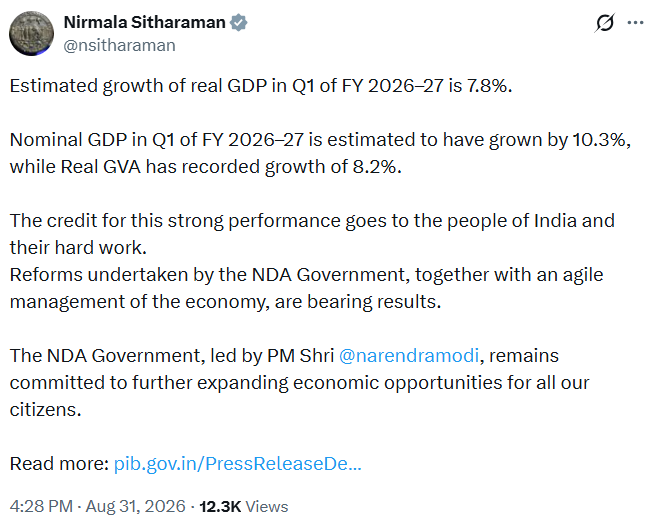
The 7.8% GDP Growth recorded in the first quarter of FY27 was considerably stronger than the 7.1% expansion expected in a Reuters poll of 58 economists before the data was released. The Reserve Bank of India had also projected growth of 7% for the quarter.
The surprise was therefore not simply that India continued to grow rapidly. It was that economic activity proved more resilient than expected despite several factors that could have weakened demand and investment.
Those pressures included high oil prices, geopolitical uncertainty and concerns about global trade. India remains highly dependent on imported crude oil, making energy-price shocks particularly important for Inflation, transportation costs and corporate margins.
Against that backdrop, the 7.8% result suggests that the domestic economy entered FY27 with considerable momentum.
| Indicator | Latest reading | What it indicates |
|---|---|---|
| India real GDP growth, Q1 FY27 | 7.8% | Strong start to the financial year |
| Economists’ Q1 FY27 forecast | About 7.1% | Actual growth significantly exceeded expectations |
| RBI Q1 FY27 projection | 7.0% | Growth was above the central bank’s expectation |
| FY26 real GDP growth | 7.7% | Growth remained strong through the previous financial year |
What drove India’s June-quarter growth?
The latest numbers point to several parts of the economy working together rather than a single sector carrying overall growth.
Private investment gains momentum
One of the most important developments was the improvement in private investment. Gross fixed capital formation strengthened during the quarter, while private investment growth rose sharply compared with the previous year.
That matters because sustained economic expansion cannot depend indefinitely on government spending alone. Public infrastructure expenditure can create demand, improve logistics and encourage businesses to invest, but a broader investment cycle requires companies to increase their own spending on factories, equipment, technology and other productive assets.
The latest data provides evidence that this process may be gaining traction. Investment activity in areas including data centres, power and metals has been highlighted as part of the stronger private-sector capital formation seen during the quarter.
If private capital expenditure continues to expand, it could become an important source of support for growth over the next several quarters.
Manufacturing remains a major growth engine
Manufacturing also provided a substantial contribution to the June-quarter performance. The sector grew 9.2% year-on-year, making it one of the stronger components of the economy.
Manufacturing growth is particularly important because it connects several parts of the economic system. Strong factory activity can increase demand for raw materials, transportation, electricity, logistics and business services while also supporting employment and investment.
The strength of manufacturing therefore gives the headline GDP figure a broader foundation than would be the case if growth were concentrated mainly in a few service industries.
Services continued to provide support
Financial and other services also remained important contributors. Financial services recorded growth of 12.1% during the quarter, according to the latest estimates.
Strong activity in financial services can reflect wider economic activity because banks and other financial institutions support household consumption, business investment and working-capital requirements.
Credit growth also accelerated significantly during the period. A stronger flow of credit can help companies finance expansion and households maintain spending, although the quality and sustainability of credit growth remain important considerations for policymakers.
Consumption gives the economy another layer of support
Domestic consumption remained a central pillar of India’s growth story. This is particularly important when global demand is uncertain.
India’s large domestic market means economic activity does not depend entirely on exports. Consumers buying vehicles, electronics, household products, services and other goods can continue to support businesses even when demand from overseas markets becomes less predictable.
Recent tax measures have also helped support household demand, according to market assessments following the GDP release. The combination of consumption and investment is especially significant because it provides two different channels for economic expansion.
Consumption supports current demand, while investment increases productive capacity. When both improve at the same time, the economy has a stronger foundation for maintaining growth.
Why the 7.8% GDP number matters
The most important message from the latest GDP data is not simply that India grew faster than expected. It is that several sources of demand remained active despite a difficult external Environment.
Economists had entered the June-quarter release with concerns about weaker private investment, high oil prices and geopolitical risks. The actual data provided a more positive picture.
The result suggests that the domestic economy has so far been able to absorb at least some of the pressure coming from abroad. That does not make India immune to global shocks, but it does mean that external weakness does not automatically translate into an equivalent slowdown in overall economic activity.
There is another important distinction. A high quarterly growth rate is useful, but its quality matters. Growth supported by a combination of consumption, investment, manufacturing and services is generally more encouraging than growth driven by a narrow temporary factor.
The June-quarter data showed strength across several of these areas.
India enters FY27 with strong momentum
The latest quarter follows a strong performance in FY26. India’s real GDP grew 7.7% during the 2025-26 financial year, according to the government’s provisional estimates.
The new 7.8% quarterly figure means the economy has carried substantial momentum into the opening quarter of FY27. However, quarterly growth rates should not be treated as a guarantee of the full-year outcome.
Economic conditions can change considerably during a financial year. Oil prices, interest rates, exports, investment decisions, Weather conditions and global financial markets can all influence subsequent quarters.
That makes the composition of future growth more important than simply repeating the latest headline number.
The biggest risk remains high oil prices
For India, energy prices represent one of the clearest external risks to the growth outlook.
The country imports a large share of the crude oil it consumes. When international oil prices rise and remain elevated, the impact can spread across the economy through fuel, transportation, manufacturing and logistics costs.
Higher energy costs can also complicate the inflation outlook. If businesses face higher input costs, they may pass part of those increases on to consumers. At the same time, more expensive fuel can reduce the purchasing power of households.
This creates a difficult policy balance. Strong growth provides room for optimism, but a persistent energy shock could make it harder to maintain both price stability and rapid economic expansion.
Geopolitics and global trade remain important risks
The global environment is another uncertainty that cannot be ignored.
Geopolitical tensions can disrupt energy supplies, Shipping routes and investment decisions. Trade uncertainty can have a similar effect by making companies more cautious about expanding production or committing capital to new markets.
India’s exports have remained an important source of support, but export performance ultimately depends on conditions outside the country. A slowdown in major trading partners or new trade restrictions could reduce demand for Indian goods and services.
For businesses, uncertainty can also delay investment decisions. Companies may postpone large projects if they are unsure about future demand, input costs or access to overseas markets.
Why private investment will be crucial from here
The next stage of India’s growth story will depend heavily on whether private investment can maintain its recent improvement.
Government capital expenditure has played an important role in supporting infrastructure and economic activity. Public investment can create roads, railways, ports, power infrastructure and other assets that reduce costs for businesses over time.
But a sustained investment cycle ultimately requires private companies to increase spending as well.
The recent improvement is therefore encouraging, particularly because stronger private capital formation can have effects beyond the immediate quarter. New factories, data centres, power projects and industrial facilities can expand production capacity and generate additional demand for suppliers and services.
The key question is whether this improvement continues after the initial boost from stronger demand and favourable business conditions.
What the GDP data means for consumers and businesses
For consumers, strong GDP growth does not automatically mean that household incomes will rise at the same pace. The benefits of economic expansion depend on employment, wage growth, inflation and the sectors in which people work.
Nevertheless, stronger economic activity can create a more supportive environment for hiring, business expansion and household spending when growth remains broad-based.
For businesses, the latest numbers provide a positive signal about demand. Companies may be more willing to invest when they see evidence that consumption and industrial activity are holding up.
However, businesses will also have to manage higher energy costs and potential volatility in global markets. Strong GDP growth does not eliminate these risks.
What could determine India’s growth in the coming quarters?
The next few quarters will provide a clearer test of whether the June-quarter performance represents the beginning of another sustained high-growth phase or a particularly strong opening quarter.
Several indicators will be especially important to watch.
- Private capital expenditure: Continued corporate investment would strengthen the durability of the recovery.
- Consumer demand: Household spending will remain important for maintaining momentum in the domestic economy.
- Manufacturing: Sustained industrial expansion would support investment, employment and supply chains.
- Exports: Strong overseas demand can add another growth engine, although it remains vulnerable to global trade conditions.
- Oil prices: A prolonged increase could raise inflation and production costs.
- Credit growth: Continued access to financing could support investment and consumption, provided financial stability is maintained.
Strong start, but the real test is durability
India’s 7.8% GDP growth in the June quarter is a stronger opening to FY27 than economists had expected. The performance shows that domestic demand, investment, manufacturing, financial services and exports have provided substantial support despite a challenging international environment.
The surprise is particularly notable because the economy was expected to slow from the previous quarter. Instead, growth remained firmly above 7%, highlighting the resilience of India’s domestic economic engine.
But the latest number should also be viewed as a starting point rather than a guarantee. High oil prices, geopolitical tensions, global trade uncertainty and financial-market volatility remain genuine risks.
The most important question now is whether the factors behind the 7.8% expansion can remain in place. If private investment continues to strengthen, consumption remains resilient and exports hold up, India could maintain a relatively high growth rate despite external pressures.
If global shocks intensify, however, the economy could face greater pressure through energy costs, trade and investment channels.
For now, the message from the June quarter is clear: India has entered FY27 with stronger-than-expected momentum. The challenge for policymakers and businesses will be turning that momentum into durable, broad-based growth across the rest of the financial year.
For breaking news and live news updates, like us on Facebook or follow us on Twitter and Instagram. Read more on Latest Business on thefoxdaily.com.






COMMENTS 0