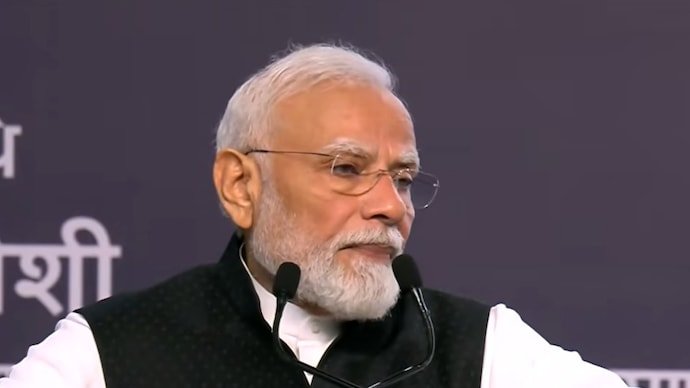
Prime Minister Narendra Modi on Saturday sharply criticised those questioning India’s latest economic growth numbers, saying critics who once viewed the country through a pessimistic lens were now struggling to accept its emergence as the world’s fastest-growing major economy.
Addressing the centenary celebrations of Shri Ram College of Commerce (SRCC) in New Delhi, Modi pointed to India’s 7.8% real GDP Growth in the April-June quarter of 2026-27 as evidence of economic resilience despite geopolitical tensions, disruptions to global trade and continuing uncertainty in world markets.
The latest figure, released by the Ministry of Statistics and Programme Implementation, showed real GDP growing 7.8% year-on-year in the first quarter, while nominal GDP rose 10.3%. The new data was calculated using the revised national accounts series with 2022-23 as the base year. :contentReference[oaicite:0]{index=0}
Modi’s remarks came as economists and former policymakers continue to debate the credibility, methodology and interpretation of India’s latest GDP data. While some critics have questioned the size of the reported expansion and its relationship with employment and investment, other economists argue that the broader indicators of economic activity are consistent with strong growth.
PM Modi revives his “half-empty glass” analogy
The setting for Modi’s latest criticism was particularly symbolic. He returned to SRCC more than a decade after his widely discussed 2013 address at the college, when he was serving as Gujarat Chief Minister.
During that earlier speech, Modi used a glass metaphor to describe competing views of India. Some people, he said, saw the glass as half full while others saw it as half empty. His own interpretation was that the glass was entirely full because one half contained water and the other half contained air.
At the centenary event, he revived that analogy to argue that those who were pessimistic about India in 2013 had retained the same outlook despite the country’s subsequent economic changes.
Modi said some people would continue to see the glass as half empty regardless of how much the country had progressed. His remarks were clearly aimed at political and economic critics who have challenged the government’s narrative of rapid growth.
The prime minister also presented the period since his first SRCC appearance as a kind of economic and political “report card”, contrasting conditions in 2013 with India’s current position.
From “Fragile Five” to fastest-growing major economy
One of the strongest comparisons in Modi’s speech was between India’s economic position in 2013 and its status today.
In 2013, India was grouped with Brazil, Indonesia, South Africa and Turkey in the so-called “Fragile Five”, a term used by analysts and financial markets to describe emerging economies considered particularly vulnerable to external financial shocks, large current-account deficits and capital outflows.
Modi recalled that period by highlighting several economic difficulties, including a weak rupee, high inflation, a large current-account deficit, slowing industrial activity, corruption controversies and what he described as policy paralysis.
India’s present circumstances are markedly different in several respects. The economy is now substantially larger, domestic financial markets are deeper, foreign-exchange reserves are much higher than they were in 2013 and India has become one of the world’s largest and fastest-growing major economies.
Official figures now show strong expansion despite international headwinds. India’s 7.8% real GDP growth in the April-June quarter exceeded the Reserve Bank of India’s earlier 7% forecast and most market expectations.
Modi used that contrast to argue that the country’s economic transformation should be judged against where India stood more than a decade ago rather than only through the latest challenges.
The 7.8% GDP number is at the centre of the political battle
The prime minister’s comments come during an unusually intense debate over India’s new GDP series.
The latest official estimate is not merely another quarterly number. It is the first major growth reading under the revised statistical framework introduced earlier this year, which replaced the previous 2011-12 base year with 2022-23. The methodology also incorporates updated data sources and statistical approaches intended to better represent the structure of the modern Indian economy.
Some economists have raised concerns over the size of historical revisions and whether the latest number is fully comparable with earlier estimates. Others have argued that using figures from different GDP series to calculate an alternative growth rate is statistically inappropriate.
The political dispute has consequently become larger than a question of whether India grew by 7.8%. It now involves the credibility of official statistics, the interpretation of revisions and the difference between aggregate economic output and people’s lived economic experience.
Why GDP growth does not automatically mean better jobs
One of the most important criticisms surrounding the 7.8% figure concerns the relationship between economic growth and employment.
GDP measures the value of goods and services produced in the economy. It does not directly measure how many jobs are being created, whether wages are rising quickly enough or how gains from growth are distributed among households.
That means a strong GDP number can coexist with economic stress for particular sections of the population.
For example, an economy can experience rapid growth driven by capital-intensive industries, financial services, infrastructure or technology while labour-intensive sectors do not expand at the same speed. The result can be a situation where headline output looks strong but workers do not immediately feel a proportional improvement in income.
This distinction explains why questions about jobs and wages remain relevant even when the GDP estimate itself is sound.
At the same time, recent data suggests that India’s current growth cycle is not being driven solely by government spending. Private investment and domestic consumption have also shown signs of strengthening, making the current expansion broader than some earlier phases of the post-pandemic recovery.
Modi says India is creating new employment opportunities
While defending the growth figures, Modi argued that India’s expansion is also generating new employment opportunities.
That claim reflects the government’s broader economic narrative: that higher production, expanding infrastructure, manufacturing growth and increasing private investment will eventually translate into more jobs and higher household incomes.
The challenge for policymakers is that employment effects can lag behind investment and output growth. A factory under construction or a new digital-services investment may initially raise capital spending without immediately producing a large number of permanent jobs.
For India’s young population, therefore, the quality and quantity of employment remains one of the most important tests of whether rapid GDP growth is translating into broader prosperity.
PM Modi defends financial inclusion through Jan Dhan
Modi also used the SRCC platform to highlight the expansion of financial inclusion through the Pradhan Mantri Jan Dhan Yojana.
He said nearly 60 crore bank accounts had been opened over the past 12 years, bringing large numbers of previously excluded citizens into the formal banking system.
The programme is one of the pillars of the government’s argument that economic development should not be limited to urban or formally employed populations.
Basic bank accounts can make it easier for people to receive government transfers, use digital payment systems, access formal financial products and build a transaction history that may help with future borrowing.
India’s expansion of digital public infrastructure has also made it possible to combine bank accounts with identity and mobile connectivity at a scale that was far more limited a decade ago.
The “mai-baap” culture attack
Modi linked financial inclusion with a broader political criticism of what he called a “mai-baap” culture in governance.
His argument was that citizens should not have to depend on government intermediaries or local political networks to receive benefits and services that can instead be delivered directly through transparent systems.
He presented the expansion of bank accounts and digital delivery mechanisms as part of a broader shift toward what he described as “P2G2” pro-people, good governance.
The concept reflects a recurring theme in Modi’s governance messaging: moving from discretionary access to public services toward systems-based delivery that reduces intermediaries.
Supporters see this as a major improvement in efficiency and accountability. Critics, however, argue that digital access alone does not eliminate the deeper challenges of poverty, exclusion or inadequate public services.
From crisis management to advance planning
Modi also said the government’s approach had changed from reacting to crises toward preparing for them in advance.
That argument fits with the government’s emphasis on infrastructure development, digital public services, supply-chain resilience and strategic manufacturing.
The shift is especially relevant after the disruptions caused by the COVID-19 pandemic, the Russia-Ukraine war and more recent geopolitical conflicts. Global supply chains have become more vulnerable to shipping disruptions, energy shocks and trade restrictions.
For India, building domestic capacity in areas such as electronics, semiconductors, defence equipment and renewable-energy technologies is therefore not simply an industrial policy choice. It is increasingly presented as an element of economic and national resilience.
Modi revisits the “Make in India” argument
The prime minister also returned to another theme from his 2013 SRCC speech: the idea that India should move toward greater domestic manufacturing instead of relying heavily on imports.
At the time, the proposition was widely discussed as an ambitious industrial-policy goal. More than a decade later, Modi used the transformation of India’s mobile-phone industry as an example of what he described as the success of the broader “Make in India” approach.
He said India, which imported most of its mobile phones in 2014, now exports mobile handsets worth more than Rs 2.5 lakh crore.
The electronics industry has indeed undergone major expansion, with India becoming an increasingly important manufacturing base for smartphones and components. Government incentives, growing domestic demand and companies seeking to diversify supply chains away from china have all contributed to that transformation.
The next challenge is moving further up the value chain. Manufacturing large volumes of finished devices does not automatically mean that the country controls the most valuable components, intellectual property or advanced production technologies.
India’s manufacturing ambitions are expanding
Modi said India is moving toward becoming a global manufacturing hub, a centre for research and innovation and a major exporter of agricultural products.
The ambition extends beyond smartphones to sectors such as semiconductors, electronics, pharmaceuticals, defence manufacturing, automobiles and renewable-energy equipment.
Private-sector investment is an encouraging sign. Recent economic data showed private investment rising sharply in the April-June quarter, while gross fixed capital formation increased as a share of the economy. Reuters reported that private investment rose close to 12% year-on-year during the quarter, accompanied by stronger corporate spending and bank credit.
These indicators strengthen the argument that the current expansion has a meaningful investment component rather than being driven entirely by government expenditure.
But the manufacturing story still has constraints
India’s progress in manufacturing should not be confused with the complete transformation of its industrial economy.
Manufacturing still faces challenges involving logistics costs, land availability, workforce skills, technology access, supply-chain depth and integration into high-value global production networks.
The country also has to create enough labour-intensive employment to absorb millions of young people entering the workforce over time.
That is why the success of Make in India will ultimately depend on more than the export value of a single product category. The bigger test is whether manufacturing can generate sustained productivity gains, stronger wages and a broad ecosystem of suppliers and skilled workers.
India’s economy is growing despite external shocks
One element of Modi’s argument is difficult to ignore: India’s economy has continued to expand despite a challenging global Environment.
The latest quarter occurred against a backdrop of severe geopolitical tensions, disrupted trade routes and volatility in energy markets. India imports most of its crude oil, making global energy shocks a significant risk to inflation and the trade balance.
Yet real GDP still grew 7.8% in the quarter ending June 2026. The official release described the economy as sustaining its growth momentum despite global headwinds.
Economists also point to domestic consumption, investment and manufacturing as important sources of resilience.
That does not make India immune to external shocks. Higher oil prices, a weaker rupee, slower global demand or prolonged disruptions in shipping can still create serious challenges.
The “Fragile Five” comparison has limits
Modi’s contrast with 2013 is politically effective, but the economic comparison needs some nuance.
The Global Economy itself has changed dramatically since then. India’s GDP is much larger, its financial system is more integrated and its foreign-exchange position is stronger. The country’s demographic, digital and consumer-market advantages have also become more prominent.
At the same time, today’s challenges are different. India now has to maintain high growth while dealing with a much larger economic base, greater exposure to global capital markets, climate risks and a more complex geopolitical environment.
Being outside the “Fragile Five” category therefore does not mean vulnerability has disappeared. It means the sources and forms of vulnerability have changed.
Political rhetoric and economic statistics are now intertwined
The GDP debate illustrates how economic statistics can become political symbols.
For the government, 7.8% growth represents evidence that its economic model has delivered resilience and that India is moving rapidly toward becoming a major global power.
For critics, the central question is whether GDP growth is translating sufficiently into jobs, wages, investment and household prosperity.
Both perspectives focus on different parts of the economic picture.
The most useful way to interpret the data is therefore not to treat GDP as either unquestionable proof of success or evidence of statistical manipulation. Instead, it should be assessed alongside employment, consumption, investment, productivity, inflation, corporate earnings and household incomes.
Why the new GDP series will remain under scrutiny
The adoption of the 2022-23 base year is expected to remain a major focus of economic debate.
India’s statistical authorities have defended the revisions as an effort to incorporate newer datasets and a more contemporary representation of the economy. The new series was officially introduced on February 27, 2026, with historical quarterly estimates recalculated under the revised framework.
That process is statistically normal, but large revisions naturally attract attention because they can alter how earlier economic performance is understood.
Greater transparency will be especially important if the government wants the new series to command broad acceptance among economists, investors and independent researchers.
The long-term credibility of GDP data depends not simply on producing a number but on making the methodology sufficiently clear for outsiders to understand how that number was reached.
PM Modi turns SRCC speech into an economic report card
Modi’s decision to revisit his 2013 SRCC appearance allowed him to frame the latest GDP figures as part of a much longer economic story.
His message was straightforward: India that was struggling with high inflation, external vulnerability and weak confidence more than a decade ago has become a major growth engine at a time when many advanced economies are expanding much more slowly.
He also used financial inclusion and manufacturing growth to argue that the transformation is visible beyond headline GDP.
That broader argument is important because economic progress cannot be judged through one quarterly growth figure alone. India’s ability to sustain investment, create productive employment, raise incomes and expand manufacturing will ultimately determine whether the current growth momentum becomes a durable structural transformation.
What 7.8% growth means for India now
The immediate significance of the latest GDP figure is that it confirms that India’s economy entered FY2026-27 with strong momentum.
Real GDP grew 7.8% in the first quarter, stronger than most forecasts, while private investment and consumption also remained supportive.
That gives policymakers a stronger starting point for the rest of the financial year. It also provides some protection against external uncertainty, although risks from energy prices, global trade and geopolitics remain.
For households, however, the more meaningful test will be whether this growth produces better employment opportunities, stronger wages and greater purchasing power.
For businesses, the question will be whether investment momentum continues rather than fading after one strong quarter.
For policymakers, the challenge is to maintain growth while keeping inflation, public finances and external vulnerabilities under control.
The debate is no longer simply about optimism or pessimism
Modi’s “half-empty glass” criticism reduces the political divide to a contest between optimism and pessimism. But the economic debate is more complicated than that.
India can be genuinely experiencing rapid economic growth while economists still question aspects of the statistical methodology. The government can point to stronger investment and consumption while critics can legitimately ask whether job creation and wage growth are keeping pace.
Those questions are not necessarily contradictory.
A mature economic debate should allow the headline GDP number to coexist with questions about its composition and distribution.
That is ultimately the real test facing India’s latest growth story: not whether critics can be dismissed as pessimists, but whether the country can turn strong aggregate growth into a broader improvement in productivity, employment and living standards.
From the 2013 “Fragile Five” to today’s growth challenge
At SRCC, Prime Minister Narendra Modi presented India’s transformation since 2013 as evidence that the country’s economic trajectory has fundamentally changed.
The comparison has considerable force. India is no longer viewed primarily through the lens of external vulnerability and weak growth. Its current position as one of the world’s fastest-growing major economies is supported by official GDP data and a range of indicators pointing to solid domestic activity.
But the next stage of the story will be harder.
India now has to convert rapid GDP expansion into sustained private investment, high-quality employment, stronger household incomes and deeper industrial capabilities. It must also manage the risks posed by global energy shocks, geopolitical conflict and trade disruption.
So while Modi used the SRCC stage to argue that the glass is no longer half empty, the larger economic question is what the country puts into the glass next.
The 7.8% growth figure is a strong headline, but India’s long-term success will ultimately depend on whether that growth becomes more productive, more employment-intensive and more widely shared.
For breaking news and live news updates, like us on Facebook or follow us on Twitter and Instagram. Read more on Latest India on thefoxdaily.com.




COMMENTS 0