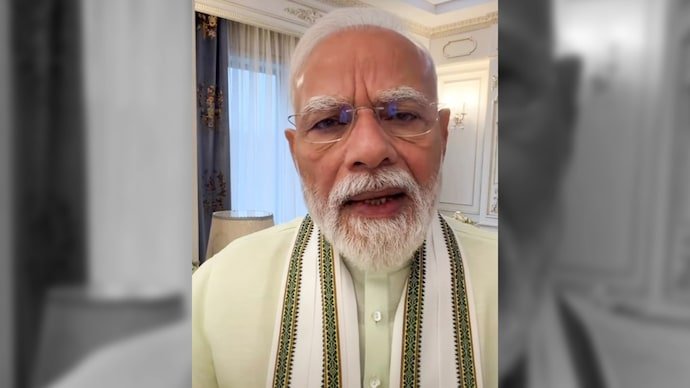
Prime Minister Narendra Modi has turned India’s latest GDP figures into both an economic message and a political one, using a selfie-style Instagram video to celebrate 7.8% growth in the April-June quarter while taking an apparent swipe at Rahul Gandhi.
In the nearly three-minute video, Modi said India was advancing rapidly despite wars, disrupted supply chains and lingering global instability. He contrasted the economic performance with what he described as an “echo of lies” and “despair” being spread in the country.
The phrase “jhooth ki goonj” has drawn attention because it is being viewed as a veiled reference to Gandhi’s “Chhatron Ki Goonj” campaign aimed at connecting with young people. Modi did not name Gandhi directly in the video, but the wording has been interpreted in the context of the Congress leader’s recent youth-focused political outreach.
Alongside the political message, Modi used the stronger GDP number to revive his economic appeal for greater self-reliance. He urged Indians to favour domestic consumption, reduce unnecessary overseas travel, hold weddings in India and avoid unnecessary purchases of gold.
Why PM Modi is highlighting 7.8% GDP growth
The immediate backdrop to Modi’s message is India’s stronger-than-expected economic performance in the first quarter of financial year 2026-27.
Official data showed real GDP Growth of 7.8% during the April-June quarter. The figure was above the Reserve Bank of India’s earlier estimate of 7% and exceeded market expectations.
The number provided the government with a strong economic talking point because expectations had been for some moderation in growth. Instead, the economy began FY27 with momentum across important parts of domestic activity.
Manufacturing, services and investment were among the areas associated with the stronger performance, while domestic demand remained an important support.
Modi framed the result against a difficult international backdrop.
“The world is drowned in war. The world is surrounded by crises. The supply chain is completely disrupted,” he said, arguing that India had continued to develop rapidly despite instability since the Covid-19 pandemic.
That framing is politically significant. Rather than presenting the GDP number in isolation, the Prime Minister is using it to argue that India’s economic performance should be judged against the conditions facing the wider global economy.
What does ‘jhooth ki goonj’ mean in the political context?
Modi’s reference to “jhooth ki goonj”, or an “echo of lies”, has become the most politically prominent part of the Instagram video.
The Prime Minister said that while India was progressing quickly, some people were engaged in spreading “jhooth ki goonj” and “nirasha”, meaning despair.
He did not explicitly name Rahul Gandhi.
However, the language has been interpreted as a response to Gandhi’s “Chhatron Ki Goonj” campaign, which has been aimed at engaging students and young voters.
The contrast is straightforward: Gandhi’s political messaging uses the idea of a “student voice” or “echo”, while Modi used the phrase “echo of lies” while discussing the economy.
That makes the GDP announcement part of a broader political communication strategy in which economic statistics are used to challenge criticism of the government’s performance.
It also reflects Modi’s increasing use of social-media formats that are designed to communicate directly with younger audiences rather than relying solely on traditional speeches, government statements or political rallies.
Why the Instagram format matters
Modi’s use of a selfie-style video is notable because it gives the economic message a more informal presentation than a conventional policy address.
The Prime Minister has increasingly used platforms such as Instagram to reach younger audiences. Instead of simply releasing the GDP figures through a formal statement, the video combines economic data, political messaging and lifestyle appeals.
The timing is also unusual because Modi was in Bishkek for the Shanghai Cooperation Organisation summit when he addressed the domestic economic issue through Instagram.
The approach allows the Prime Minister to speak directly to Indian audiences even while travelling abroad. It also turns a statistical economic announcement into content designed for social-media consumption.
His caption summed up the message: “7.8% growth. Strong numbers. Even stronger confidence.”
The format is particularly relevant to Modi’s effort to connect with younger Indians, for whom Instagram and short-form video have become important channels for political communication.
GDP growth becomes part of a larger political argument
Economic growth figures are not merely technical statistics in Indian Politics. They can become evidence used by governments to demonstrate policy success and by opposition parties to challenge the government’s claims.
The 7.8% number gives the government a favourable statistic at a time when global economic uncertainty remains high.
Modi had already described the result as a “herculean feat” in a post on X after the data were released. His latest Instagram message extends that argument by linking the growth figure to confidence in India’s economic direction.
The political message is essentially that strong economic performance provides a response to pessimistic narratives about the country.
But GDP growth alone does not answer every question about the economy. A headline growth rate measures the expansion of overall economic output; it does not by itself reveal how evenly that growth is distributed across households, regions or sectors.
That distinction is important when interpreting Modi’s message. The 7.8% figure is a significant macroeconomic indicator, but the wider economic debate also involves employment, household purchasing power, private investment, Inflation and the quality of growth.
Why Modi is asking Indians to “Wed in India”
The second major theme of the video is Modi’s renewed push for domestic spending and self-reliance.
He urged Indians to follow the principles of “Vocal for Local” and “Wed in India”, while also advising people to avoid unnecessary overseas travel and gold purchases.
The message fits within the broader Atmanirbhar Bharat framework, which promotes greater economic self-reliance and domestic production.
The argument has a foreign-exchange dimension as well.
India relies heavily on imports for several important goods, including crude oil. When international energy prices rise, the country’s import bill can come under pressure. Gold imports and overseas travel also involve foreign-exchange outflows.
Reducing unnecessary external spending can therefore support the broader objective of limiting avoidable pressure on the external balance.
Modi had made a similar appeal previously amid concerns about the economic effects of the Iran war and wider Middle East instability.
Why gold and foreign travel are part of the message
Gold has a particularly unusual place in India’s economy. It is widely purchased by households for jewellery, savings and cultural reasons, but imported gold also contributes to the country’s import demand.
When international energy prices rise sharply, India faces additional pressure because crude oil is a major import requirement.
Modi’s argument is therefore not simply about encouraging people to buy Indian products. It is also about directing spending in ways that can reduce unnecessary foreign-exchange outflows.
The same logic applies to overseas travel. Money spent abroad represents expenditure outside the domestic economy, while travel within India keeps more of that spending within the country’s tourism and services ecosystem.
The Prime Minister’s “Wed in India” appeal similarly seeks to encourage large wedding-related spending to remain within the country.
That could potentially benefit domestic hotels, event companies, restaurants, transport providers, jewellery businesses and other service industries, although the broader economic effect would depend on how consumers actually change their spending decisions.
Modi links Swadeshi to the next generation
Modi connected the Swadeshi message to his longer-term vision for India.
He said greater emphasis on domestic production and self-reliance would help fulfil the aspirations of the next generation and expressed confidence that India would present a developed economy to young Indians when the country reaches 100 years of independence.
That gives the video a broader political frame. The GDP figure is presented not simply as a quarterly achievement but as part of a longer economic transformation.
For the government, the challenge is turning high headline growth into sustained improvements in productivity, investment, employment and living standards.
What is driving India’s stronger growth?
The latest GDP performance reflects the continued importance of domestic economic activity.
Manufacturing and services have remained important components of India’s growth story, while investment and domestic consumption have helped offset some of the uncertainty created by the international Environment.
Government capital expenditure has also played a role in supporting infrastructure and construction activity.
This matters because India’s relatively large domestic market provides some protection from swings in global demand. An economy with substantial internal consumption is not entirely dependent on exports to maintain growth.
That does not make India immune to global shocks. Higher oil prices, weaker international demand, geopolitical tensions and disruptions to trade can still affect inflation, corporate costs, exports and investment.
But strong domestic demand can provide an important cushion.
The limits of the 7.8% number
The political debate around the GDP figure is likely to continue because a single quarterly growth number cannot capture the entire state of the Indian Economy.
For policymakers, one of the most important questions will be whether the momentum seen in the first quarter can be maintained.
High growth needs to be supported by sustained private investment rather than relying too heavily on public expenditure. Businesses need sufficient confidence to expand capacity, households need purchasing power to sustain consumption, and exports need to remain competitive in a volatile global market.
There is also the question of whether growth remains broad-based across different parts of the economy.
These are issues that will become clearer as additional quarters of FY27 data are released.
Rahul Gandhi and the youth outreach battle
The political subtext of Modi’s Instagram video is particularly relevant because both the Prime Minister and Rahul Gandhi have been seeking stronger engagement with younger Indians.
Gandhi’s “Chhatron Ki Goonj” campaign is part of that effort, while Modi has increasingly used direct digital communication to appeal to younger social-media users.
The clash therefore extends beyond the interpretation of one GDP figure. It reflects a wider competition over who gets to define the economic reality being presented to young voters.
For the government, 7.8% growth provides a concrete statistic around which to build a positive economic narrative. For the opposition, the focus is likely to remain on whether strong aggregate growth is translating into sufficient jobs, income growth and broader economic opportunity.
The difference between those narratives is likely to remain a feature of India’s political debate.
What comes next for the Indian economy?
The next few quarters will determine whether the 7.8% first-quarter performance represents the beginning of sustained momentum or a particularly strong period before growth moderates.
The outcome will depend on several factors, including domestic consumption, private investment, government spending, export demand and global commodity prices.
Oil prices will remain especially important because changes in energy costs can influence India’s import bill, inflation and business expenses.
Global trade conditions will also matter. Continued geopolitical tensions or disruptions to supply chains could create new pressures for Indian businesses even if domestic demand remains resilient.
For now, however, the government has a strong economic number to point to.
The 7.8% GDP growth rate gives Modi an opportunity to combine an optimistic economic message with his broader calls for self-reliance, domestic consumption and youth-focused communication.
The bigger message behind Modi’s Instagram post
Modi’s latest video is about more than GDP.
It combines three messages: India’s economy is growing faster than expected, criticism should not obscure that performance, and citizens can contribute to economic self-reliance through their spending choices.
The “jhooth ki goonj” remark adds a clear political edge, even though Rahul Gandhi was not named directly. The reference has placed the video within the wider contest between the government and opposition over how India’s economic performance should be understood.
The underlying economic fact remains the simplest part of the story: India recorded 7.8% real GDP growth in the first quarter of FY27.
Whether that momentum can be sustained will ultimately matter more than any single social-media exchange. If consumption, investment and productive capacity continue to strengthen, the government’s confidence in the growth story will have a firmer foundation. If external shocks or domestic weaknesses begin to slow activity, the political argument over what the GDP numbers really mean is likely to become sharper.
For now, Modi is using the strongest economic statistic available to him to make both an economic and political case: that India’s growth is continuing despite a difficult world, and that confidence in the country’s economic direction should be stronger than the pessimism surrounding it.
For breaking news and live news updates, like us on Facebook or follow us on Twitter and Instagram. Read more on Latest India on thefoxdaily.com.



COMMENTS 0